September in Halifax still feels like summer. The roads are dry, the harbour breeze is mild, and winter tires are nowhere near the top of your list. Then a nor’easter rolls through in late October, your neighbour mentions they just got their winters mounted, and every shop from Herring Cove Rd to the Bedford Highway is booking two to three weeks out with half the popular sizes already thin.
We see this pattern every year. Drivers who called in September are booked, mounted, and done. Drivers who wait until the first snowfall are often still on bald all-seasons, sometimes settling for a size or brand they didn’t actually want. Buying winter tires early isn’t about being anxious about winter. It’s about keeping your options open while they still exist.
Here’s why supply gets tight, which sizes go first, and what to do if you want to buy now but aren’t ready to install until the temperature actually calls for it.
Why Winter Tire Stock Shrinks Through the Fall
Tire distributors plan their shipping cycles months ahead. Canadian warehouses receive the bulk of their winter stock over the summer, and that stock is finite. Once a distribution centre runs low on a particular size, restocking can take weeks, or not happen again before Christmas.
Many Nova Scotia drivers run winter tires each season, and that’s a lot of people making the same switch inside a short window. Halifax, Dartmouth, and Bedford drivers tend to move together: a cold snap hits, the news mentions road conditions, and phones start ringing at every shop in HRM at once.
By mid-October, demand is already climbing. By November, popular crossover and half-tonne truck sizes, the bread-and-butter 215/60R16s and 225/65R17s, can be genuinely scarce regionally. A driver who waited might end up with their second-choice brand, a different size, or a longer wait than they’d like heading into December.
Which Sizes Sell Out First in Halifax
The sizes that disappear fastest are the most common fitments on the road here: mid-size SUVs, crossovers, and half-tonne trucks. If you drive a Nissan Rogue, Honda CR-V, Ford F-150, Toyota RAV4, or Subaru Outback, your factory size is also the size thousands of other HRM drivers are chasing. Sizes in the 215–225mm width range and 60–65 series profile are consistently the first to thin out.
Performance sizes for sports cars and European sedans tighten up quickly too, mostly because distributors stock fewer of them to begin with. A 245/40R18 or similar can get genuinely narrow by late October.
Specialty fitments, large truck sizes, low-profile performance tires, unusual metric conversions, run out earliest of all, simply because there was less inventory to start with.
Buying early keeps the full tire selection open to you: preferred brand, the performance tier you actually want, and a studless compound suited to Halifax’s mix of ice, slush, and bare pavement.
How Supply Tightens as the Season Progresses
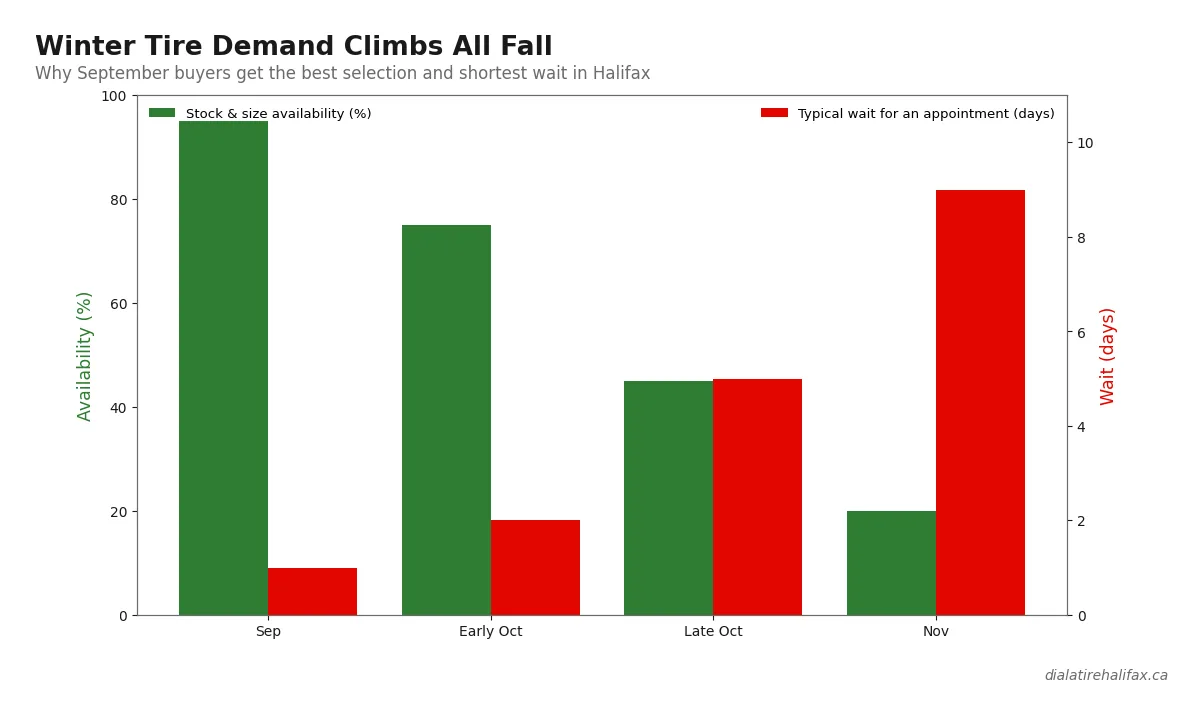
Picture it as a funnel. In late summer, distributor warehouses across Atlantic Canada are near capacity and shops like ours have healthy stock on hand. As September turns to October, shops keep moving product and reordering, but distributor stock is depleting at the same time. By mid-October restocking slows. By November, some sizes simply aren’t available for quick reorder, and any gap between what a shop has on the shelf and what a customer needs becomes a real problem.
Booking follows the same curve. A proper winter installation takes time: unmounting the all-seasons, mounting and balancing the winters, setting pressures, checking Tire Pressure Monitoring System (TPMS) sensors where your vehicle has them. Each bay only fits so many cars a day. When volume spikes in late October, a one or two-day wait can stretch to two or three weeks. If your first real snow hits in early November and your appointment isn’t until the 22nd, that’s a problem you could have skipped entirely with a September phone call.
The “Buy Now, Install Later” Option
One of the questions we hear most in early fall: “Can I buy the tires now and have them installed later?” Yes, and it’s a practical way to handle the timing gap.
Buy your winter tires early and you lock in stock and your preferred size before anyone else takes them. Installation can wait until temperatures actually call for it, typically when daytime highs sit consistently below 7°C, an industry changeover guideline rather than a strict cutoff. In Halifax that usually lands in late October or early November. There’s no benefit to running winters on warm September pavement anyway.
This splits two decisions that don’t need to happen together: the purchase and the installation appointment. The tires exist, the size is confirmed, and you can often book that installation slot in advance too, no frantic calls during the first cold week.
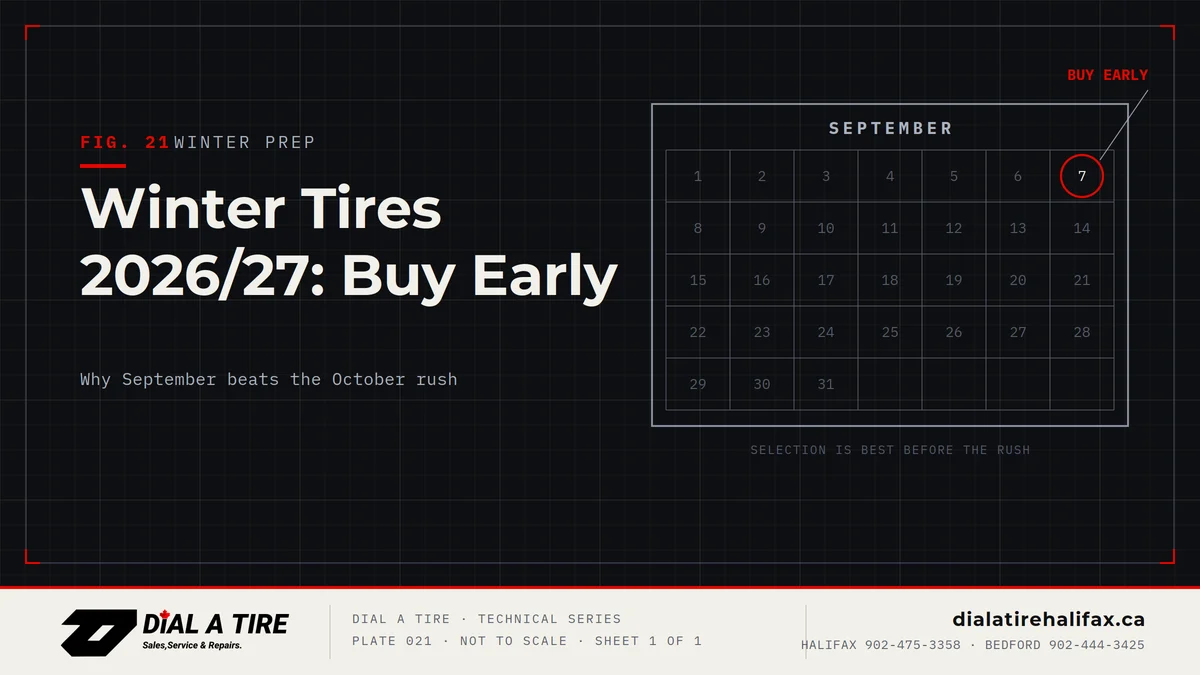
Aim to Buy Before Mid-to-Late September
There’s no hard deadline printed anywhere, but the pattern is consistent enough to plan around. Aim to have your winter tires purchased by mid-to-late September if you want first pick of size and brand. That still leaves plenty of runway before installation makes sense, and it puts you ahead of the October rush when shop calendars and warehouse shelves both start thinning at once. Waiting into October isn’t fatal, but your options narrow with every week that passes.
Why So Many Nova Scotia Drivers Run Winters
Halifax has real winters: ice storms, freezing rain, packed snow on the hills, road conditions that can change hour to hour. Nova Scotia doesn’t mandate winter tires the way Quebec does, but a lot of drivers here reached the same conclusion on their own: all-season tires aren’t enough for what a Maritime winter delivers.
Quebec’s mandatory changeover deadline concentrates that province’s rush around one date. In Nova Scotia the rush is driven by weather instead, which means it can arrive fast and without much warning once the first serious cold snap hits. Winter tires measurably shorten stopping distances on ice compared to all-seasons, and that’s the margin most Nova Scotia drivers have decided is worth protecting. The result each fall is a competitive market for stock, one where early buyers come out ahead.
What to Look for When Buying Winter Tires in Halifax
Not all winter tires are built the same. A few things worth checking before you buy:
The Three-Peak Mountain Snowflake (3PMSF) symbol. This sidewall marking means the tire passed a standardized snow traction test. The older Mud and Snow (M+S) designation only describes tread pattern; it doesn’t certify real winter performance. For genuine Nova Scotia conditions, 3PMSF is the standard to look for.
Compound type. Modern winter tires use silica-rich compounds that stay pliable below 7°C, which is what gives them traction on ice and packed snow. Older or cheaper compounds harden in the cold and lose much of that advantage.
Tread pattern. Directional V-shaped patterns are strong at clearing slush and water. Asymmetric patterns blend snow traction with dry handling. Your usual mix of city, highway, or rural driving changes which fits better, and our team can walk you through it.
Brand and model within your budget. Real-world performance varies meaningfully between tire lines, and the right choice for Halifax’s mix of ice, freezing rain, and wet pavement isn’t necessarily the most expensive one. We’ll tell you honestly what we’d put on our own vehicles.
For sizing help, our tire size guide explains how to read the sidewall and confirm the right fitment.
🔧 Engineering Corner
All-season rubber leans on a higher share of natural rubber, which begins to stiffen as temperatures drop below roughly 7°C. Winter tire compounds swap in more silica-reinforced synthetic rubber, which stays flexible well below −20°C. In practice, a winter compound holds onto meaningfully more contact-patch flexibility than an all-season compound at the same cold temperature, meaning more rubber actually touching the road instead of skating over it. That’s the reasoning behind the 7°C changeover guideline, not the first snowfall.
Halifax’s Winter Hazards, and Why Timing Matters
Halifax’s geography creates its own set of winter challenges. The South End grades, the Citadel hill, the Macdonald Bridge approaches, and the climb up from Spryfield along Herring Cove Rd all get unforgiving when they ice over. Freezing rain shows up here about as often as heavy snowfall, and freezing rain on a hill is one of the harder scenarios for any tire to handle. The harbour keeps temperatures hovering near freezing more than well below it, which is exactly the wet-ice and packed-slush combination a good winter compound is built for.
Bedford drivers face the same freeze-thaw cycle on brine-treated roads, frost heaves, and potholes that can turn a clear evening into a glazed morning. A good set of winter tires is meaningful safety equipment for the roads people here actually drive.
How winter tires compare to all-season tires in Nova Scotia conditions covers the performance gap in more depth, and our guide on when to take off winter tires in Halifax covers the spring side, so you’re not wearing down winter rubber unnecessarily once April warms up.
What This Means for Your Car
If winter tires are in your plan this season, and for most Nova Scotia drivers they are, act now rather than in November. You don’t need to install them yet. You just need to secure the tires and book installation for when temperatures actually call for it.
Waiting costs you selection, costs you appointment availability, and in a bad year can cost you weeks driving on all-seasons through conditions they weren’t built for. Acting early costs you nothing beyond a bit of planning.
Call us, tell us your vehicle, and we’ll confirm whether we have your size in stock or what the lead time looks like. No pressure, just information, so you’re making the call on your own timeline instead of November’s.
Ready to get sorted before the rush? Book an appointment or browse our seasonal tire change service, and cross one thing off the list before the first snowflake falls.
Frequently Asked Questions
Why do winter tires sell out in Halifax?
A lot of HRM drivers switch over inside the same few weeks each fall, and distributors only bring in one big shipment of winter stock over the summer. Once a size is gone from the warehouse, it can take weeks to get more in, so the common crossover and truck sizes are usually the first to go.
Can I buy winter tires now and have them installed later?
Yes, that’s a common approach here. You lock in your size and brand while the shelves are still full, then book the installation for whenever the weather actually turns, usually late October or early November in Halifax.
By when should I buy winter tires in Halifax?
Mid-to-late September is a good target if you want your pick of size and brand. You’ll still be waiting weeks before installation makes sense, but you won’t be scrambling once the October rush hits.
Which winter tire sizes sell out first in the Halifax area?
The common crossover, SUV, and half-tonne truck sizes go first, think 215–225mm widths in the 60–65 series range, because so many HRM vehicles share those fitments. Low-profile performance and specialty sizes run out early too, simply because shops stock fewer of them to begin with.
What is the Three-Peak Mountain Snowflake symbol and why does it matter?
It’s the sidewall marking that means a tire actually passed a winter traction test, unlike the older Mud and Snow stamp, which only describes the tread pattern. If you want real performance on Nova Scotia ice and slush, that’s the symbol to check for.
HALIFAX — Dial A Tire
308 Herring Cove Rd, Halifax, NS
902-475-3358
BEDFORD — Dial A Tire
70 Rosno Lane, Bedford, NS
902-444-3425
Open daily 8 AM–5 PM. Please call before coming.
Locally owned since 1994 · Red Seal technicians · Professional installation & precision balancing