Halifax spring is hard on tires in ways that don’t show up in the tread. Our potholes are legendary — the freeze-thaw cycle punches gaps in pavement overnight, and the first warm days in April have drivers dodging craters on Herring Cove Road and swerving on the Bedford Highway. What that does to tread depth is visible. What it does to the tire sidewall often isn’t noticed until someone spots the problem at a gas station or during a tire rotation. Sidewall damage is the category of tire wear most likely to be misread: some of it is cosmetic, some of it is worth monitoring, and some of it means you should not drive the car until the tire is replaced.
The sidewall is the thinnest, most structurally loaded part of the tire. It flexes millions of times over the life of the tire, absorbing road shock that the steel-belted tread cannot. Unlike the tread area, the sidewall cannot be patched, plugged, or repaired in any meaningful way. Once the internal structure is compromised, the only option is replacement. Understanding what each type of damage actually signals will help you make that call quickly — and avoid a blowout on the 102 or the Mackay Bridge.
This guide walks through the four main types of tire sidewall damage you’re likely to encounter in Halifax, what each one means structurally, and which ones require a same-day visit to the shop.
Sidewall Bubbles: The One That Cannot Wait
A bubble — sometimes called a bulge — on the sidewall is a structural emergency. It should never be driven on any longer than absolutely necessary to reach a shop safely, and only at low speeds.
Here is what causes it. The tire’s sidewall is built around a framework of fabric cords (most commonly nylon or polyester) embedded in rubber. These cords give the sidewall its ability to flex without tearing. When a tire hits a pothole, a deep crack in pavement, or a raised rail crossing at speed, the impact can sever some of those cords. Air pressure from inside the tire immediately exploits that weakness, forcing rubber outward through the gap between broken cords. The visible bubble is inflated rubber with no cord reinforcement behind it — it’s being held together by a thin layer of outer rubber alone.
Cord failure is not repairable. No shop can rebuild the internal structure of a sidewall from outside. The bubble will grow as driving continues, and eventually the remaining rubber ruptures. That is a blowout — sudden and total loss of pressure, often accompanied by a violent jerk of the steering wheel. At highway speed, this is genuinely dangerous.
A few things to know about bubbles:
- They can appear hours after the impact, not immediately. A driver hits a pothole, checks the tire, sees nothing, and then finds a bubble the next morning. The cords may have been weakened rather than immediately severed, with the failure completing overnight as the tire cooled and heat and pressure cycled.
- They look obvious when you know to look. Run your hand around the full circumference of each sidewall — a bubble will be a raised, rounded protrusion that doesn’t match the rest of the profile.
- Inner sidewalls develop bubbles too. The inboard face of the tire is not visible without crouching down and looking under the car, or putting it on a lift. An inner-sidewall bubble from a curb strike or pothole hit can go unnoticed for weeks.
- A bubble on a winter tire stored flat can look similar but is caused by uneven weight distribution on a flat-stored tire — still a reason to inspect carefully before remounting.
Bottom line: if you find a bubble, call the shop that day. This is not a “book it for next week” situation.
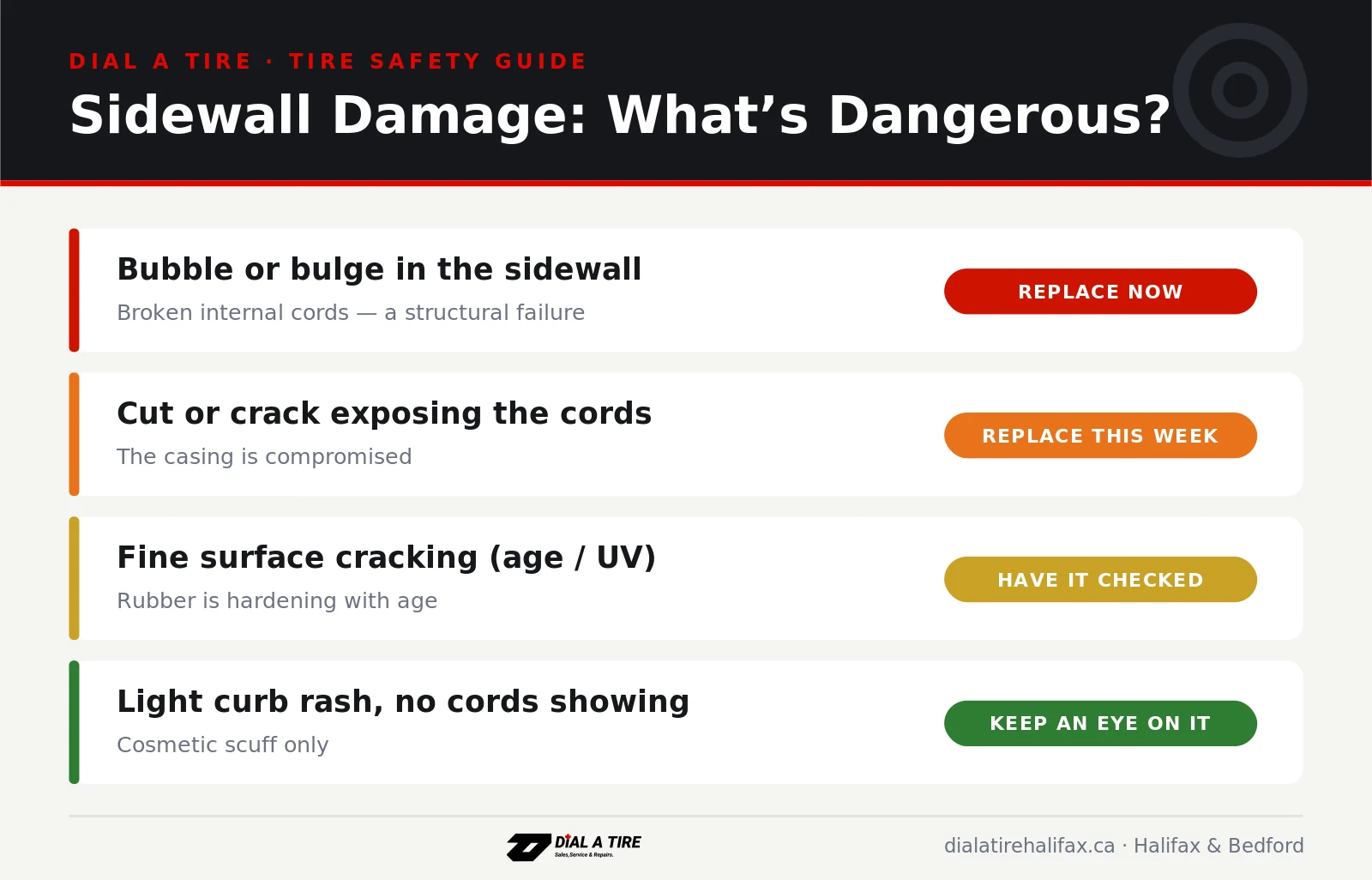
Sidewall Cracks: Age and ultraviolet (UV) vs. Structural Damage
Cracks in the sidewall rubber are far more common than bubbles, and they span a wide range from normal ageing to a sign that replacement is overdue.
Rubber is not permanent. The polymers that give a tire its elasticity degrade over time through oxidation, ultraviolet light exposure, and ozone in the atmosphere — a process called oxidative degradation. Manufacturers add anti-degradant chemicals (antiozonants and antioxidants) to the compound, but these are consumed over time, especially in tires that sit unused for long periods. When the chemical protection is depleted, the rubber surface becomes brittle and begins to crack.
Surface crazing — a fine network of shallow cracks that looks like a dried riverbed — is the most common form. These hairline cracks in the outer rubber layer are largely cosmetic at first, but they signal that the rubber has aged significantly. The Tire and Rubber Association of Canada (TRAC) recommends that tires more than six years old be inspected by a professional even if they appear fine, and that tires over ten years old be replaced regardless of appearance. The age is stamped on the sidewall as a four-digit Department of Transportation (DOT) code: the last four digits tell you the week and year of manufacture. A tire reading “2318” was made in the 23rd week of 2018. See our sidewall reading guide for how to decode the full DOT string.
Cracks that are deeper, wider, or extend into visible grooves in the rubber are a different story. These can allow moisture and oxygen to reach the internal cords, accelerating corrosion and weakening the structure. Look for:
- Deep cuts or grooves — any crack where you can see the gap open visibly when you squeeze the sidewall
- Cracking concentrated near the bead — the bead is the stiff rim-to-tire interface; cracks here can compromise the air seal
- Cracking on both inner and outer sidewall — suggests the rubber compound has degraded through the full thickness
Shallow surface crazing on a tire under six years old with good tread is usually monitored rather than acted on immediately — but it’s always worth having a technician look at it. Deep cracking, extensive crazing on older tires, or any crack that runs along a ridge or flex zone warrants replacement.
Nova Scotia winters accelerate this process. Long months of UV exposure on stored tires, repeated freeze-thaw cycling, and road salt all stress the rubber chemistry faster than a mild-climate vehicle would experience.
Curb Rash: Rim Damage vs. Tire Damage
Curb rash is a category error that trips up a lot of drivers. When a tire scrapes a curb — pulling too tight on a parallel park, misjudging a tight corner — the visible damage is usually on the rim (wheel), but the tire may also have taken a hit. These are two separate issues that need separate assessments.
Rim curb rash is the scuffed, scratched, or gouged paint and metal on the outer lip of an alloy or steel wheel. This is typically cosmetic. It does not affect how the wheel holds a tire bead or balances, unless the gouge is deep enough to distort the flange that contacts the tire bead. A small cosmetic scrape: no action required beyond the aesthetic botheration. A gouge that dips below the bead seat surface or distorts the flange: needs assessment — it can cause an air leak or prevent proper seating.
Tire curb rash is what the rubber took during the same event. Look on the sidewall closest to the curb for:
- Abrasion that has removed outer rubber, exposing the lighter-coloured layers underneath
- A clean cut or slice from a sharp curb edge
- Any wound that appears to go deeper than the outer rubber layer
Surface abrasion that has removed outer rubber but has not cut through to the cords is on the monitoring list — it weakens the rubber at that point and should be watched at every subsequent inspection. Any cut that penetrates the cords is the same situation as a bubble structurally: the internal skeleton has been compromised. Replace the tire.
One practical Halifax note: the granite curbs along Spring Garden Road and in older residential neighbourhoods have sharp edges that are unkind to alloy wheels and tires alike. Low-profile tires — those with a short sidewall relative to their width — have less rubber cushioning between the rim and the road, making curb strikes more immediately damaging to both the wheel and the tire sidewall.
Pothole Impacts: Halifax Spring’s Specialty
Halifax consistently ranks among Canadian cities with the roughest road surfaces, and the freeze-thaw cycle is the reason. Water seeps into pavement cracks, freezes and expands, then thaws — widening the crack each cycle until pavement fails and a pothole forms. The first weeks of April and November are the worst. Some of the impact force from a pothole strike goes into the suspension, but a significant portion passes directly through the tire sidewall.
The physics is straightforward: when a wheel drops into a pothole, the leading edge of the pothole strikes the lower sidewall like a blade. The tire is squeezed between the road edge and the wheel rim — what technicians call a “pinch impact.” This is the primary mechanism behind sidewall cord failure and bubble formation. Wider, deeper potholes are worse; hitting one at higher speed dramatically increases the impact energy (force goes up with the square of velocity).
After any significant pothole strike, it’s worth doing a walk-around inspection within 24 hours:
- Look at both sidewalls — inboard and outboard — for bubbles or deformation
- Check tread area for cuts or obvious damage
- Note whether the car now pulls to one side, vibrates at speed, or feels different in the steering — these are signs of possible rim damage or alignment shift
- Check tire pressure — a pinch impact can unseat the bead slightly, causing slow pressure loss
Suspension components can also be affected by severe pothole impacts — bent control arms or tie rod ends are not uncommon on Halifax roads. If the car’s handling feels different after a hard pothole hit, a wheel alignment check is advisable even if the tires look fine. Our post on how road salt and freeze-thaw cycles damage Halifax vehicles goes deeper on the pavement-to-suspension connection.
The Rule the Sidewall Holds Firm: It Is Not Repairable
Tread punctures in the centre of the tread area — a nail or screw through the running surface — can be properly repaired with a combination plug and patch from the inside, provided the hole is within the repairable zone (tread centre, no larger than 6 mm in diameter, not in the shoulder). The Tire and Rubber Association of Canada (TRAC) is explicit about this in its repair guidelines.
The sidewall has no equivalent repair standard because no repair restores the structural function of the cords. Attempts to plug or patch a sidewall from outside are a temporary cosmetic fix only — the air pressure is still being held by compromised structure. Any shop offering to “fix” a sidewall puncture is not following industry-standard practice.
This is not an abundance of caution. The sidewall flexes through a significant angular deflection with every revolution of the wheel. A repaired area cannot flex the way undamaged cord-and-rubber structure does. Under repeated load, it fails — and tire failures at speed cause accidents.
When to Come In Same-Day vs. Monitor
Here is the practical summary:
| Damage Type | Action |
|---|---|
| Sidewall bubble or bulge (any size) | Replace — do not drive at highway speed |
| Cut or puncture penetrating the sidewall | Replace — not repairable |
| Curb rash that exposes cord layers | Replace |
| Deep cracking or bead-area cracking | Professional inspection — likely replace |
| Surface crazing, tire under 6 years old | Monitor; inspect at next service |
| Surface crazing, tire over 6 years old | Professional inspection recommended |
| Cosmetic rim curb rash only | No action required (unless bead seat affected) |
| Surface abrasion — outer rubber removed, cords intact | Monitor closely; professional inspection soon |
If you are uncertain which category applies, the correct answer is always to have a technician look at it. Sidewall damage is one of those cases where the cost of being wrong — a blowout at speed — is far too high to guess.
What This Means for Your Car
Tires are the only part of the vehicle that touches the road. Everything else — steering, braking, suspension — communicates with the road through four contact patches, each roughly the size of a hand. The sidewall is the structure that keeps each of those contact patches shaped correctly under all the loads a car generates. When the sidewall is compromised, grip, handling, and blowout resistance are all affected in ways that are invisible from the driver’s seat until something fails.
Halifax driving conditions — pothole season, granite curbs, tight parking on residential streets in the South End and North End — create more sidewall stress than average. A quick walk-around inspection once a month, squatting down to look at both sidewalls, takes two minutes and catches bubbles and cracks before they become emergencies. If you change your own tires seasonally, it’s worth running your hands around both sidewalls of each tire before remounting — stored tires can develop cracking, and a pinch damage bubble is easier to catch off the car than on it.
Book a Sidewall Inspection in Halifax
If you’ve found a bubble, a suspicious crack, or aren’t sure whether a curb strike caused cord damage, bring the car in. We lift the car and check both inboard and outboard sidewalls on all four tires. If a tire needs to come off to inspect properly, we do that. The inspection itself takes minutes — it’s faster to check than it is to worry. If a replacement is needed, we carry a wide range of passenger, light truck, and performance tires and can usually have you back on the road the same day. You can also book an appointment online if you’d like a set time.
HALIFAX — Dial A Tire
308 Herring Cove Rd, Halifax, NS
902-475-3358
BEDFORD — Dial A Tire
70 Rosno Lane, Bedford, NS
902-444-3425
Open daily 8 AM–5 PM. Please call before coming.
Locally owned since 1994 · Red Seal technicians · Professional installation & precision balancing