Halifax drivers have a reliable autumn ritual that has nothing to do with raking leaves: the Tire Pressure Monitoring System (TPMS) warning light appears on the dashboard on the first genuinely cold morning of September, a little orange horseshoe that was not there yesterday. The temperature dropped overnight (maybe 12 degrees) and the pressure in every tire dropped with it. No leak. No damage. Just physics.
Tire pressure and temperature are locked together by one of the oldest laws in physical chemistry. Understanding that relationship takes about five minutes and makes pressure checks much easier to get right. It will also explain a few things that confuse a lot of Halifax drivers: why pressure seems fine in the shop but low the next morning, whether nitrogen fill is worth it, and whether you should ever bleed air from a hot tire (you should not).
The science is straightforward, the worked example uses numbers from a real Halifax Regional Municipality (HRM) seasonal swing, and the practical takeaways cost nothing to follow.
What Happens Inside a Tire When the Temperature Changes
Air is a gas, and gases obey a straightforward rule: at constant volume, pressure rises when temperature rises and falls when temperature falls. The air sealed inside your tire cannot expand the way it would in a balloon. The steel belts, fabric plies and rubber carcass keep the volume essentially fixed. So when the air molecules slow down on a cold morning, they hit the inner walls less often and with less force. The gauge reads a lower number.
Every gas molecule carries kinetic energy proportional to its temperature. Lower the temperature and you lower the energy of every collision. The tire did not lose air. Nothing leaked. The same number of molecules is simply hitting the walls with less force, and a tire gauge measures force per unit area. Pounds per square inch (psi) or kilopascals (kPa) in metric. The volume stayed constant; only the temperature changed; therefore the pressure changed. That is the entire story at a molecular level.
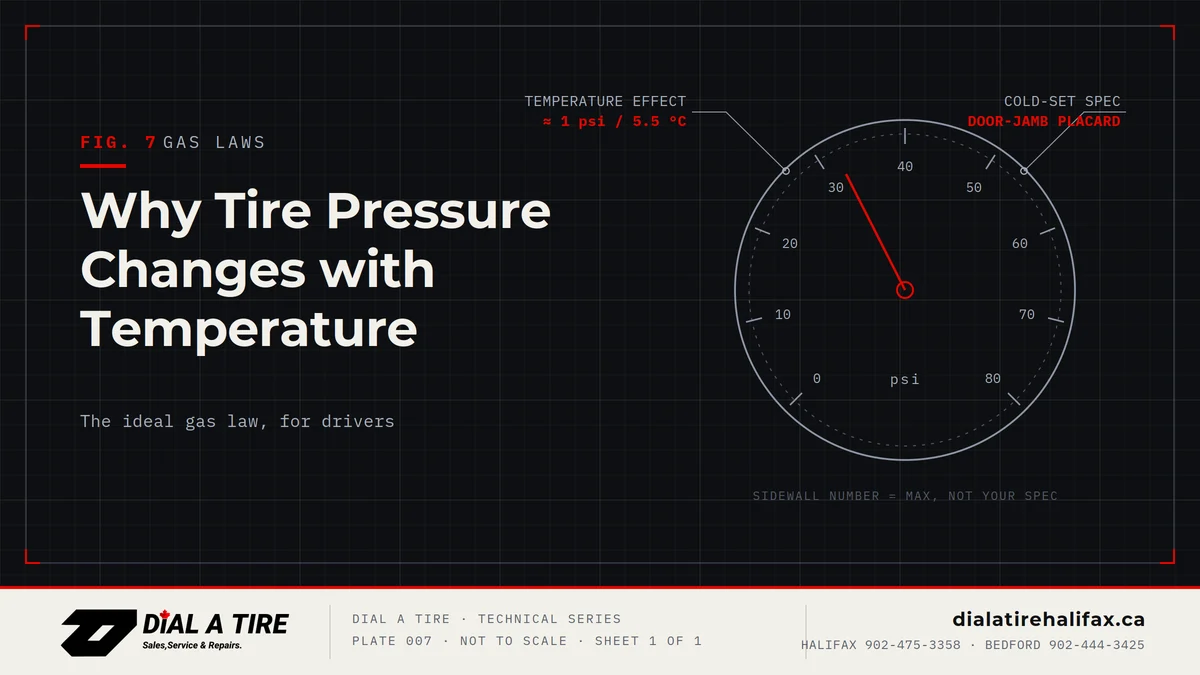
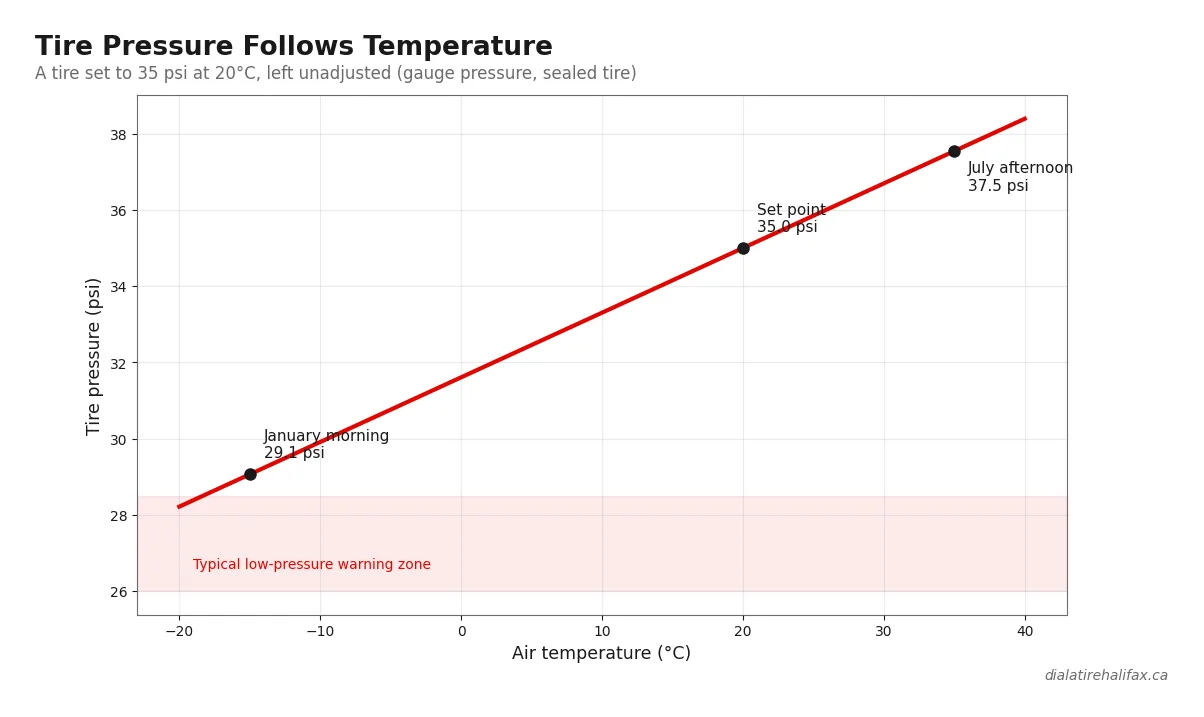
The practical rule of thumb that Transport Canada publishes is about 1 psi for every 5°C drop in ambient temperature, and many tire manufacturers quote a similar 5–6°C figure. Halifax regularly swings 15–20°C between a mid-summer afternoon and a September dawn. Do the arithmetic: that is 2.5–4 psi of natural variation without a single molecule of air escaping from your tire.
The Gas Law in Plain Words, and in Symbols
The formal relationship is called Gay-Lussac’s Law (a special case of the Ideal Gas Law), and it states that for a sealed, fixed-volume container, pressure divided by absolute temperature remains constant. In symbols: P₁/T₁ = P₂/T₂, where T must be expressed in Kelvin. The absolute temperature scale that starts at −273°C (absolute zero), not at the freezing point of water. Treating a tire as a rigid container of ideal gas is a first approximation — real tires flex slightly and real air is not a perfectly ideal gas — but at passenger-tire pressures the approximation is very good. One detail matters for the arithmetic: the P in the formula is absolute pressure (your gauge reading plus about 14.7 psi of atmospheric pressure), not the gauge reading itself.
The Kelvin conversion is simple: add 273 to your Celsius reading. So 20°C becomes 293 K and −10°C becomes 263 K. That distinction matters. If you use Celsius directly in the ratio the math breaks down, because at 0°C there is still plenty of molecular motion, zero Celsius is not zero energy.
🔧 Engineering Corner
The formula: P₁/T₁ = P₂/T₂ (temperatures in Kelvin: K = °C + 273; pressures in absolute terms: gauge reading + 14.7 psi)
Worked Halifax example: You inflate your tires on a warm October afternoon when the air temperature is 22°C (295 K) to the recommended 35 psi on the gauge — that is 49.7 psi absolute. Overnight the temperature drops to 2°C (275 K).
P₂ = P₁ × (T₂/T₁) = 49.7 × (275/295) = 49.7 × 0.932 = 46.3 psi absolute = 31.6 psi on the gauge
That is a drop of roughly 3.4 psi — right in line with Transport Canada’s 1-psi-per-5°C rule of thumb. Enough to trigger a TPMS alert (which typically activates around 25% below the recommended cold pressure. Roughly 26 psi on a tire that should be 35) on a cold morning if you started from the low end of the acceptable range. A 28°C swing (common from a Halifax July afternoon to an October predawn) pushes the drop to nearly 5 psi.
Plain English: every 6°C the thermometer falls, your tires lose about 1 psi. Every 6°C it rises, they gain 1 psi. The air did not go anywhere. It just changed speed.
Why the TPMS Light Comes On in September and Not in August
The Tire Pressure Monitoring System warning activates when any tire falls to 25% below its recommended cold inflation pressure — the threshold set by the U.S. federal safety standard (FMVSS 138), which the TPMS systems in Canadian-market vehicles follow in practice. On a tire recommended at 35 psi, that trigger point is roughly 26 psi. During summer your tires stay warm, ambient temperature stays high, and any small loss of pressure still leaves you above the alert threshold. Then September arrives.
The first cold morning of autumn often arrives without warning. Halifax can drop from 18°C to 4°C overnight when a northwest wind moves through. Your tires, inflated last month when it was 24°C outside, drop roughly 3–4 psi in a single night. If they were already slightly low (say 32 psi instead of the recommended 35) that 3–4 psi loss brings you to 28–29 psi. Close to, or past, the TPMS threshold.
The light is not a fluke or a sensor failure. It is doing exactly what it was designed to do: alert you that pressure is outside the safe operating range. The appropriate response is to check all four tires with a gauge when cold (before you have driven more than 1–2 km that morning) and inflate to the door-jamb specification. Resetting the TPMS without adding air is not a fix. It just silences a warning you need. Our earlier post on TPMS warning lights and cold weather covers the sensor details and reset procedures in full.
Always Check Pressure Cold. Here Is Why Hot Readings Mislead You
When you drive, the tires flex continuously. Flex generates heat. Significant heat on a highway run. That heat raises the temperature of the air inside the tire, and by the same gas law, raises the pressure. After 20 minutes of highway driving a tire that read 35 psi cold might read 38–41 psi. If you check pressure after driving and it reads 38 psi, that does not mean you should bleed it back to 35. The pressure will drop back to roughly 35 psi when the tire cools.
The vehicle manufacturer’s recommended pressure (printed on the door-jamb sticker or in the owner’s manual) is always a cold inflation pressure. It is calibrated for the tire before it has warmed up from driving. Checking hot and then deflating to hit the “cold” target leaves you underinflated once the tire cools, which is exactly the wrong outcome. Underinflation is more dangerous than the modest hot pressure rise from normal driving.
“Cold” means the vehicle has been sitting for at least three hours, or driven fewer than 1–2 km at low speed. Early morning before the first drive of the day is ideal. A monthly cold-check habit (plus a check any time ambient temperature swings more than 10°C) keeps you in the safe range year-round.
What Underinflation Does to the Contact Patch
Pressure does more than move a gauge needle. It determines the shape of the contact patch. The roughly hand-sized area of rubber actually touching the road at any moment. A properly inflated tire presents a relatively even, rectangular contact patch. An underinflated tire allows the sidewalls to bulge outward and the centre of the tread to bow up slightly, creating a curved, edge-heavy contact patch.
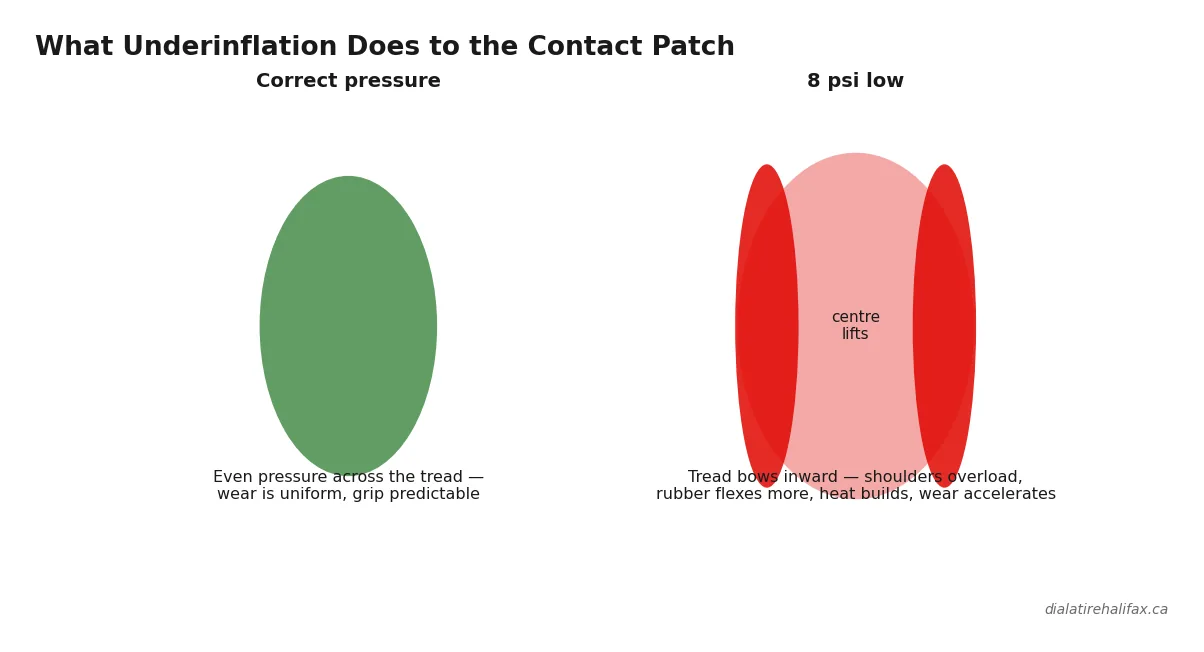
That distorted patch wears the tire unevenly (you will see the outer and inner shoulder edges wear faster than the centre) and it generates more heat because the sidewall is flexing through a larger angle with every revolution. More flex means more heat, and heat is one of the main enemies of tire longevity. A tire running consistently 6 psi underinflated can lose a meaningful fraction of its service life compared with the same tire kept at specification, and the relationship is not linear: heat build-up and wear accelerate as underinflation deepens, so a chronically soft tire ages faster than the pressure gap alone would suggest.
For more on how the contact patch works and why its shape determines your car’s handling limits, our contact patch explainer covers the geometry in detail.
Nitrogen Fill: Honest Assessment for Halifax Street Drivers
Nitrogen fill for passenger tires is sometimes sold as a premium service that keeps pressure more stable through temperature swings. The science behind it is real but the benefit for street driving is marginal. Here is why.
Regular compressed air is approximately 78% nitrogen already. The remainder is mostly oxygen, with traces of water vapour and other gases. The argument for pure nitrogen is that oxygen molecules are slightly smaller and permeate through rubber marginally faster, and that water vapour in regular air expands more dramatically with heat than dry nitrogen does. Both facts are true. Both effects are small in practice.
Published research suggests that pure nitrogen tires lose pressure slightly more slowly through permeation than air-filled tires. The difference over a month is typically fractions of a psi, not the 2–4 psi seasonal swings that the gas law creates. A nitrogen-filled tire will still lose 2.4 psi when the temperature drops 14°C overnight, because the gas law applies to nitrogen exactly as it applies to air. The physics does not care what gas you use.
Where nitrogen genuinely earns its reputation is in motorsport and commercial aviation, where tires run at extreme temperatures, pressure changes are more severe, and the cost of a blowout is catastrophic. For a daily driver in Halifax, the more important variable is checking pressure monthly and especially before seasonal temperature transitions. A good-quality tire gauge and five minutes of your time every four weeks will do more for your tire longevity and safety than nitrogen fill.
The Seasonal Pressure Habits That Matter Most in Nova Scotia
Nova Scotia’s climate creates more pressure-related work than many Canadian provinces because the temperature range is large and the swings can be rapid. Halifax commonly sees a range of 40–45°C between its coldest winter nights (around −15°C) and warmest summer afternoons (high 20s, occasionally warmer). A swing that size represents roughly 7–8 psi of gas-law variation across the year, which is not trivial.
The practical habits that compensate for this:
- Monthly cold check, every month. Set a calendar reminder. Pick the same morning each month. Before driving. Use a quality gauge, not a gas-station forecourt gauge that may not have been calibrated since it was installed.
- Check within a week of your seasonal changeover. Winter tires are often stored at a different pressure than summer tires. When you put them back on, inflate to the door-jamb specification for that vehicle, not to whatever pressure they held in storage. Our seasonal tire changeover service always includes a pressure check and inflation to specification.
- Check after any significant temperature event. A rapid cold snap (15°C or more in 24 hours) is worth a morning pressure check. It costs two minutes.
- Use your door-jamb sticker, not the tire sidewall. The number moulded into the sidewall is the maximum pressure the tire can safely hold, not the recommended operating pressure. Those two numbers are not the same. For many passenger cars the door-jamb recommendation is 30–36 psi; the sidewall maximum might read 51 psi. Inflating to the sidewall number would be dangerous.
What This Means for Your Car
Pressure is not a set-and-forget number. It is a living value that tracks temperature, and in a climate like Halifax’s that means it changes meaningfully across seasons, and noticeably across a single day. The gas law is not an abstraction. It is the reason that tire that seemed fine on Sunday afternoon triggers a dashboard warning on Monday morning.
The fix is simple and costs nothing: check cold, check monthly, check after big temperature swings. Inflate to the door-jamb specification. Never bleed a hot tire. Ignore the sidewall maximum. Those five habits protect your tires, maintain your fuel economy [see our related post on tire rotation and longevity in Halifax], and keep your TPMS light where it belongs. Off.
Book Your Pressure Check or Seasonal Changeover in Halifax or Bedford
If your TPMS light is on, if you have not checked your tire pressures since last season, or if it is time for your seasonal changeover, we are ready to help at both locations. Every changeover appointment includes tire inflation to specification, a visual condition check, and a torque check on wheel fasteners. Book an appointment online or call either location. We are open daily including weekends, which most shops in Halifax are not.
HALIFAX — Dial A Tire
308 Herring Cove Rd, Halifax, NS
902-475-3358
BEDFORD — Dial A Tire
70 Rosno Lane, Bedford, NS
902-444-3425
Open daily 8 AM–5 PM. Please call before coming.
Locally owned since 1994 · Red Seal technicians · Professional installation & precision balancing