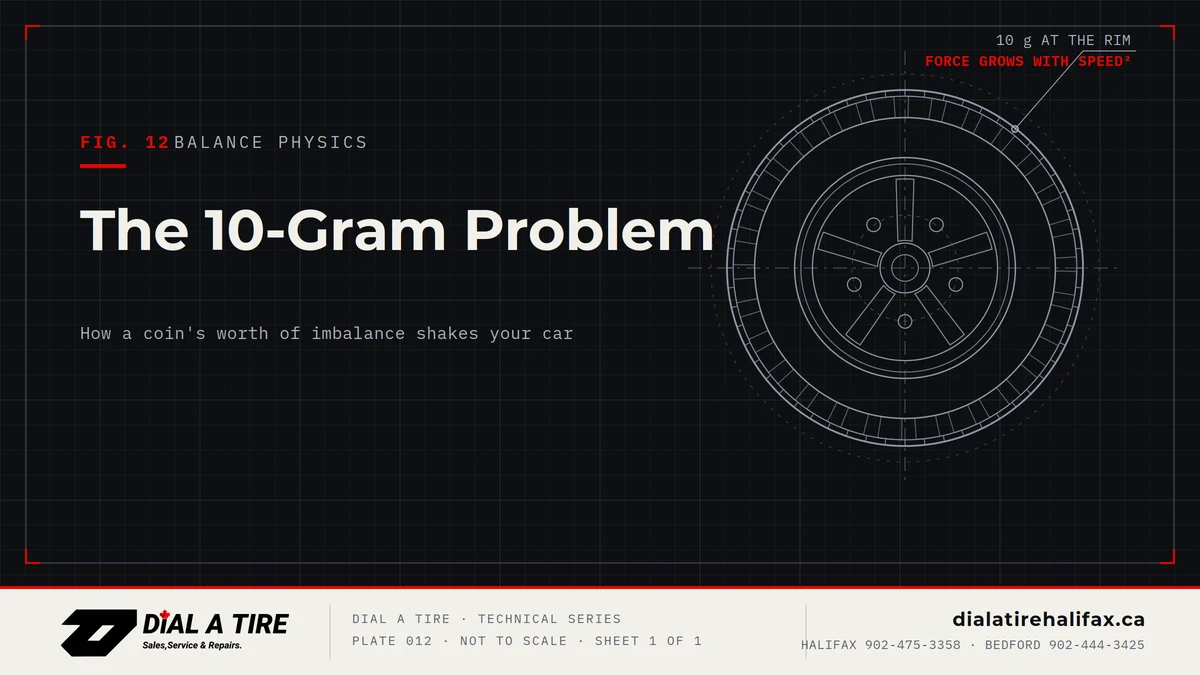
Pick up a toonie and a nickel — together roughly ten grams — and hold them in your palm. That is approximately the mass imbalance that can generate a noticeable shake through your steering wheel at highway speed. It is a mass so small you would not feel it if you held the wheel in your hand. But mounted on a tire and spinning at 800 revolutions per minute, that same small offset generates a force that cycles more than thirteen times per second through your suspension, steering column, and seat. Wheel balancing is the process of eliminating that imbalance before it becomes something the driver feels, and long before it starts wearing out suspension components and tires unevenly.
Most drivers know imbalance as a steering-wheel vibration at highway speed. What fewer drivers appreciate is that the same physics applies to rear wheels too, where the vibration shows up in the seat rather than the steering column. Or that weights fall off rims in winter on Halifax roads, turning a previously balanced wheel into an unbalanced one without any obvious event to flag it. Or that a tire that was perfectly balanced when new develops effective imbalance as it wears unevenly, which is one of many reasons regular tire rotation matters.
This post explains what wheel balancing actually does, the physics behind why small mass offsets cause large forces, what your car is telling you when it vibrates at specific speeds, and what the difference is between static and dynamic balance.
Why a Small Mass Creates a Large Force
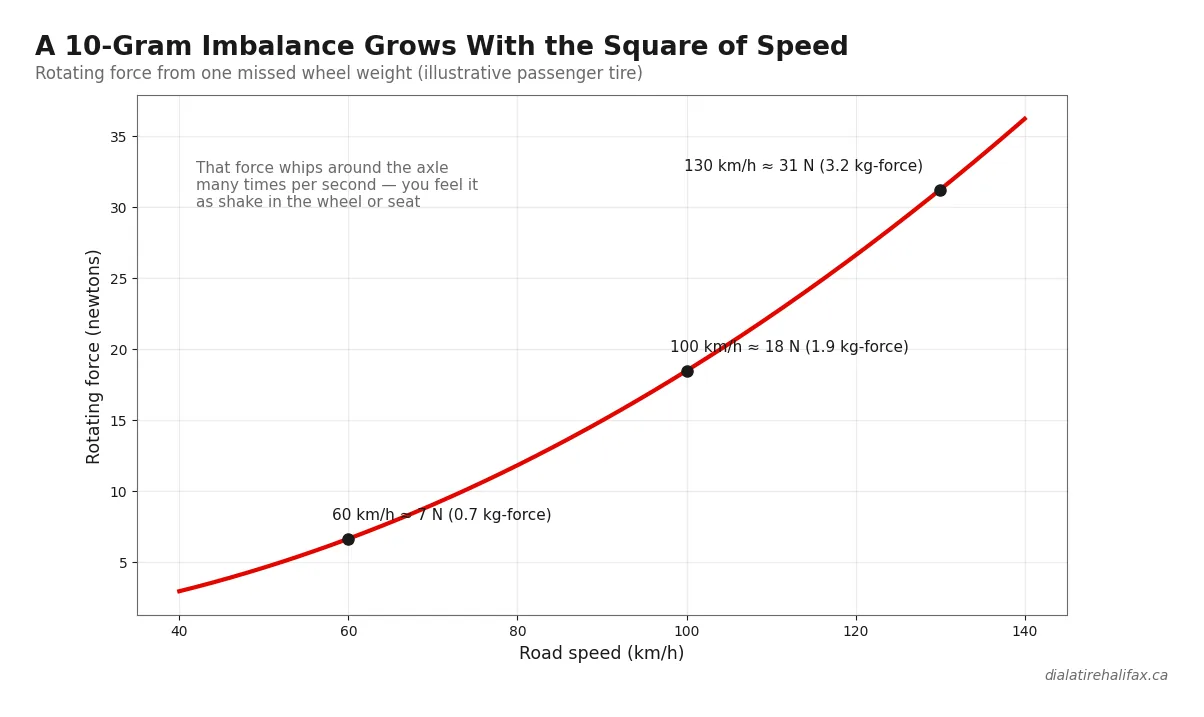
When a wheel spins, any mass that is not centred on the rotational axis generates a centrifugal force (more precisely, a centripetal acceleration requirement) that tries to pull that mass outward from the centre of rotation. The heavier the mass, the farther it sits from the axis, and the faster it spins, the larger that force becomes. Crucially, the force scales with the square of the rotational speed: double the speed, quadruple the force.
At low speeds, this force is trivial. At 100 km/h on the Bicentennial Highway, it is not.
Engineering Corner
Modelling the imbalance as a single point mass — a good first approximation — the centrifugal force it generates is:
F = m × r × ω²
Where F is force in newtons, m is the imbalance mass in kilograms, r is the radius from the rotational axis to the imbalance mass in metres, and ω (omega) is the rotational speed in radians per second.
Worked example: A 10 g (0.010 kg) imbalance sitting 0.30 m from the wheel centre. Roughly the distance from hub to mid-sidewall on a 195/65 R15 tire. At 100 km/h, a typical 195/65 R15 tire rotates at approximately 800 revolutions per minute (rpm), which is 800 × 2π / 60 ≈ 83.8 radians per second.
F = 0.010 × 0.30 × (83.8)² = 0.010 × 0.30 × 7,022 ≈ 21 N, equivalent to roughly 2.1 kg-force.
That 2.1 kg-force cycles in a rotating direction (up, sideways, down, sideways) at 13.3 times per second (once per revolution). Because force scales with ω², the same 10 g imbalance at 130 km/h generates approximately 35 N, more than 3.5 kg-force. A single small coin, pulling on your suspension with that force, more than 13 times per second, every kilometre you drive.
Reading the Vibration: Where It Shows Up and What Speed
The speed at which a vibration appears (and where in the car you feel it) are both diagnostic clues. They point to which wheel or wheels are the likely source.
Steering wheel vibration between roughly 100 and 120 km/h is the classic symptom of a front wheel imbalance. The front wheels are connected directly to the steering column through the steering rack; imbalance forces travel up the tie rods and reach your hands. The vibration tends to be most pronounced at a specific speed and can diminish somewhat above or below that speed. This is often because the imbalance frequency sweeps through a resonant frequency of the front suspension, which amplifies it near that speed.
Vibration felt primarily in the seat or floorboards at similar speeds suggests rear wheel imbalance. The rear wheels are not connected to the steering column, so the forces travel through the rear subframe and floor rather than up to your hands. If a passenger mentions feeling a vibration that you can barely feel in the wheel, rear balance is a likely cause.
Vibration that appears at lower speeds (say, 60 to 80 km/h) and stays consistent above those speeds, or a heavy thumping rather than a smooth vibration, may indicate something other than weight imbalance: a flat spot in the tire from a hard brake event or from a tire stored flat for a long period, tire separation, or a bent wheel. These are worth distinguishing from simple balance issues.
Vibration that changes character when you change lanes (and hence shift weight side to side) suggests the imbalance is sensitive to load transfer. A dynamic balance issue rather than a simple static one.
Static Balance vs. Dynamic Balance
There are two distinct types of wheel imbalance, and they require different measurement and correction approaches.
Static imbalance is the simpler case: the mass distribution is uneven around the circumference of the wheel and tire. If you were to mount the wheel on a perfectly frictionless spindle and let it settle, it would rotate until the heavy point was at the bottom. This creates a vertical force as the wheel spins. A bounce, or hop. On older single-plane balancers, this is the only type measured.
Dynamic imbalance involves mass distributed unevenly across the width of the wheel, that is, more mass on the inboard side than the outboard side, or concentrated off-centre laterally. As the wheel spins, this lateral imbalance creates a wobbling or oscillating force that tries to make the wheel lean from side to side. The wheel looks like it is spinning correctly if you view it from the side, but from the front or rear it is wobbling. This wobble is what causes steering shimmy.
Modern two-plane computer balancers measure both simultaneously. The wheel is mounted on the balancer spindle and spun up to speed; sensors at two points along the spindle measure both the radial (static) and lateral (dynamic) imbalance. The computer calculates not just how much weight to add, but exactly where on the inboard and outboard planes of the rim to place it. Many shops today use this two-plane approach as standard.
The balance weights themselves are either clip-on steel weights, which clamp to the rim’s inner lip, or adhesive weights, which stick to the inner barrel of the wheel and are preferred on alloy wheels where clip-on weights would scratch or damage the finish. Adhesive weights are more susceptible to falling off in cold weather. A relevant Halifax consideration, as we will get to shortly.
Why Weights Fall Off in Winter, and What Happens When They Do
Adhesive wheel weights are bonded to the wheel with a pressure-sensitive adhesive. In warm conditions this adhesive holds reliably. In the cold (and Halifax gets well below freezing from November through March) the adhesive becomes brittle and less compliant. Road grime, salt residue, and the thermal cycling between a cold parked car and a heat-soaked wheel during driving further compromise the bond. Weights can fall off after a single cold night or after repeated freeze-thaw cycles.
When a weight falls off, the wheel returns to its pre-balance state. A vibration that was corrected when you did your seasonal changeover can reappear in January with no other change to the car. This is not a failure of the balancing itself. It is a consequence of adhesive weight behaviour in cold conditions. Some shops use clip-on weights on the inboard barrel of alloy wheels specifically to avoid this, since clip-on weights do not depend on adhesive bond strength.
If your car develops a steering vibration mid-winter that was not there after your autumn changeover, a lost balance weight is among the most likely explanations. It is worth mentioning to the shop at your next visit, or booking a rebalance if the vibration is significant.
How Imbalance Damages Tires and Suspension Over Time
The 2.1 kg-force calculated in the Engineering Corner above cycles more than 13 times per second at 100 km/h. Over a Halifax driving year (with lots of short winter trips around HRM and highway runs on the 102 and 103) that adds up to an enormous number of load cycles hitting the same components repeatedly.
The tread itself is the first thing affected. Imbalance causes the tire to bounce slightly with each revolution, meaning the contact patch momentarily lifts from the road and then strikes it again rather than rolling smoothly. This creates a wear pattern called cupping or scalloping. A wavy, dished surface around the tire’s circumference. Cupped tires generate a characteristic thumping or humming noise at speed, and the damaged tread cannot be recovered by rotation or balancing. The tire needs replacement once cupping is pronounced. See our post on why tires wear unevenly for a deeper look at wear patterns and their causes.
Suspension and steering components are also affected. Wheel bearings, tie rod ends, and ball joints are all subjected to those repeated cyclic forces. They are built to handle the forces of normal driving; sustained vibration from imbalance is an additional load cycle that accelerates wear in these components. A car that vibrates for years due to unaddressed imbalance will often need front-end work sooner than a car with consistently balanced wheels.
When Standard Balancing Isn’t Enough
Occasionally, a wheel and tire combination that measures in balance on the balancer still produces a vibration when driving. This can happen because the balancer measures mass distribution but not uniformity of the tire’s stiffness around its circumference. A tire can have a stiff spot that generates a force variation even when the mass is perfectly centred. If standard balancing hasn’t resolved a persistent vibration, we can inspect for bent wheels, tire damage, and other causes before recommending the next step.
When to Get Your Wheels Balanced
The standard recommendations are straightforward:
- Every time a tire is mounted on a rim. The new tire-and-wheel combination’s mass distribution is unknown until measured, which is why balancing is always included with mounting; for a seasonal swap of already-mounted wheel sets, ask us if you feel any vibration
- After any tire rotation, or at least when you next notice a vibration after rotation
- Whenever you feel a new steering-wheel or seat vibration, especially one that appears at a consistent speed
- After a significant pothole impact or curb strike. These can shift weight distribution and knock off adhesive weights
- After a tire repair. The plug-and-patch process can alter the tire’s mass distribution slightly
Balancing and alignment are related but different services. Alignment corrects the geometric angles of the wheels relative to each other and the road, while balancing corrects mass distribution. A car can have perfect alignment and poor balance, or vice versa. Our post on tire balancing vs. wheel alignment explains the distinction in detail.
What This Means for Your Car
Ten grams sounds inconsequential. At highway speed, the physics of rotating mass turns that into a multi-kilogram force cycling faster than the eye can follow. The good news is that wheel balancing is one of the cheapest and most effective maintenance steps available. It costs far less than the suspension wear and tire cupping it prevents.
The most practical habit for Halifax drivers is to request a balance check at every seasonal changeover, and to pay attention when a vibration appears. A vibration that develops mid-winter after a good autumn balance is often a fallen weight. A five-minute rebalance. A vibration that appears gradually over the summer is often progressive tire cupping or a new imbalance from uneven wear. Neither is serious if caught early; both cause meaningful damage if left alone for a full driving season.
Book a Wheel Balance at Dial A Tire
We balance wheels on a two-plane computer balancer as standard, matching weights to both the inboard and outboard rim planes for accurate correction. If you’ve got a persistent vibration that hasn’t responded to balancing elsewhere, ask us about our diagnostic process, we’ll work through the likely causes systematically. You can book an appointment online, or call either location directly.
HALIFAX — Dial A Tire
308 Herring Cove Rd, Halifax, NS
902-475-3358
BEDFORD — Dial A Tire
70 Rosno Lane, Bedford, NS
902-444-3425
Open daily 8 AM–5 PM. Please call before coming.
Locally owned since 1994 · Red Seal technicians · Professional installation & precision balancing