If there’s one thing we wish more Halifax drivers would do, it’s this: look at their tires before they’re completely bald.
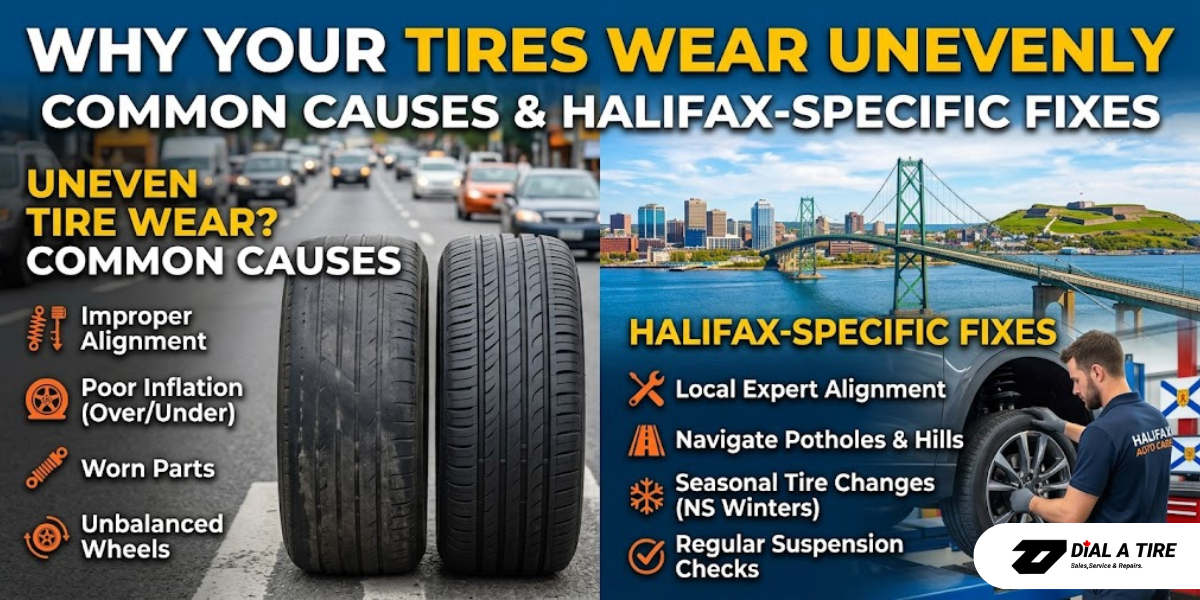
Not just the tread depth though that matters too. We mean the pattern of the wear. Because tires don’t just wear out evenly and gracefully. They wear in specific patterns that tell a story about what’s happening with the alignment, suspension, inflation, and driving conditions. And if you can read that story, you can fix the cause before it ruins the next set too.
We see hundreds of unevenly worn tires every year at Dial-A-Tire. Some of them come in on vehicles where the owner had no idea anything was wrong the car “drove fine.” But one look at the tread told us the whole history: an alignment knocked out by a pothole in February, a slow leak that kept the left rear underinflated all summer, a worn strut that let the tire bounce down Highway 102 for 30,000 km.
Here’s the guide to reading your own tires what each wear pattern means, what causes it, and what to do about it.
Pattern #1: Inside Edge Wear (The Most Common In Halifax)
What It Looks Like:
The inside edge of the tread (the side closest to the centre of the car) is noticeably more worn than the outside edge. Sometimes the inner edge is practically bald while the outer edge still has plenty of tread left.
What Causes It:
Excessive negative camber. Camber is the inward or outward tilt of the tire when viewed from the front of the vehicle. If the top of the tire leans inward (toward the engine), that’s negative camber and it puts more of the load on the inner edge.
The most common reason for this in Halifax? Potholes. A hard pothole impact can bend a control arm, shift a subframe, or knock a strut mount out of position any of which changes the camber angle. Once that happens, the inside edge starts wearing away kilometre by kilometre.
Worn control arm bushings and ball joints can also allow camber to drift over time, especially after years of Halifax road conditions.
Why It Matters More Here:
Halifax’s freeze-thaw cycle creates potholes that are deeper, more plentiful, and more sudden than in many Canadian cities. We see inside edge wear often on vehicles that haven’t had an alignment check in a couple of years.
The Fix:
A wheel alignment that specifically corrects camber. If the camber is out because a component is bent or worn (not just adjusted out of spec), the damaged part needs to be repaired or replaced first an alignment alone can’t correct a bent control arm.
Pattern #2: Outside Edge Wear
What It Looks Like:
The outside edge (the side facing outward, toward the fender) is more worn than the rest of the tread.
What Causes It:
Three possible culprits:
1. Excessive positive camber
The top of the tire tilts outward. Less common than negative camber, but it happens especially on vehicles with worn or sagging springs that change suspension geometry.
2. Chronic underinflation
This is actually the more common cause. When a tire is underinflated, the centre of the tread lifts slightly and the load shifts to the outer shoulders. If a tire runs 5–10 PSI low for months at a time, the edges wear faster than the centre.
3. Aggressive cornering
Spirited driving through corners loads the outside edge heavily. If you’re carving the curves on Purcells Cove Road every day, the outside edges will eventually show it.
The Fix:
Check inflation first it’s the easiest and most common cause. Correct pressure should match the sticker on the driver’s door jamb, not the maximum PSI written on the tire sidewall.
If inflation is correct, get an alignment check. And if both are fine and you’re simply an enthusiastic driver, regular tire rotation helps distribute the wear more evenly.
Pattern #3: Centre Wear
What It Looks Like:
The centre strip of the tread is worn down while the shoulders (edges) still have plenty of depth.
What Causes It:
Chronic overinflation. Too much pressure pushes the centre of the tread outward, creating a slightly crowned contact patch that rides mostly on the middle.
We see this surprisingly often, and the cause is usually well-intentioned: someone reads the tire sidewall (which shows the maximum pressure, often 44 PSI or higher) and inflates to that number instead of the vehicle’s recommended pressure typically 30–35 PSI for many passenger vehicles.
Some TPMS systems can also create a false sense of security. The warning light only triggers when pressure gets too low. A tire sitting at 42 PSI on a vehicle that calls for 33 PSI won’t trigger a warning, but it’s still significantly overinflated and wearing the centre aggressively.
Overinflation is the most common cause of centre wear, though driving style and tire construction can also contribute.
The Fix:
Set pressures to the number on the driver’s door jamb sticker not the sidewall, not “what feels right,” and not whatever the gas station air machine defaults to. Check pressure monthly, especially during major temperature swings.
Pattern #4: Edge Wear (Both Shoulders)
What It Looks Like:
Both the inside and outside edges are worn more than the centre. The tread looks like a shallow valley high in the middle, low on both sides.
What Causes It:
Chronic underinflation. The opposite of centre wear. When pressure is too low, the centre of the tread “sags” and the shoulders carry more of the load.
This is one of the most expensive wear patterns because it burns through tread life quickly you’re effectively using the least efficient portion of the tire to support the vehicle.
Halifax Factor:
Cold weather drops tire pressure. Roughly every 5–6°C drop in temperature can reduce pressure by about 1 PSI. In a Halifax winter where temperatures can swing dramatically within days, a tire that was correctly inflated earlier in the week can quietly become underinflated by the weekend.
The Fix:
Check tire pressure monthly especially during seasonal temperature transitions. A basic tire gauge costs a few dollars and can save you hundreds in premature tire wear.
Pattern #5: Cupping or scalloping
What It Looks Like:
Wavy, patchy wear across the tread surface high spots alternating with low spots in an irregular pattern. Run your hand across the tread and you’ll feel a bumpy texture instead of a smooth surface.
What Causes It:
Worn shock absorbers or struts. This is one of the most common causes.
When shocks wear out, they can’t keep the tire planted consistently against the road. Instead, the tire bounces slightly, causing certain tread areas to hit the pavement harder than others. Over thousands of kilometres, those spots wear unevenly and create cupping.
Worn wheel bearings, unbalanced tires, and loose suspension components can also contribute.
Why This Pattern Gets Expensive:
By the time cupping is visible or audible, the damage is usually done both to the shocks and to the tire itself. Even after replacing the shocks, severely cupped tires often stay noisy and vibrate.
The Fix:
Replace the worn shocks/struts and any contributing suspension components. Then evaluate whether the tires are still usable or need replacement.
How To Catch It Early:
Push down firmly on each corner of the vehicle and release. If the vehicle bounces repeatedly before settling, the shocks may be worn. Also listen for rhythmic humming or thumping noises that change with speed.
Pattern #6: Feathering
What It Looks Like:
Each tread block is smooth on one side and sharp on the other. Run your hand across the tread and it feels smooth one direction and rough the other like tiny ramps.
What Causes It:
Toe misalignment. Toe refers to whether the tires point slightly inward (toe-in) or outward (toe-out) when viewed from above.
When toe is off, the tire doesn’t roll perfectly straight it gets dragged sideways slightly with every rotation, which scrubs the tread unevenly.
The Fix:
A wheel alignment that corrects toe settings. Toe is the alignment angle most likely to drift over time due to potholes, normal wear, or worn tie rod ends.
Pattern #7: One-sided Wear On A Single Tire
What It Looks Like:
One tire is dramatically more worn than the others or shows a completely different wear pattern.
What Causes it:
Usually a localized mechanical issue, such as:
- a seized brake caliper creating drag and heat
- a bent rim causing wobble
- a damaged suspension component on that corner
- incorrect inflation that was never corrected
The Fix:
Diagnose that specific corner of the vehicle. Once the underlying issue is repaired, the tire may need replacement depending on how severe the wear is.
The Halifax Uneven-Wear Cycle (And How To Break It)
Here’s the pattern we see over and over:
- A pothole knocks alignment out in February
- The driver doesn’t notice because the car “still drives fine”
- Tires wear unevenly all winter and spring
- At the next seasonal changeover, the worn set goes into storage and another set goes on but the alignment is still off
- The new set starts wearing unevenly too
- By the time the issue is obvious, two sets of tires have been compromised
The fix is simple: get an alignment check after a significant pothole impact, and ideally once per year especially during spring changeover season.
An alignment typically costs far less than replacing a damaged tire early.
Bottom Line
Uneven tire wear is never random. Every pattern points to something inflation, alignment, suspension wear, or driving conditions.
The key is catching it early before the issue destroys the next set too.
Next time you walk by your car, crouch down and actually look at the tread. Run your hand across it. If it’s smooth and even, great. If it’s not, you now know what the tire may be trying to tell you.
At Dial-A-Tire, we inspect for uneven wear during every changeover and service. If we spot a pattern, we’ll explain what’s causing it and what the fix involves straight, no pressure, no upsell.
Book online or call 902-475-3358 for a tire inspection, wheel alignment, balancing, or suspension check in Halifax your tread is trying to tell you something.
FAQs
Q1. What Causes Tires To Wear On The Inside Edge?
Answer: Excessive negative camber where the top of the tire tilts inward. In Halifax, pothole impacts are a common cause because they can shift alignment or damage suspension components.
Q2. Why Do My Tires Wear Unevenly Even Though I Check The Pressure?
Answer: Proper pressure prevents inflation-related wear, but alignment and suspension problems can still cause uneven wear. If you’re seeing edge wear with correct pressure, get an alignment inspection.
Q3. Can Uneven Tire Wear Be Fixed?
Answer: The underlying issue can be fixed, but the wear already on the tire cannot be reversed. If caught early, the tire may still have usable life after correcting the cause.
Q4. How Often Should I Check For Uneven Tire Wear?
Answer: At every seasonal tire changeover and any time you notice pulling, vibration, or unusual road noise. A quick visual check once a month is a great habit.
Q5. Does Uneven Wear Mean I Need New Tires Immediately?
Answer: Not always. Mild uneven wear caught early can sometimes be managed with rotation and correcting the root cause. Severe wear, exposed cords, or structural damage usually means replacement is necessary.
Also Read:
How Often Should You Rotate Tires in Halifax? And Why It Saves You Money
Signs Your Winter Tires Are Worn Out – Check Before Next Season
How Road Salt Destroys Tires & Suspension in HRM And What You Can Do About It
For a deeper look at how alignment and inflation affect wear patterns, Transport Canada’s tire safety guide explains how improper inflation accelerates uneven wear, while the Tire Rack wear-pattern reference shows exactly what each wear signature tells you about your vehicle. If you’re dealing with edge wear, centre wear, or one-sided wear in Halifax, a wheel alignment check is almost always the right first step — and pairing it with a regular tire rotation is what keeps wear even over time. Suspension problems compound the issue quickly; our guide on how road salt damages suspension in HRM explains why Halifax drivers are especially prone to premature wear. If the damage is already done, our tire shop can help you find the right replacement.
Frequently Asked Questions
What causes tires to wear faster on the inside edge?
Inside-edge wear is almost always a negative camber problem — the wheel is leaning inward, putting extra load on that edge. In Halifax, potholes and frost heaves can knock camber out of spec without any warning. A wheel alignment will confirm whether camber is the culprit and correct it before the tire — sorry, tire — is ruined.
Can I keep driving on unevenly worn tires?
It depends on how severe the wear is, but you should get it inspected promptly. Uneven wear reduces traction, can cause vibration, and signals an underlying problem — alignment, inflation, or suspension — that will only damage new tires if left uncorrected. Book an appointment and let a technician assess the wear pattern.
Does tire rotation fix uneven wear?
Rotation redistributes wear so all four tires age at a similar rate, but it does not fix the root cause. If alignment is off or a suspension component is worn, rotation alone will not prevent the problem from returning. Address the mechanical issue first, then rotate on schedule — typically every 8,000–10,000 km.
How does Halifax weather make uneven tire wear worse?
Freeze-thaw cycles damage road surfaces and suspension bushings, while road salt accelerates corrosion in ball joints and tie rods — all of which affect alignment and load distribution. Switching between winter and all-season tires also creates opportunities to spot wear problems early, which is why a seasonal tire change paired with a quick inspection is good practice.
Updated June 2026.