
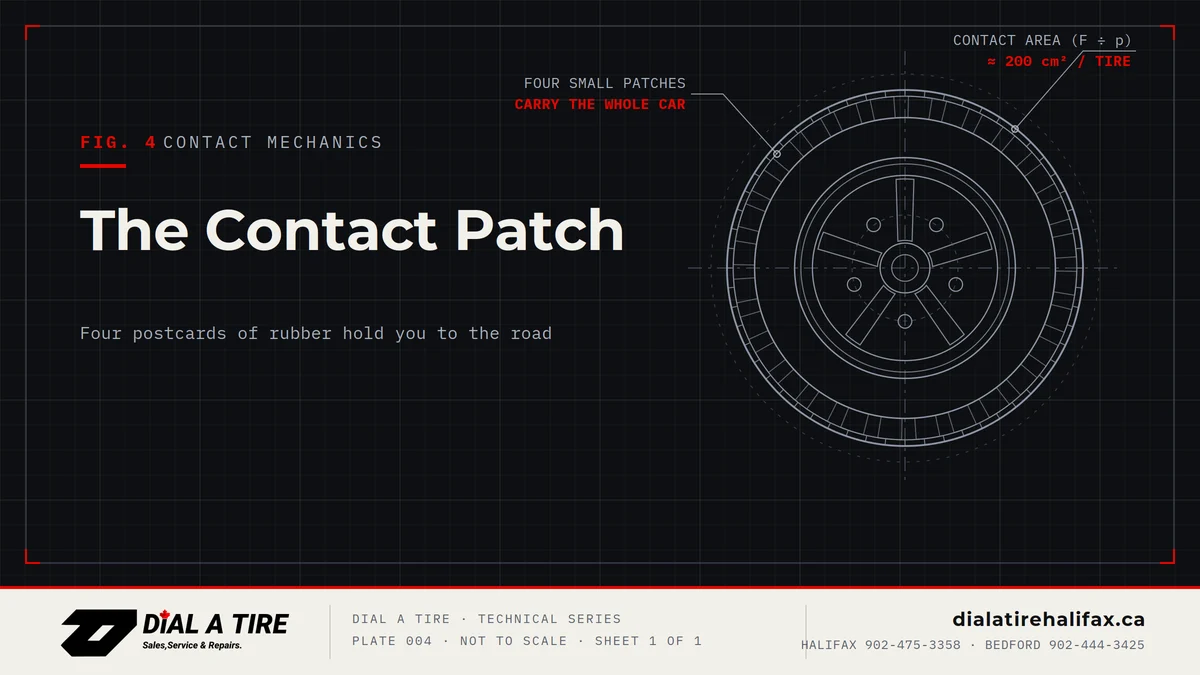
A typical passenger car weighs between 1,400 and 2,000 kg. Every braking, acceleration and cornering force has to pass through four patches of rubber whose combined area is often compared to four postcards. That is the tire contact patch: the interface between everything your car can do and the road it is doing it on.
How large each patch is, what shape it takes, and how evenly load is distributed across it determines how well your car grips, stops, and steers on every Halifax road surface in every season. What follows is the physics of the contact patch, translated into the maintenance decisions that actually matter.
What the Contact Patch Actually Is
The contact patch is the portion of the tire tread in direct contact with the road at any instant. A tire is an inflated pressure vessel shaped into a ring. Inflation pressure pushes the tire walls outward in all directions; where the tire meets the road, the road pushes back, and that section flattens slightly into a roughly rectangular contact zone.
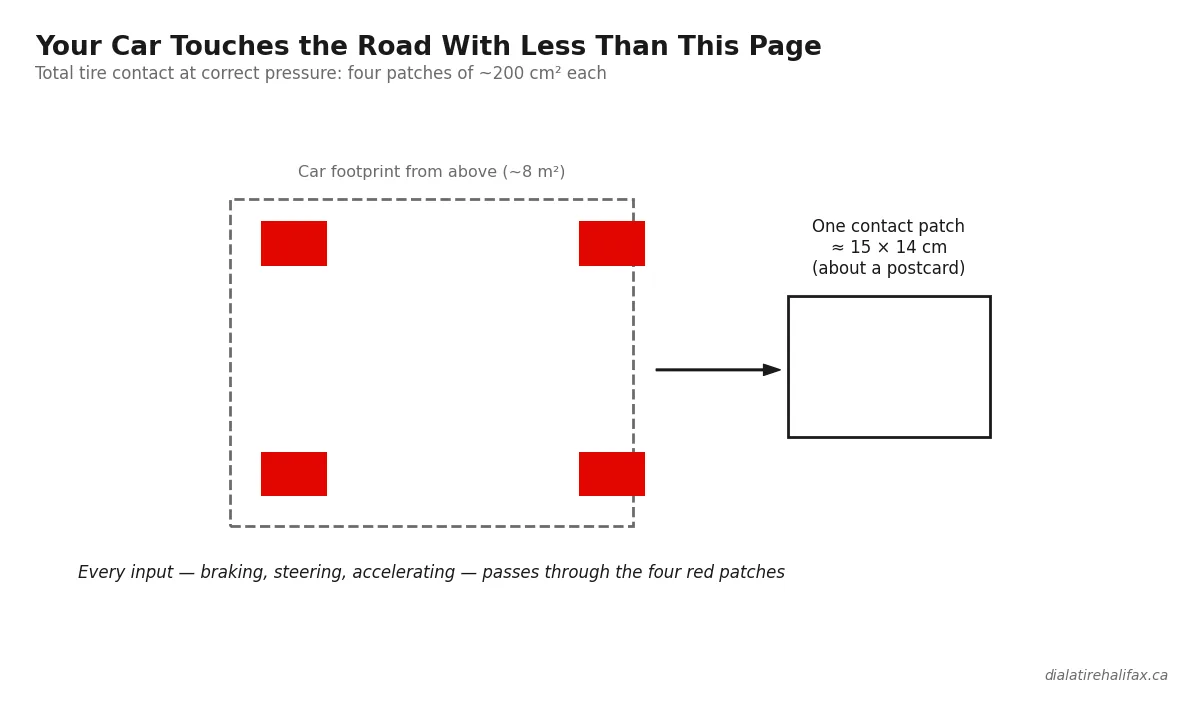
For a typical 205/55 R16 passenger tire (common on mid-size sedans across Atlantic Canada) the contact patch at correct inflation pressure works out, as an illustrative estimate, to roughly 150–200 cm² per tire (the true footprint depends on the vehicle’s corner load, pressure and the tire’s construction, not the size printed on the sidewall), or well under 800 cm² for all four combined: less floor space than a single sheet of bristol board. At its simplest: inflation pressure multiplied by contact patch area equals the load the tire carries. Add load and the patch grows slightly; lower pressure and the patch also grows but distorts, concentrating load at the outer edges rather than spreading it evenly. That distortion is central to why pressure matters.
🔧 Engineering Corner
A useful first approximation is P × A ≈ W, where P is inflation pressure in pounds per square inch (psi), A is the contact patch area, and W is the load on that tire. As a first approximation, patch area rises with load and falls with pressure. A real tire does not follow the equation exactly, because the casing, belts, sidewalls and tread stiffness also carry and distribute load. Add significant load (say, four adults and a loaded boot) and the patch doubles in area unless you also raise pressure. For a tire inflated to 35 psi carrying 500 kg of vehicle load, the patch area works out to roughly 200 cm², simply the load divided by the pressure. This is also why some manufacturers specify a higher cold pressure for heavy loads (on the door-jamb placard or in the owner’s manual): without it, the tire flexes and runs hotter, and shoulder wear accelerates. It also hints at why overinflating to chase fuel economy is self-defeating: the change in footprint shape and pressure distribution costs the tire some of its ability to conform to the road.
Pressure, Load, and Patch Shape
At the manufacturer’s specified inflation pressure (printed on the sticker inside your driver’s door jamb, not on the tire sidewall) the contact patch is designed to be roughly uniform across its width. The tire’s internal structure (the casing plies and belt package) is engineered to work with that specific pressure to keep the patch flat and even.
Underinflation bows the sidewalls outward and deflects the tread centre away from the road. Pressure across the footprint redistributes toward the shoulders, and over time that shows up as extra shoulder wear and heat. This is why underinflated tires wear faster on the shoulder blocks and why their centre grooves, critical for water drainage, press less firmly against the road. Overinflation does the opposite: depending on the tire’s construction, loading tends to concentrate toward the centre of the tread, and the tire conforms less well to the road surface. Neither extreme is a worthwhile trade-off.
Load matters too. Many door jamb stickers list a higher “full load” pressure precisely because a heavily loaded car needs more pressure to maintain the correct patch shape. The Cabot Trail is not the place to discover your tires are visibly squatting because nobody checked that column before departure.
The Friction Circle: How Braking and Cornering Share Grip
Grip is not a fixed property of a tire. It is the maximum friction force the contact patch can generate at any moment, and it is shared among everything the car is doing simultaneously. Acceleration, braking, and cornering all draw from the same budget. The clearest way to picture this is a circle. The radius represents total available grip. Braking force pulls in one direction, cornering pulls laterally, acceleration in another. The combined demand, represented as a vector, must stay inside the circle. The moment it pushes outside (braking hard while also cornering hard, for instance) the tire slides.
Carroll Smith described this with characteristic precision in Tune to Win: any tire has a finite and approximately circular grip envelope, and any combination of lateral and longitudinal forces that lies within that circle will be handled. Any that lies outside will not.
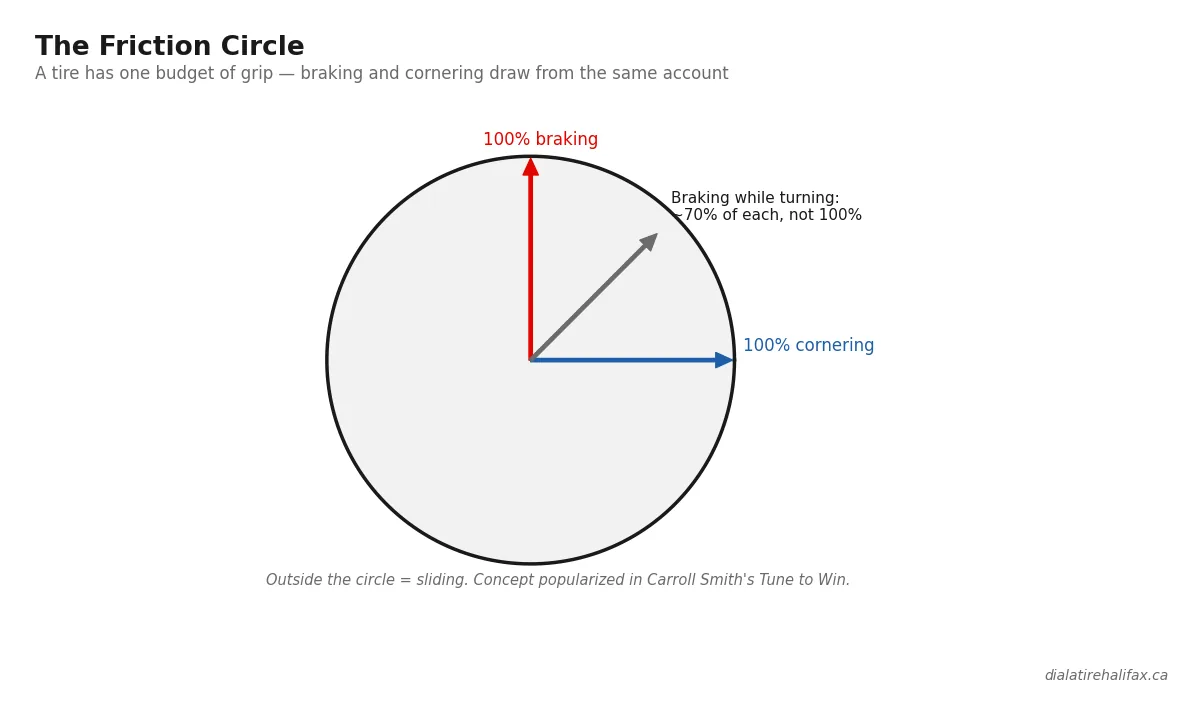
The practical implication for everyday driving is direct and important. When you are braking hard (say, approaching the Armdale Roundabout faster than you intended) your tires are already using a significant fraction of their available grip just to slow the car. If you then also try to corner sharply, you are asking the contact patch to do both simultaneously. The combined demand may exceed what the patch can supply, and the result is understeer (the front tires wash wide) or oversteer (the rear tires step out) depending on which end runs out of grip first.
An Anti-lock Braking System (ABS) monitors wheel speeds and rapidly modulates brake pressure when a wheel approaches excessive slip, preserving steering control instead of letting the tire lock and slide. Electronic Stability Control (ESC) does something similar across all four wheels when it detects a combination of forces approaching the limit. These systems are genuinely effective, but they cannot expand the circle itself. That is determined by tire compound, contact patch size, road surface, and temperature. Two tires with near-identical footprint dimensions can behave very differently at the circle’s edge because of compound, construction and tread design, which is why independent test results matter more than price category or footprint size.
Underinflation and the Distorted Patch: What Really Happens
An underinflated tire flexes more with each revolution than it is designed to. That extra flex generates heat through hysteresis, the energy lost as rubber deforms and rebounds. More heat accelerates compound degradation, weakens adhesion between the casing plies, and in severe cases causes tread separation or blowout at highway speed. Severe or prolonged underinflation is one of the major causes of heat-related tire failure at highway speed, alongside impact damage, overloading, aging and improper repairs.
None of it is visible from outside the car. An underinflated tire at 6–8 psi below specification can look normal to a casual glance. The only reliable way to know is with a gauge. Checking monthly (or whenever the Tire Pressure Monitoring System (TPMS) warning light illuminates) is the minimum, and always check cold: after the car has been parked several hours or driven only a couple of kilometres. Our guide to the TPMS warning light covers the important distinction between a low-pressure alert and a sensor-fault warning.
How the Contact Patch Changes When You Corner
Under straight-line driving the contact patch is centred and symmetric. In cornering, vertical load shifts to the outside tires. Their patches grow while the inside tires unload and shrink, though grip does not rise in direct proportion to load — one reason cornering capacity falls as load transfer gets extreme. The tread blocks in the contact patch experience lateral shear as the tire works through its slip angle: the small difference between the direction the tire is pointing and the direction the car is actually travelling. That slip angle is what generates cornering force. Unevenly worn tires can make that feel vague or inconsistent, because different parts of the footprint carry different loads; the bigger safety cost of low tread arrives in rain and snow, where the tire has little capacity left to clear water or bite into loose surfaces. If you have ever driven a car with badly worn front tires and noticed a vague, reluctant steering feel (not dramatically unsafe, just imprecise) you have felt a degraded contact patch struggling at low slip angles. Tire balancing and wheel alignment both affect how load is distributed across the patch in ways that compound over time.
The Contact Patch and Braking Distance
Stopping distance is the most direct consequence of contact patch performance. A properly shaped, well-compounded patch under the correct load generates more friction force, decelerates the car faster, and reduces stopping distance. Independent tire testing has consistently shown that the difference in wet stopping distance between a new tire and one at 3 mm of tread depth is measured in car lengths, not centimetres. Independent wet-braking tests repeatedly show stopping distances growing substantially as tread wears toward the minimum, well before a tire is legally worn out. In an emergency stop, the difference can amount to several car lengths.
Worn tires combined with underinflation and a wet road are not an exotic scenario. It is exactly what happens when routine summer maintenance gets deferred and the first serious autumn rain arrives. The footprints are unevenly loaded, the tires are flexing excessively, and the worn tread has far less capacity to evacuate water. The friction circle has shrunk, and the driver may not know it until they need it. Proper wheel alignment keeps each patch oriented and wearing evenly. Regular tire rotation ensures no single patch wears ahead of the others. A car with one worn tire has its effective grip limited by that weakest patch.
What This Means for Your Car
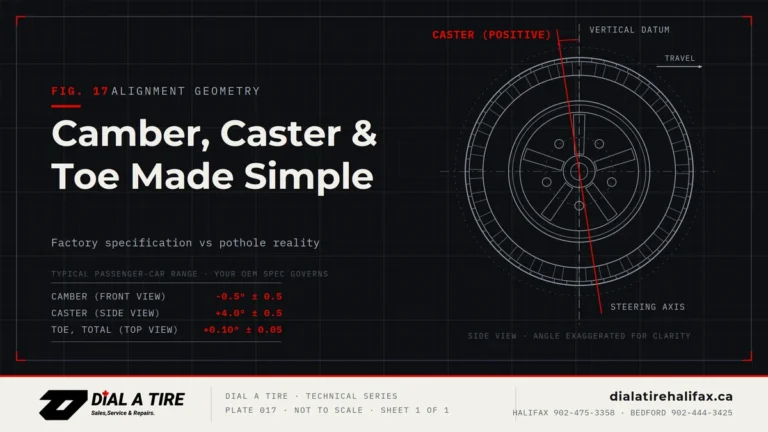
The contact patch is the physical reason behind almost every practical tire recommendation. Check pressure monthly. Correct pressure keeps the patch properly shaped. Rotate your tires so all four patches wear evenly and consistently. Replace worn tires well before the 1.6 mm (2/32″) minimum used in Nova Scotia vehicle inspections, because a worn patch has less drainage area, less compound depth for grip, and less reserve in the friction circle. Align your wheels, because misalignment distorts how each patch meets the road and accelerates uneven wear.
Halifax drivers put plenty of kilometres on hard, freeze-thaw roads. At highway speeds each contact patch makes and breaks contact with the road hundreds of times per second. Over a season that mileage takes a toll, and the condition of those four small patches has a direct effect on braking distances, wet-weather stability, and the car’s ability to handle the unexpected.
If you are not sure whether your tires are giving you the contact patch performance your car deserves, come in for a tread-depth and pressure check. It takes only a few minutes at either location. If replacement is approaching, we can walk you through the options without any sales pressure (intended). Book an appointment or call us directly. You can also browse our tire selection online.
HALIFAX — Dial A Tire
308 Herring Cove Rd, Halifax, NS
902-475-3358
BEDFORD — Dial A Tire
70 Rosno Lane, Bedford, NS
902-444-3425
Open daily 8 AM–5 PM. Please call before coming.
Locally owned since 1994 · Red Seal technicians · Professional installation & precision balancing
The explanation of how such a small contact patch handles all the forces of braking, steering, and acceleration really puts tire maintenance into perspective. One thing that’s also worthBlog Comment Creation Guide keeping in mind is that temperature changes can affect tire pressure enough to change the shape of the contact patch, so checking pressures regularly is just as important as checking tread depth.