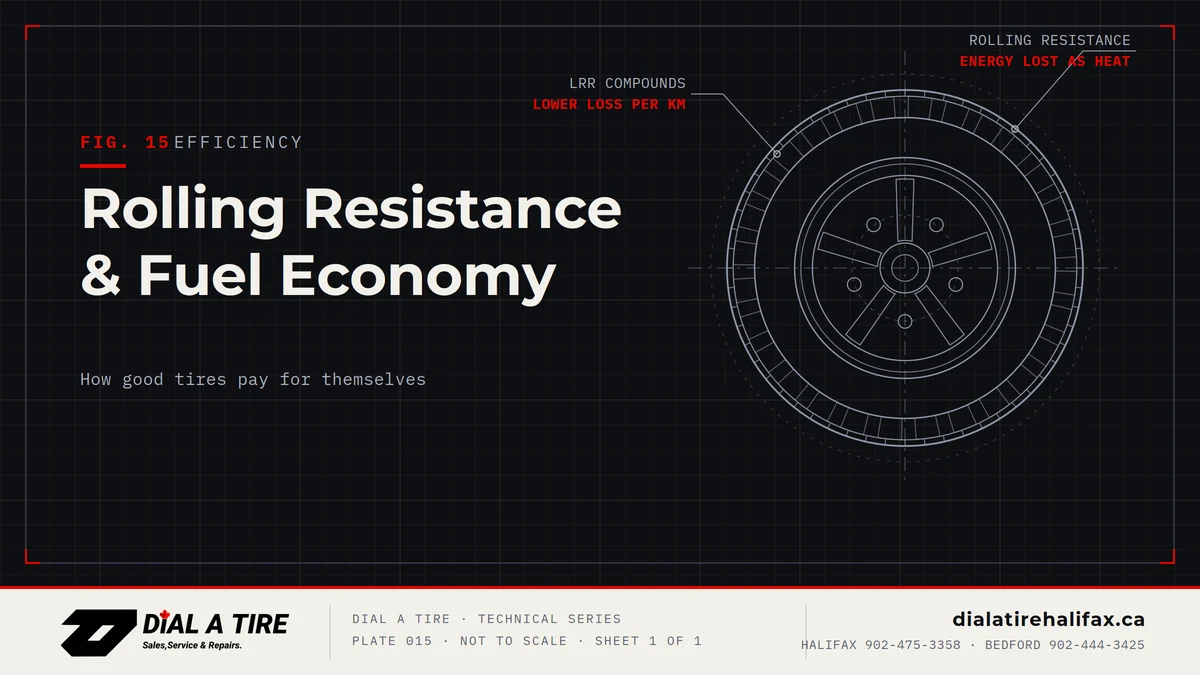
You fill the tank, watch the numbers climb, and drive away wondering where all that fuel actually goes. Some goes to moving the engine, some to the transmission, some to accessories. But a significant slice, especially at city speeds, disappears into your tires. Rolling resistance is the force that opposes your tires rolling forward, and it is working against you on every single kilometre you drive in Halifax. The good news is that it is also one of the few fuel costs you can actually control.
Rolling resistance is not caused by friction between the tire and the road in the conventional sense. It is caused by the continuous deformation of the tire as it rotates. Every time a section of tire enters and then leaves the contact patch (that hand-sized footprint where rubber meets asphalt) it flexes, generates heat, and that heat represents energy that never reaches your wheels. The technical name for this cycle of deformation and heat loss is hysteresis.
For a Halifax driver’s typical annual mileage, even a small improvement in rolling resistance adds up to a meaningful reduction in fuel consumption over the life of a set of tires. Understanding what drives rolling resistance puts that control in your hands.
What Hysteresis Is and Why It Costs You Fuel
Hysteresis is the gap between the energy put into deforming a material and the energy recovered when it springs back. In a perfectly elastic material, you would recover every joule. Tire rubber is not perfectly elastic. It is viscoelastic, which means it deforms readily but recovers sluggishly, and the difference is released as heat.
Picture the tire’s contact patch as a continuous conveyor belt. The leading edge of the patch is being pushed flat against the road surface; the trailing edge is rebounding. The rubber going into that flat zone absorbs energy from the car’s forward motion. The rubber leaving the zone gives some of it back, but not all. The shortfall is rolling resistance — heat bleeding from the tire into the air, kilometre after kilometre.
This is why a tire run on a drum test rig gets measurably warm even when the road surface is cool. Compound chemistry — the mixture of natural rubber, synthetic polymers, carbon black, silica, and processing oils — matters enormously because different compounds have different hysteresis characteristics across the temperature range a tire will see in service.
🔧 Engineering Corner
As a first approximation, rolling resistance force can be modelled as Frr = Crr × W, where Crr is the dimensionless rolling resistance coefficient and W is the vehicle’s weight pushing down on that tire. A typical passenger car tire has a Crr between roughly 0.007 and 0.014 — meaning it takes about 7 to 14 newtons of force to keep a tire loaded with 1,000 newtons rolling at steady speed. A premium low-rolling-resistance tire might achieve 0.006 or lower. On a 1,600 kg car, dropping from Crr 0.012 to 0.008 across all four tires reduces the total rolling resistance force by roughly 63 newtons — energy that goes back into forward motion instead of into heat.
Natural Resources Canada notes that rolling resistance accounts for a meaningful share of a vehicle’s total fuel consumption, particularly at lower city speeds where aerodynamic drag is less dominant. At highway speeds the proportion shifts toward aerodynamics, but rolling resistance never disappears. It is always present, from the moment the car starts moving.
The Pressure Connection: Why Underinflation Is a Hidden Fuel Tax
The single most controllable driver of rolling resistance is tire pressure, and in Halifax the pressure swings with the weather. Every 5 to 6°C drop in temperature costs roughly 1 pound per square inch (psi) of tire pressure, so a car that was correctly inflated in August can be 4–6 psi low by the time October mornings arrive without a single molecule of air escaping.
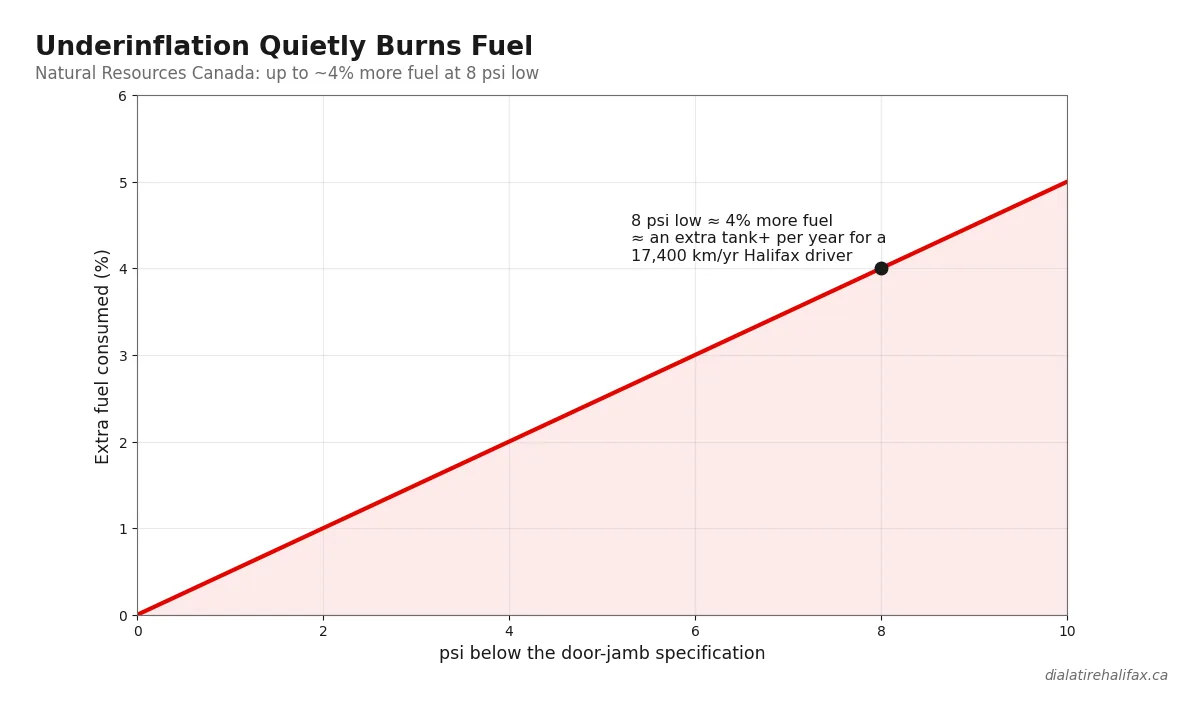
A softer tire deforms more with every rotation. The contact patch flattens and bulges further than it should, the sidewall flexes through a greater arc, and the hysteresis cycle extracts more energy per kilometre. Natural Resources Canada research indicates that tires underinflated by approximately 8 psi can increase fuel consumption by up to about 4 per cent. That may sound small, but for a Halifax driver covering plenty of kilometres, it accumulates into a real cost over time.
Underinflation also shortens tire life, compromises handling, and can mask the early warning signs of other problems. It is the simplest maintenance item on any vehicle (a basic pressure gauge that costs less than a coffee, and two minutes once a month) yet it is consistently the most neglected. The Tire and Rubber Association of Canada (TRAC) regularly surveys Canadian drivers and finds a large portion running below the placard pressure. Check your tire pressure cold, before the car has been driven, using the pressure on the door jamb sticker, not the maximum figure moulded into the tire sidewall.
Our post on what the Tire Pressure Monitoring System (TPMS) warning light means explains why that light is a lagging indicator. Pressure can be 25% low before most TPMS sensors trigger, so real efficiency is being lost long before the dashboard tells you.
The Silica Revolution: How Tire Chemistry Changed the Trade-Off
For most of the twentieth century, tire engineers faced a frustrating compromise: compounds that gripped well in the wet tended to have high rolling resistance, and compounds with low rolling resistance tended to be hard, with poor cold-weather grip. The two properties seemed to pull in opposite directions.
The arrival of silica-filled compounds in the 1990s broke that trade-off. Silica (silicon dioxide, essentially fine-grained sand chemistry) interacts with rubber polymer chains differently than carbon black, the traditional filler used since the early days of pneumatic tires. Silica-reinforced compounds deform readily at low temperatures (important for grip) but recover their shape quickly (reducing hysteresis and heat build-up). The result was a generation of tires that could post genuinely low rolling resistance numbers while also delivering strong wet braking and acceptable cold-weather flexibility.
This is why modern all-season and summer tires from premium manufacturers can be meaningfully more fuel-efficient than equivalent tires from fifteen years ago, even at the same pressure. The compound is doing more work at the molecular level to return energy to the system rather than bleeding it away as heat.
Winter tires are a partial exception: their low-Tg (glass-transition temperature) compounds are designed to stay soft and flexible in cold weather — the thinking behind the industry’s 7°C changeover guideline — but that softness comes with higher hysteresis at warmer temperatures. This is one of several reasons to swap winter tires off promptly in spring. Beyond wear, you are also paying a fuel penalty running them in warm weather. Our guide on when to take winter tires off in Halifax covers that timing in detail.
Low-Rolling-Resistance Tires: What the Labelling Actually Means
Many tire lines now carry explicit low-rolling-resistance (LRR) designations, and some markets use standardized fuel economy labelling on the tire itself. These ratings are derived from standardized laboratory tests (typically the international standard ISO 28580 or equivalent) that measure rolling resistance force at a specific speed, load, and inflation pressure on a calibrated drum.
Under the current European scheme (rescaled in 2021), the label grades run from A (best) to E (worst) for fuel efficiency. Moving up one full class is associated with roughly 0.1 litres per 100 km for a typical passenger car, and crossing the whole range from worst to best is commonly estimated at several tenths of a litre per 100 km. Across plenty of kilometres, that starts to look like money.
It is worth noting that a low-rolling-resistance rating does not tell the whole story. The same standardized tests also measure wet braking performance and noise, and a tire that earns an A for fuel but an F for wet grip is a dangerous bargain. Reading the full label, or asking for the measured test data from an independent source, gives you a more complete picture. The Tire Rack publishes measured wet braking distances and comparative fuel economy data for many tire models, which is more useful than manufacturer marketing claims alone.
When we fit new tires, we are happy to walk you through the data on the options that fit your vehicle. The right tire for a Halifax commuter who mainly drives the Highway 101 corridor is not necessarily the same as the right tire for someone doing daily stop-and-go in Dartmouth. Vehicle weight, driving pattern, and which performance attribute matters most to you all factor in.
Other Factors That Influence Rolling Resistance in Daily Driving
Pressure and compound are the two biggest levers, but a few other variables matter in daily driving.
Load. Rolling resistance scales directly with vehicle weight. A full car with four adults and luggage will have higher rolling resistance than the same car with one driver, which is part of why fuel economy dips on loaded road trips, beyond highway speed alone.
Temperature. Cold rubber is stiffer and takes longer to reach operating temperature, so rolling resistance is higher on a cold Halifax morning than after the tire warms up. This is the mechanical reason cold-weather fuel economy tests come in below warm-weather figures.
Tire age. Aged or cracked rubber loses elastic recovery. A tire that is seven or more years old may contribute more rolling resistance than a newer tire of the same design, even if it still has tread depth.
Wheel alignment. Misaligned wheels cause the tire to scrub sideways as it rolls forward. A different energy loss from hysteresis, but it shows up on your fuel bill the same way. Our wheel alignment service addresses this. Halifax freeze-thaw cycles knock alignment out more often than most drivers realize.
What This Means for Your Car
Rolling resistance is not an abstract engineering concept. It shows up as dollars at the pump and kilometres of range per charge if you drive an electric vehicle (EV). The three practical actions that pay back the most are: keep your tires properly inflated year-round, choose tires with published rolling resistance data when it is time to replace, and keep your alignment in specification.
You cannot change the laws of thermodynamics, but you can choose how much energy your tires bleed away on every trip. Halifax drivers who stay on top of tire pressure through the seasonal swings, switch winter tires on and off at the right time, and select tires thoughtfully are likely spending measurably less at the pump than drivers who treat tires as an afterthought.
For those who want the underlying physics, the Bosch Automotive Handbook provides a thorough treatment of rolling resistance theory, including how compound properties translate into measured coefficients.
Ready to Make Your Tires Work Harder for You?
Whether you are looking to replace a worn set with low-rolling-resistance options, need a pressure check before a long summer drive, or want to make sure your alignment is not quietly draining your fuel economy, we can help. Browse our tire selection or book an appointment online. We are open daily at both locations.
HALIFAX — Dial A Tire
308 Herring Cove Rd, Halifax, NS
902-475-3358
BEDFORD — Dial A Tire
70 Rosno Lane, Bedford, NS
902-444-3425
Open daily 8 AM–5 PM. Please call before coming.
Locally owned since 1994 · Red Seal technicians · Professional installation & precision balancing