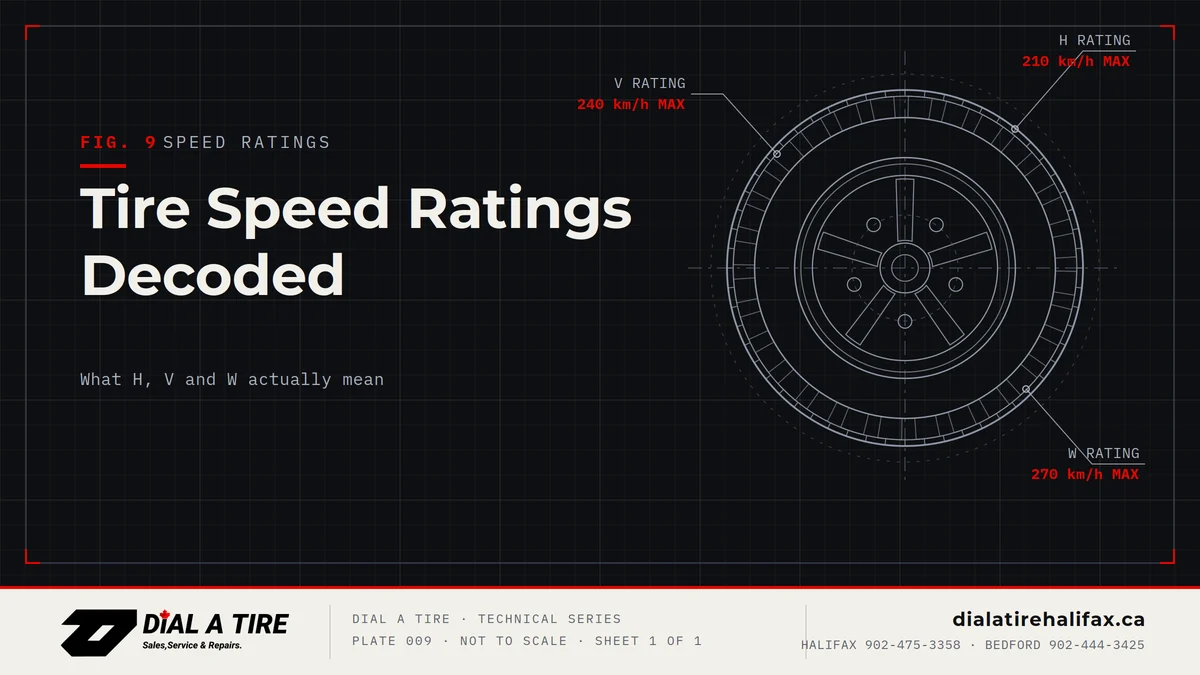
You pull a new set of tires from their box, glance at the sidewall, and read something like 225/60R16 98H. You understand the width and the rim size. But that final letter (the tire speed rating) often gets overlooked or misread as a minor detail. It isn’t. That letter tells you the maximum sustained speed the tire was designed to handle under load, and it is one of the most consequential numbers on the whole sidewall.
Here in Nova Scotia, nobody is driving 240 km/h on the 102. So why does speed rating matter? Because the rating is really about heat management and structural design at sustained speed, more than a simple top-speed number. A higher-rated tire is built with stiffer belts, a tighter bead, and a compound that resists heat buildup. All of which translate directly into how the tire handles emergency manoeuvres, sustained highway driving, and the hard cornering you’ll find on the Cabot Trail switchbacks. Getting the rating wrong, whether you downgrade without knowing it or mix ratings on an axle, can affect both safety and (worth being aware of) your insurance coverage.
This guide decodes every letter you are likely to encounter, explains what sits behind the numbers, and helps you choose a rating that actually matches how you drive in Atlantic Canada.
What Is a Tire Speed Rating and Where Does It Come From?
A tire speed rating is a standardized laboratory result, not a manufacturer’s marketing claim. The tire is run at progressively higher speeds on a drum under controlled load until it reaches the target velocity, then it must sustain that speed for a defined period without structural failure. The result is mapped to a letter code on an international standard scale originally developed by European regulators and now used worldwide.
Each letter corresponds to a kilometre-per-hour threshold:
| Rating | Maximum Sustained Speed | Common Applications |
|---|---|---|
| S | 180 km/h | Light trucks, SUVs, some winter tires |
| T | 190 km/h | Minivans, family sedans, light trucks |
| H | 210 km/h | Sedans, coupes, crossovers. Among the most common ratings in Canada |
| V | 240 km/h | Performance sedans, sports cars, many modern SUVs |
| W | 270 km/h | High-performance vehicles, sport-tuned SUVs |
| Y | 300 km/h | Exotic and ultra-high-performance vehicles |
| Z | Above 240 km/h (requires W or Y sub-rating) | Older high-performance designation; now superseded by W/Y |
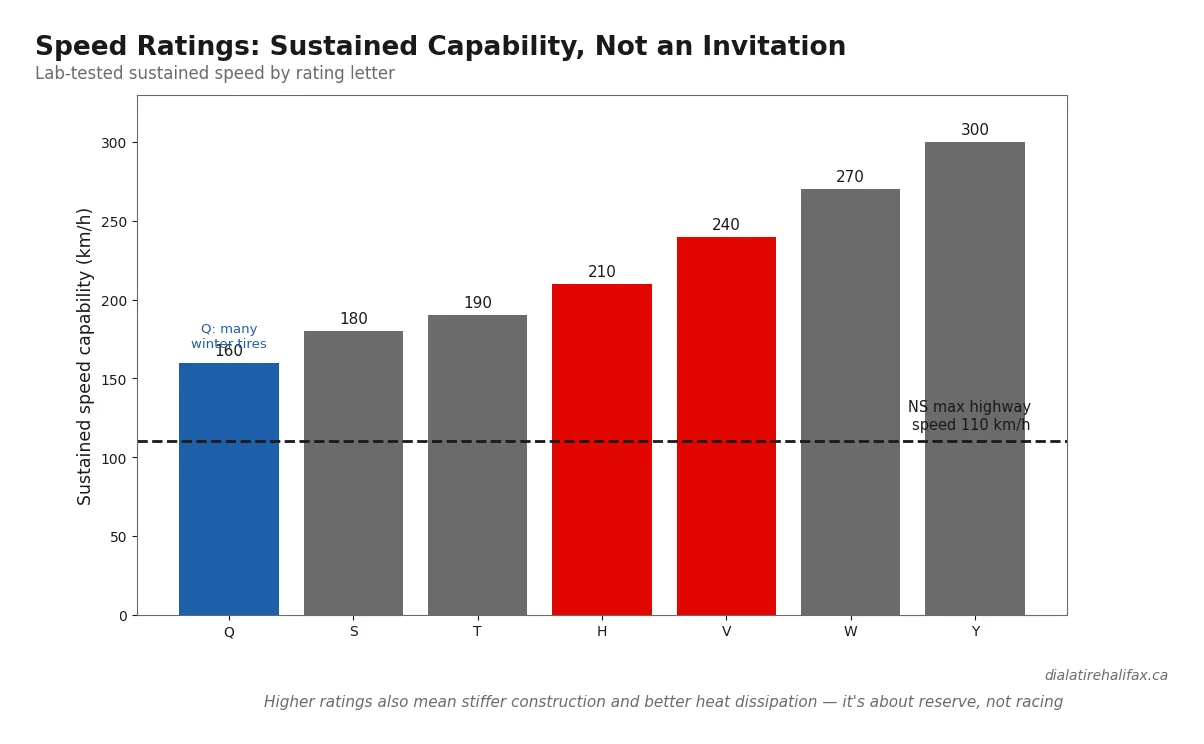
Note: there is no I or O rating in the sequence (too easily confused with digits), and Q is common on studded and dedicated winter tires. The scale is not a simple alphabet run, so checking a table is more reliable than guessing from letter position.
Why Speed Rating Matters at Nova Scotia Legal Speeds
The practical value of speed rating is not about doing 270 km/h. It is about what the engineering required to achieve that rating does for you at 110 km/h. The connection comes down to three things: heat dissipation, belt stiffness, and compound formulation.
Heat dissipation. A tire generates heat with every rotation: the rubber flexes, energy is lost to internal friction (a property called hysteresis), and temperature rises. At sustained highway speeds, a lower-rated tire accumulates heat faster than its construction can shed it. That doesn’t mean the tire explodes at 181 km/h the moment you buy an S-rated tire. It means over a long drive at 120 km/h in August, a tire rated for 180 km/h has less thermal headroom than one rated for 240 km/h. On a run from Halifax to Cape Breton on a summer day, that headroom matters.
Belt stiffness and handling response. Higher-rated tires tend to use stiffer internal belt packages under the tread. Stiffer belts mean the tread deforms less under lateral load, which generally translates into crisper steering response and can help shorten stopping distances in emergency situations. When you swerve to avoid debris on the 104, the tire’s structural rigidity is doing quiet but important work.
Compound formulation. Tire engineers balance grip, heat resistance, wear, and rolling resistance. Higher-rated tires typically use compounds that stay stable across a wider temperature range, resisting softening at the elevated temperatures that high-speed driving generates.
🔧 Engineering Corner
The centrifugal forces acting on a tire’s belt structure grow with the square of rotational speed. Double the speed and the forces on the belt increase fourfold. This is why tire engineers must significantly reinforce the belt package for higher-rated tires. It is not a linear engineering challenge. A tire rated W (270 km/h) is operating at roughly 2.25 times the belt stress of a tire rated S (180 km/h) at its design limit, because (270 ÷ 180)² ≈ 2.25. In plain terms: the letter on your sidewall represents a real structural engineering commitment, more than a legal speed limit sign.
What “Never Mix Ratings on an Axle” Actually Means
Mounting a V-rated tire on the left front and an H-rated tire on the right front is a handling problem, not merely a rule-book violation. The two tires have different belt stiffnesses, different load-deformation characteristics, and slightly different effective rolling circumferences. Under hard braking or sharp cornering, each front tire responds at a slightly different rate. The vehicle will pull toward the side with the more compliant (lower-rated) tire, and the Anti-lock Braking System (ABS) cannot fully compensate for a mechanical asymmetry it was never designed to correct.
Tire manufacturers’ guidance is consistent on this point: avoid mixing speed ratings on the same axle. If you must mix ratings between front and rear axles (an unusual situation), fit the higher-rated tires on the rear to reduce the risk of oversteer, but matching all four is always preferable.
In practice we see mixing happen when one tire is damaged and replaced urgently. If the shop does not have the exact specification and offers a different rating, ask specifically about axle matching before agreeing. Our team always checks the existing tires before recommending a replacement to keep the set consistent.
Winter Tires and Speed Ratings: Lower Is Normal and Fine
Many drivers are surprised to discover their winter tires carry a Q, R, S, or T rating. Lower than the H or V rating on their summer or all-season set. This is not a compromise or a quality shortcut; it is deliberate engineering.
A winter tire’s compound is formulated to stay soft and flexible in temperatures well below 0°C. That very softness, which gives you grip on a slushy Bedford parking lot in January, generates more internal heat at high speed than a firmer summer compound would. Winter tire engineers accept a lower maximum sustained speed because winter driving conditions (snow, ice, wet cold pavement) physically cannot be driven at 240 km/h safely anyway. The compound optimization that gives you grip in the cold is incompatible with the heat resistance needed for a V rating.
Nova Scotia’s maximum posted highway speed is 110 km/h. An S-rated winter tire (180 km/h limit) gives you a 70 km/h buffer above legal highway speed. That is more than adequate. If you have a performance vehicle that originally came with V or W summer tires, fitting Q or S winter tires is completely normal practice, just ensure you restore your original-equipment rating (or better) when you swap back in spring. Our seasonal tire changeover service includes a full inspection of both sets at each swap.
What Happens If You Downgrade Your Speed Rating?
Fitting a lower speed rating than your vehicle’s original-equipment specification carries two categories of risk: engineering and insurance.
Engineering risk. Your vehicle manufacturer chose the original-equipment speed rating in concert with the suspension tuning, Anti-lock Braking System (ABS) calibration, and overall vehicle dynamics. A lower-rated tire with a more compliant belt structure changes the steering feel, can extend stopping distances, and may behave differently in an emergency lane-change. For most daily driving the difference is subtle, but it is real.
Insurance risk. Some insurers consider whether replacement tires meet the vehicle manufacturer’s specification when they assess a claim. We are tire people, not insurance people, so before accepting a lower-rated tire to save money, have that conversation with your broker before you accept a cost-saving substitution.
Upgrading to a higher speed rating is generally safe and sometimes improves handling. But it may increase rolling resistance slightly and, depending on the tire, affect ride quality. Higher is not automatically better if your car was not designed around stiffer belt construction.
How to Find the Right Speed Rating for Your Vehicle
The definitive source is the tire placard on your vehicle. It’s usually found on a sticker inside the driver’s door jamb or the fuel filler flap. The placard lists the exact size and, in many cases, the minimum acceptable speed rating. Your owner’s manual will confirm this and often explains why the manufacturer chose that specification.
If the placard is worn or the vehicle is used without documentation, the original-equipment specification is searchable by Vehicle Identification Number (VIN), our staff look this up routinely.
When you are shopping for tires, our tire finder filters by your vehicle’s specifications automatically, so you won’t accidentally land on an incompatible rating. If you want to understand more about how to read the complete sidewall code (not just the speed rating but the load index, the section width, and the aspect ratio) our tire size guide walks through every number and letter in plain language.
Pressure, Heat and Speed Rating: The Connection
An underinflated tire runs hotter because more of the sidewall flexes with each revolution. For a tire that already has limited thermal headroom (an S-rated tire on a long summer highway run, for instance) low pressure meaningfully shrinks that safety margin. Your Tire Pressure Monitoring System (TPMS) is the early-warning system for this. Maintaining correct cold inflation pressure, checked monthly, is the single easiest way to keep your tire within its rated performance envelope. Our guide on tire pressure and temperature explains exactly how Halifax’s seasonal swings affect your readings.
What This Means for Your Car
For most Nova Scotia drivers in everyday sedans, crossovers, or minivans, the speed rating conversation comes down to three rules:
- Match or exceed the original-equipment specification on your all-season and summer tires. H or V is typical for most passenger cars built in the last fifteen years.
- Accept a lower rating on winter tires. Q, R, S, or T is completely normal, and Nova Scotia speeds mean you will never approach the rated limit in winter conditions.
- Never mix ratings on the same axle. If you are replacing one damaged tire, match the rating of the surviving tire on that axle.
When in doubt, the door jamb sticker and your owner’s manual are authoritative. If neither is available, our team can look up the specification for your vehicle before you commit to a purchase.
Ready to find tires with the right speed rating for your vehicle? Book an appointment at either location and we will match you to the right set for summer and winter, so every season starts on the correct specification.
HALIFAX — Dial A Tire
308 Herring Cove Rd, Halifax, NS
902-475-3358
BEDFORD — Dial A Tire
70 Rosno Lane, Bedford, NS
902-444-3425
Open daily 8 AM–5 PM. Please call before coming.
Locally owned since 1994 · Red Seal technicians · Professional installation & precision balancing