You are driving down Barrington Street on a wet October afternoon, water pooled in the low spots near the Cogswell interchange, moving at about 70 km/h. Then your steering goes light — almost eerily quiet — for a second or two. That is hydroplaning, and it happens to Halifax drivers every autumn more often than most people realise.
Hydroplaning occurs when a tire cannot displace water fast enough to maintain contact with the road. A wedge of pressurised water lifts the tire off the pavement. Braking input, steering input, and forward grip all effectively disappear until rubber finds dry road again. The whole event can be over before your brain registers it, or it can last long enough to send you into a guardrail. Understanding the physics shapes the choices that keep Nova Scotia drivers safe: what speed to carry in the rain, when to replace worn tires, and what to do if it happens.
How the Water Wedge Forms
At the leading edge of the contact patch — the roughly hand-sized footprint where rubber meets road — incoming water must be forced aside or funnelled into the tire’s grooves. At low speeds the tire has time to do this and the contact patch stays largely dry. As speed rises, the tire arrives at each new section of wet road faster than the water can escape, and pressure begins to build at the leading edge.
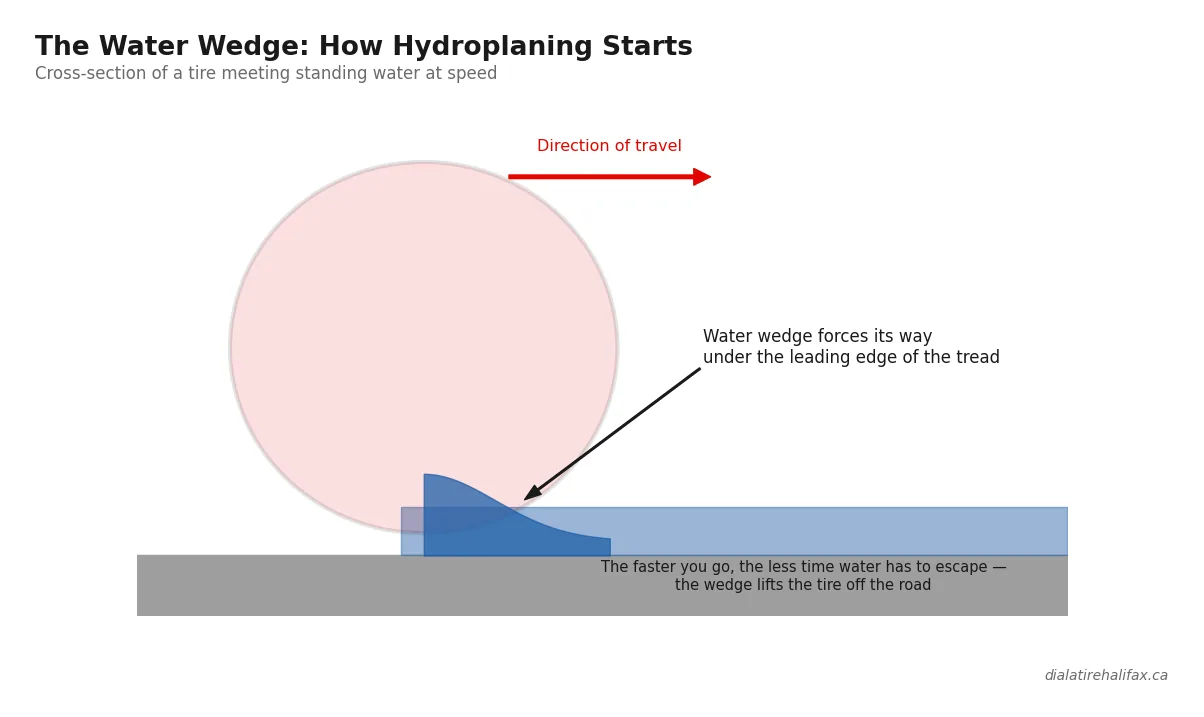
Water, unlike air, is virtually incompressible — it cannot simply be squeezed away. Once the hydrodynamic pressure in the wedge equals the contact pressure pushing the tire down, the tire lifts. That lift zone grows backward as speed increases further until the entire contact patch is airborne and the tire spins freely on a water film that may be less than a millimetre thick. Research by the United States National Aeronautics and Space Administration (NASA), originally conducted for wet-runway aircraft safety in the 1960s and 1970s, showed that hydroplaning onset speed is not fixed for all tires — it depends heavily on inflation pressure and tread depth.
The Speed and Tread Depth That Define Your Risk
Tread depth is the single largest variable under a driver’s control. A tire’s grooves are a precision drainage system, not decoration — a tire in good condition can move several litres of water out of the way every second at highway speed — premium designs claim far more, and that flow rate drops sharply as grooves wear down.
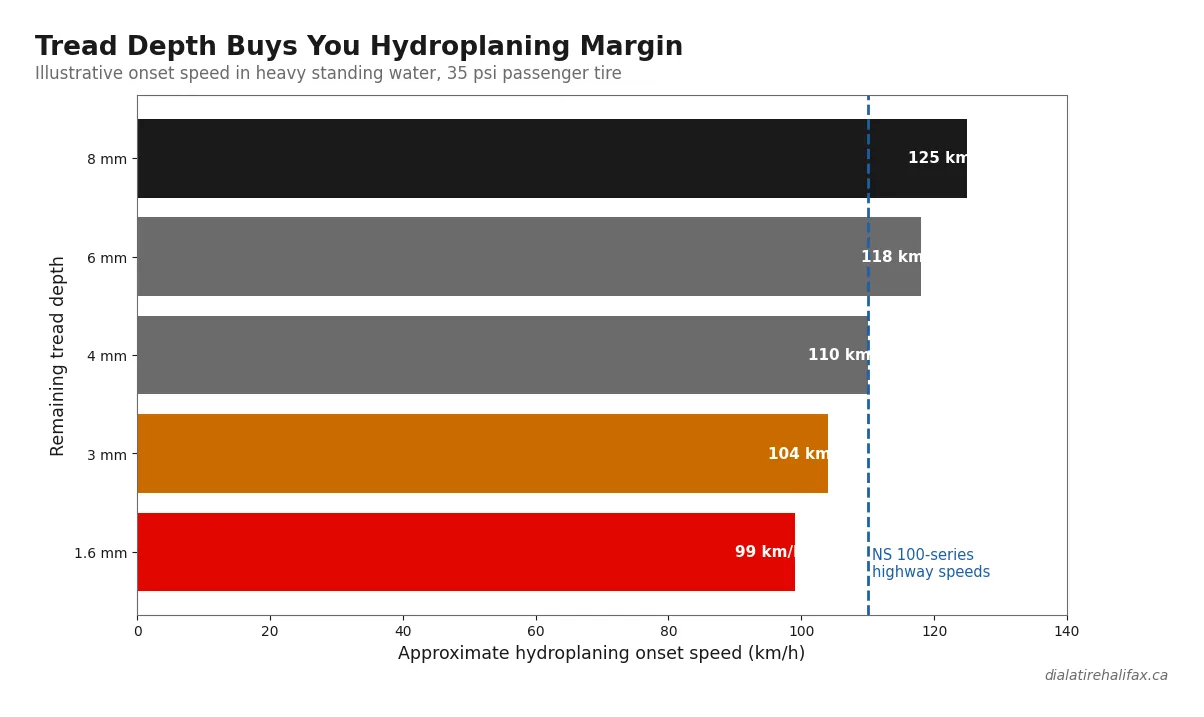
New passenger tires typically leave the factory with 8–10 mm of tread depth. The legal minimum in Nova Scotia — and across Canada under Transport Canada motor vehicle safety regulations — is 1.6 mm. But the real-world hydroplane risk climbs steeply well before the legal limit. At 2–3 mm, a tire’s ability to channel water is substantially compromised. Many tire engineers treat 4 mm as the practical wet-weather safety threshold, particularly at highway speeds. At 60 km/h a tire with decent tread manages most Halifax road water. At 90 km/h on a worn tire, moderate rain on the 101 westbound through Windsor can initiate full hydroplaning. At 110 km/h, the margin disappears almost entirely.
🔧 Engineering Corner
The NASA-derived rule of thumb for hydroplaning onset speed is: V ≈ 16.7 × √P, where V is the hydroplaning onset speed in kilometres per hour and P is tire inflation pressure in pounds per square inch (psi). For a typical passenger car tire inflated to 35 psi, that works out to roughly 99 km/h — derived from NASA aviation research on smooth tires over standing water. Real tread raises that threshold, which is exactly why tread depth matters so much.
What Happens to Your Car When Hydroplaning Begins
The steering wheel goes unusually light and unresponsive. Engine revs may rise slightly as driven wheels spin without road resistance. The car may continue roughly straight, or it may drift toward the edge of the lane. What is happening is that the tire’s slip angle — the small angular difference between where the tire points and where the car is actually going — has become meaningless. On a water film there is no meaningful friction, so steering input goes unanswered until rubber meets road again.
Braking is equally compromised. Anti-lock Braking System (ABS) is designed to keep tires rotating at the threshold of maximum friction rather than locking and skidding. On a water film, that threshold is essentially zero. ABS will correctly keep the wheels turning, but stopping distance on a fully hydroplaning tire is dramatically longer than any wet-grip figure suggests.
What to Do If You Hydroplane
Every instinct says to do something — brake harder, steer into the skid, accelerate out of it. Every one of those inputs makes things worse. The correct response is to ease off the accelerator smoothly and completely, avoid stamping the brake, hold the steering wheel firmly without wrenching it, and let the tires find the road again as speed drops. The event is usually one to two seconds. Once you feel steering weight returning, apply gentle progressive braking.
Sudden inputs are dangerous because grip does not return evenly across all four patches at once. A sharp steering correction or a hard brake application at that moment can trigger a spin — often worse than the hydroplane itself. After any event, reduce speed before continuing. The road ahead still holds the same water.
Halifax Rain and Where the Risk Is Highest
Halifax’s topography — a peninsula draining into the harbour with older road infrastructure in the core — creates predictable wet-road problem spots. Barrington Street in the downtown core accumulates surface water quickly during heavy rain. The sections of the 102 and 104 between Windsor and Truro carry high speeds and develop the kind of rutted surface water that is hardest to see. The Armdale Roundabout sits at a low point that collects water from several directions.
Fall is the highest-risk season in Nova Scotia, because it combines heavy rainfall with leaf accumulation that blocks drainage and with the timing of seasonal tire changeovers. Drivers running all-season tires close to the wear limit — planning to replace them when they put on winter tires — are driving on their lowest-tread rubber at exactly the wettest time of year. If your tires are approaching 3–4 mm, the autumn rains are a compelling reason to act before waiting for the first snow. Our guide to winter tires vs. all-season tires in Nova Scotia covers the compound differences in detail.
The Role of Tire Pressure in Wet-Road Safety
Higher inflation pressure means higher contact pressure between tire and road, which requires more hydrodynamic lift to overcome. An underinflated tire has lower resistance to the water wedge — even if its tread depth is fine. The manufacturer’s specified pressure is on the sticker inside the driver’s door jamb (not the tire sidewall), and a tire running 10 pounds per square inch (psi) below that specification has meaningfully lower wet-road performance. Pressure also drops roughly one psi for every 5–6°C of cooling — a tire set correctly on a warm September afternoon can read 3–4 psi low on a cold October morning. Our guide to Tire Pressure Monitoring System (TPMS) warning lights explains how your car’s sensors track these changes and when to take the alert seriously.
Tread Patterns and Why They Are Engineered the Way They Are
A tire’s groove geometry is a precision drainage system. The four or five circumferential grooves carry the bulk of water away from the leading edge of the contact patch. Lateral sipes — fine cuts across the tread blocks — bite through the residual water film after the main grooves have acted. Angled shoulder channels let water exit sideways once routed out of the contact zone.
What wear removes is not just depth — it removes the precision geometry that makes the system work. A groove worn from 8 mm to 3 mm carries less than half the water volume and loses the sharp edge that slices through the residual film. The combination of reduced volume and rounded edges explains why wet-road performance deteriorates faster than a simple depth measurement suggests.
What This Means for Your Car
The practical take from all of this physics is straightforward. Check your tread depth before the autumn rains arrive — a quick check with a tread depth gauge or even a quarter coin is enough to know whether you are above or below 4 mm. If you are close to 1.6 mm — the legal minimum — on any tire, replace it before driving in wet conditions at highway speeds. Maintain the recommended inflation pressure year-round, not just at seasonal changeover. And if hydroplaning catches you off guard, ease off the throttle, hold the wheel steady, and let the tire find the road again before making any further input.
These are not complex interventions. The tire is the only part of your vehicle that touches the road, and in rain, its ability to maintain that contact is the difference between a routine drive and a serious incident. Halifax drivers put plenty of kilometres on hard, freeze-thaw roads — which means more time in the rain, more tread wear per season, and more reason to stay ahead of the maintenance curve.
If you are not sure where your tires stand heading into fall, our team can check tread depth and pressure at either location in a few minutes. It costs you nothing but the stop.
Ready to assess your tire condition before the next major rainstorm? Book an appointment online or call either location below. We also carry a wide selection of replacement tires if it turns out yours are due — browse our tire inventory or let us find the right fit for your vehicle and driving pattern.
HALIFAX — Dial A Tire
308 Herring Cove Rd, Halifax, NS
902-475-3358
BEDFORD — Dial A Tire
70 Rosno Lane, Bedford, NS
902-444-3425
Open daily 8 AM–5 PM. Please call before coming.
Locally owned since 1994 · Red Seal technicians · Professional installation & precision balancing