Dial A Tire Q&A #3 — We get these questions every summer from someone about to hitch up a trailer or load a roof box before a camping trip.
Summer in Halifax means Subarus with kayaks on the roof, minivans towing pop-up trailers to Kejimkujik, and station wagons loaded within inches of their rated capacity. In every case the tires are doing more work than the driver realises. The tire load index printed on your tire sidewall is the number that governs all of it — and most people have never looked at it.
Here are the five questions we hear most often when customers are planning a loaded summer trip.
What Does the Number Before the Speed Letter Mean?
That number is the tire’s load index — a standardised code that tells you the maximum weight the tire is designed to carry when properly inflated. You’ll find it on the sidewall as part of the tire’s size and rating string. A marking like 225/65R17 102H breaks down as: 225 mm section width, 65% aspect ratio, radial construction, 17-inch rim diameter, load index 102, speed rating H.
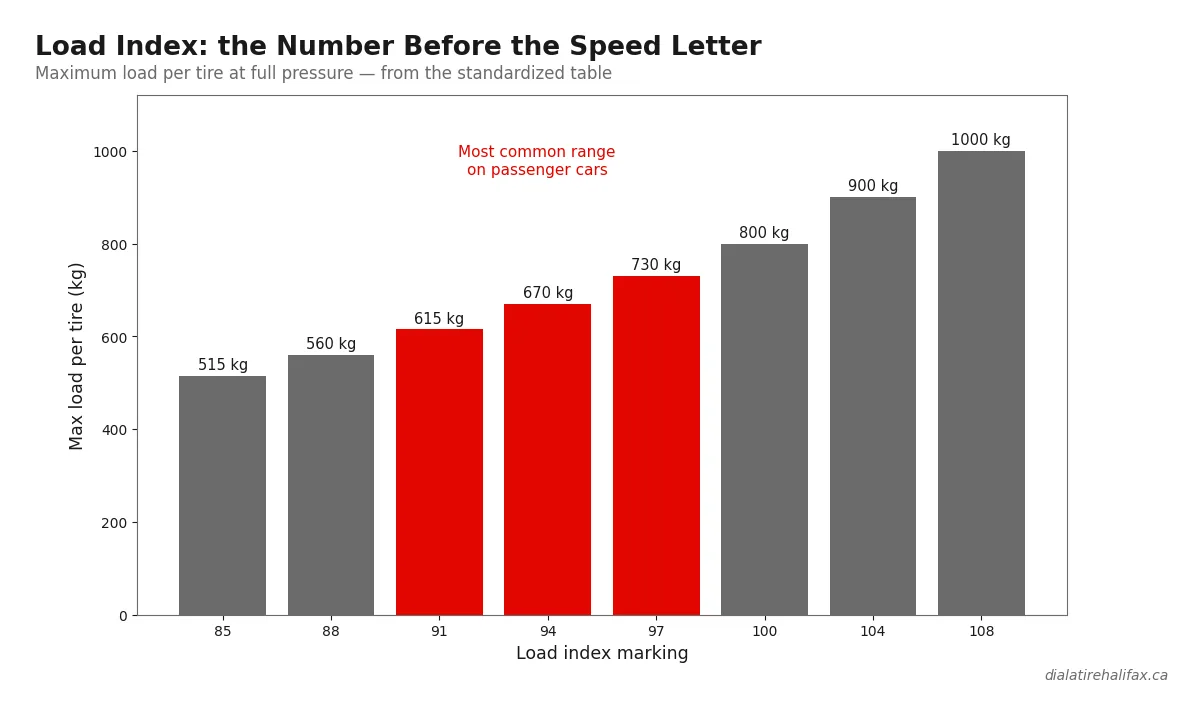
The load index is not a weight in kilograms — it’s a code number that maps to a specific weight from a standardised table. Common values: load index 91 = 615 kg, 97 = 730 kg, 102 = 850 kg, 107 = 975 kg, 112 = 1,120 kg. These are per-tire maximums at rated inflation pressure. You can multiply by four for a rough total capacity, but because weight distribution is uneven across the axles, the per-tire figure is what matters.
The Tire and Rubber Association of Canada (TRAC) publishes the complete load index table. Your vehicle’s Gross Vehicle Weight Rating (GVWR) and original tire size are on the door jamb sticker. Replacement tires must meet or exceed the original load index. Going lower is not acceptable even if the tire physically fits the wheel.
Four Adults Plus Camping Gear — Am I Overloaded?
Possibly — and it’s worth checking. Find your vehicle’s kerb weight (in the owner’s manual or on the door jamb sticker) and subtract it from the GVWR. The remainder is your payload capacity. A typical mid-size crossover has a payload of 450–600 kg. Four adults at 80 kg each is 320 kg; add camping gear, a cooler, and a roof rack and you’re very close to the limit, or past it. We see this regularly — a lot of vehicles heading to Cape Breton for the summer are running near capacity without the driver realising it.
Near the GVWR, tires run at their design edge and heat builds faster with every revolution. This is why your door jamb sticker has a separate “full load” inflation pressure — use it. If you’re unsure which column applies, use the higher figure. You won’t over-inflate a tire by following the manufacturer’s full-load spec.
For the full pre-departure routine, our Atlantic Canada road trip tire checklist covers every check including load-adjusted pressures.
Does a Roof Box Change Anything?
Yes, in two ways. First, a roof box raises the centre of gravity, increasing lateral forces on the tires during cornering. The tires aren’t carrying more vertical weight, but they’re working harder resisting body roll — which is why roof box manufacturers specify maximum speeds (typically 130 km/h, above any Nova Scotia highway limit) and why the box should come off when not in use.
Second, the box and its contents count against your payload. A loaded roof box typically adds 30–60 kg. Many vehicles have a maximum roof load rating of 75–100 kg including the rack itself — a loaded box of camping gear can reach that surprisingly quickly. Check the roof load rating in your owner’s manual separately from the total payload.
With a loaded roof box: use the full-load tire pressures, keep speeds reasonable, and confirm you’re inside both limits. If you’re unsure whether your tires are the right load index for how you use the vehicle, bring it in and we’ll check the sidewall markings against your spec.
Do I Need Different Pressure When Towing?
For the tow vehicle: use the full-load pressure from the door jamb sticker. Towing puts the rear axle under significantly more load — the trailer tongue weight plus towing resistance — and higher rear pressure reduces the flexing that generates heat.
For the trailer’s tires, the answer comes from the trailer manufacturer, not the tow vehicle door jamb. Trailer tires are marked “ST” (Special Trailer) and are built differently from passenger tires for the specific load and flexing patterns of a towed axle. The pressure spec is usually on a sticker on the trailer frame or in the owner’s manual. Most ST-rated tires run 50–65 pounds per square inch (psi) — higher than passenger tires. Check them cold before every tow. Trailer tires sit unused for months and lose pressure from natural permeation through the rubber.
If you’re buying tires for your trailer or tow vehicle in Halifax, we can confirm the correct load index and pressure spec before you go.
What Does Overloading Actually Do to a Tire?
Two things happen, and both are bad.
First: excessive flexing. An overloaded tire bends more with each revolution than its rubber and internal cord structure were engineered for. That repeated flexing generates heat deep inside the tire body — through the layers of rubber, fabric, and steel. Internal heat degrades the rubber compounds and can cause the cords to delaminate from the surrounding rubber. When cords separate, you get a blowout — sudden and complete, not a slow leak. At highway speeds that’s a serious safety event.
Second: distorted contact patch geometry. The contact patch is the small area of tire actually touching the road — roughly the size of your hand per corner. An overloaded tire has a patch that’s stretched wider and shorter than designed, concentrating wear in the tread centre and reducing the tire’s ability to channel water. Hydroplaning risk rises, cornering grip drops, and braking distances increase.
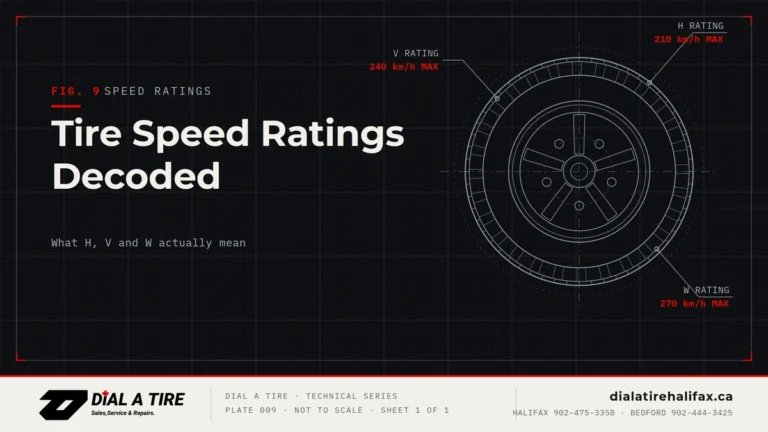
We see the results in wear patterns: rapid centre wear and small cracks at the base of tread blocks. By the time those are visible, the damage is done. Our sidewall markings guide explains how to read the load index and speed rating codes so you can check any tire against your vehicle’s requirements.
What This Means for Your Summer Plans
Towing, loading a roof box, and packing the family car are exactly what your vehicle and tires are designed for. The key is using the load correctly: right pressure for the weight, right load index for the vehicle, right speed for the conditions. If you tow regularly or run a loaded roof box through multiple seasons and you’re unsure whether your tires are the right spec, bring the car in. We’ll check the sidewall ratings against your door jamb spec — it takes five minutes.
Questions about load ratings or tire specs? Book an appointment at our Halifax or Bedford location — we’re open every day and happy to look at what you’ve got before you head out.
HALIFAX — Dial A Tire
308 Herring Cove Rd, Halifax, NS
902-475-3358
BEDFORD — Dial A Tire
70 Rosno Lane, Bedford, NS
902-444-3425
Open daily 8 AM–5 PM. Please call before coming.
Locally owned since 1994 · Red Seal technicians · Professional installation & precision balancing