July in Halifax: the pavement on Robie Street is shimmering, you’ve just driven back from the Valley, and a yellow light pops up on your dashboard. Or maybe someone at a backyard gathering tells you to let a bit of air out of your tires on a hot day. Summer raises more tire pressure questions than any other season, and some of the common answers floating around are genuinely dangerous.
We hear these questions weekly in the shop. Here are five of the most common ones — answered straight, with the physics to back it up.
Why does my Tire Pressure Monitoring System (TPMS) warning light come on after a hot drive?
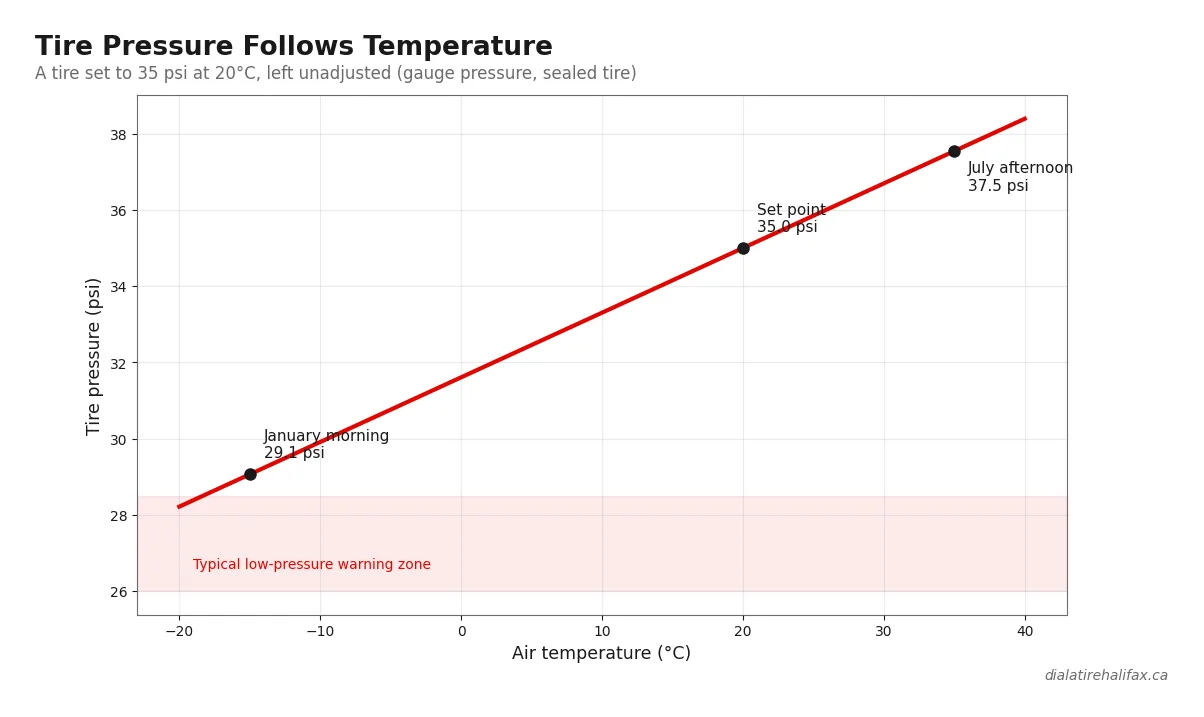
The most likely explanation is that your tires were already slightly low before you drove, and the heat exposed the shortfall. Here’s what happens: a Tire Pressure Monitoring System (TPMS) triggers a warning when pressure drops roughly 25 per cent below the vehicle manufacturer’s recommended cold inflation pressure. On a cool morning your tires may be borderline — close enough to the threshold that the warning doesn’t appear. Then you drive for an hour on summer highways. Tire pressure increases with temperature (roughly 1 pounds per square inch (psi) for every 5–6°C rise in air temperature), so your tires actually gain pressure during the drive. The TPMS is not warning you that pressure got too high — it’s warning you that when it re-evaluates pressure at operating temperature against its thresholds, the calibration reveals the pre-existing under-inflation.
A less common but real scenario: your TPMS sensors have a battery life of roughly 5–10 years. An aging sensor can send erratic readings, particularly when temperature swings are large. If the warning appears and disappears inconsistently, and your tires inflate to spec properly, have the sensors checked.
The right response when the TPMS light comes on after a hot drive: let the car cool for at least three hours, then check pressure cold against the placard on the driver’s door jamb (not the number moulded into the tire sidewall, which is a maximum, not a target). If the tires are low, inflate to spec. If they’re at spec and the light persists, have the sensors diagnosed. Our post on what the TPMS warning light means and what to do about it goes deeper on the sensor side.
Pavement is 50°C in July — does that actually hurt my tires?
Hot pavement does add thermal load to your tires, but properly inflated tires in good condition handle it without damage. The concern is real but often overstated for normal driving. Here’s the nuance.
Asphalt in a Halifax summer can reach surface temperatures of 50°C or higher on a hot afternoon. The tire’s contact patch — the section in direct contact with the road — absorbs heat conductively from the pavement and also generates its own heat through the flexing of the sidewall and tread as the tire rotates (the hysteresis we discussed in our post on tire rubber chemistry). Under normal driving conditions, the heat the tire generates and absorbs is within design parameters for any tire in good condition.
Where hot pavement becomes a genuine risk is when it combines with other factors: significantly underinflated tires (which flex more and generate more heat), very high speeds sustained over long distances, or tires that are already aged and have lost some of their heat-dissipating oils. If you’re driving to Cape Breton on a hot day with tires that are 10 psi low, the sustained thermal load is real and the risk of a heat-related failure — blistering, delamination, or in extreme cases a blowout — goes up significantly.
The practical answer: keep your tires properly inflated and you don’t need to worry about summer pavement temperatures in normal Nova Scotia driving. The pavement temperature is not a variable you control; the inflation pressure is.
Should I let air OUT of my hot tires to reduce pressure?
No. Do not bleed air from hot tires. This is one of the most persistent and harmful tire myths we encounter, and we want to put it to rest clearly.
The premise sounds logical: if pressure rises with heat, shouldn’t you release some to bring it back down? But the logic is backwards. The pressure rise you’re seeing in a hot tire is not a problem — it’s the tire working exactly as designed. Tire engineers specify cold inflation pressures knowing that pressure will rise during driving. The operating pressure (hot) is already factored into the tire’s load capacity, heat management, and handling behaviour. When the car manufacturer specifies 32 psi cold, they expect the tire to run at perhaps 36–38 psi during a highway drive on a summer day. That’s normal and correct.
If you bleed air from a hot tire to bring it back to 32 psi, you have now set the cold pressure significantly below spec — likely to 27–28 psi or lower. When the tire cools, it will sit at that dangerously low pressure. An underinflated tire flexes more with each rotation, generating excess heat, wearing the tread edges unevenly, and — at the extreme — risking a heat-related structural failure. You’ve taken a healthy tire and turned it into a liability.
The rule is simple and absolute: always check and set tire pressure cold. Cold means the vehicle has been parked for at least three hours, or driven less than two kilometres. If you check pressure on a hot tire and the reading is higher than your cold spec, that is correct — leave it alone.
Is 120 km/h on the highway harder on tires than city driving?
Yes, in specific ways — though “harder” needs unpacking.
Highway driving generates more sustained heat than city driving. At 120 kilometres per hour, the tire’s sidewall flexes roughly twice per second per revolution of the wheel, and that flexing rate generates heat continuously for as long as you hold that speed. City driving involves more frequent stopping and starting, but each stint at speed is short and the tire cools somewhat during low-speed manoeuvring. The net thermal load over a two-hour highway run can exceed a two-hour city drive of the same distance.
However, highway driving is generally gentler on tire wear than city driving. The continuous rolling at steady speed produces even, low-stress wear. City driving involves frequent hard acceleration, braking, turning, and the occasional curb encounter — all of which wear tires faster and unevenly. Halifax’s mix of city and highway driving (short winter trips around HRM, highway runs to the Valley) represents a mix that most tire designs are built to handle comfortably.
The speed rating on your tire is the relevant specification for highway use. A tire rated H (210 km/h sustained) or higher is designed with the compound and construction to manage the heat of Nova Scotia highway speeds indefinitely. If you’re driving a tire rated S (180 km/h), you’re technically within the sustained speed rating at 120 km/h, but the thermal margin is narrower. On a hot day with a loaded vehicle, a higher-rated tire provides more thermal headroom. We cover how to read your tire’s sidewall markings including the speed rating in detail in our tire size guide.
How often should I check tire pressure in summer?
Once a month, cold, is the correct answer — and summer is when it matters most.
Tires lose approximately 1–2 psi per month through normal permeation of air through the rubber, even with no puncture or damage. In summer, the larger temperature swings between morning and afternoon make it harder to track whether pressure loss is from permeation or from temperature change, so regular cold checks are the only reliable method. The morning of a long road trip, before you load the car, is an ideal moment — pressure is cold, you can adjust for the loaded-vehicle setting if your door jamb placard specifies one, and you catch any slow leak before you’re committed to the highway.
Check all four tires, and check the spare while you’re at it. A flat spare discovered at the side of the road is entirely avoidable. The correct pressure for your vehicle is on the driver’s door jamb placard — not 35 psi because that’s what someone told you, not the maximum moulded into the tire sidewall, which is a structural limit that has nothing to do with your vehicle’s recommended operating pressure.
A few minutes once a month is the single easiest tire maintenance task. It costs nothing, takes under five minutes with a decent gauge, and has a direct effect on fuel consumption, tire wear life, and safety. Natural Resources Canada data consistently links correct inflation to measurable fuel savings — worth revisiting if you want the full physics behind why pressure and temperature interact the way they do.
If your tires are losing pressure faster than 1–2 psi per month, or if you’re repeatedly finding one tire low while the others hold, come in and let us check for a slow leak. A nail or valve stem issue caught early is a quick fix; the same nail found after a blowout at highway speed is not.
Questions about your tire pressure or summer driving? Both our Halifax and Bedford shops are open daily, and a pressure check takes minutes. If you’re due for a tire service or changeover, or want to book an appointment online, we’re ready to help.
HALIFAX — Dial A Tire
308 Herring Cove Rd, Halifax, NS
902-475-3358
BEDFORD — Dial A Tire
70 Rosno Lane, Bedford, NS
902-444-3425
Open daily 8 AM–5 PM. Please call before coming.
Locally owned since 1994 · Red Seal technicians · Professional installation & precision balancing