Dial A Tire Q&A #4
Halifax roads are generous with sharp objects (pothole debris, construction screws, the occasional roofing nail) and we handle flat tire repairs at both locations every single week. The questions customers ask at the counter are, in our experience, almost always the same five, so here they are with straight answers.
The short version: a nail in the tread does not automatically mean a new tire, but it doesn’t automatically mean a quick plug either. Whether a flat tire is safely repairable depends on where the puncture is, how big it is, and what kind of repair gets done.
Nail in My Tire. Drive to the Shop or Call a Tow?
If the tire still holds air and the nail or screw is still embedded in the tread, you can drive carefully to a shop, but do it promptly and keep speeds low. The fastener is actually acting as a temporary plug, slowing the air loss. Leave it in. Pull it out and you may have minutes of air rather than a slow overnight leak. Removal is the shop’s job, with the repair ready to go.
We see this situation regularly. Someone notices the nail on a Monday morning in their driveway in Spryfield, checks the pressure, finds it’s only lost a few pounds per square inch (psi) overnight, and drives in. That’s usually fine. What isn’t fine is continuing to drive on it for days. Even a slow leak cycles you through underinflation, which stresses the sidewall, generates heat, and can turn a repairable puncture into an irreparable one.
Call a tow if any of these apply: the tire is visibly flat or very low (below roughly 15 psi), you can hear or feel rapid air loss, you are on a highway, or the object is in the sidewall. Driving on a severely underinflated tire at highway speed can destroy the tire’s internal structure within a kilometre. Turning a simple repair into a full replacement. If you have a spare and know how to use it safely, fitting it roadside is also a perfectly good option for getting to the shop under your own power.
Can Every Puncture Be Fixed?
No, and understanding the limits can save you from being talked into a repair that isn’t safe, or from buying a new tire you don’t actually need.
The repairable zone, under the industry repair guidelines distributed in Canada by the Tire and Rubber Association of Canada (TRAC), is the central tread area only. A puncture is potentially repairable when it meets all of these conditions:
- Located in the central tread zone, not the shoulder and definitely not the sidewall
- No larger than 6 mm in diameter
- The tire has not been run flat (driven significantly while completely deflated)
- There is no secondary damage. No cracking, no belt separation, no sidewall deformation
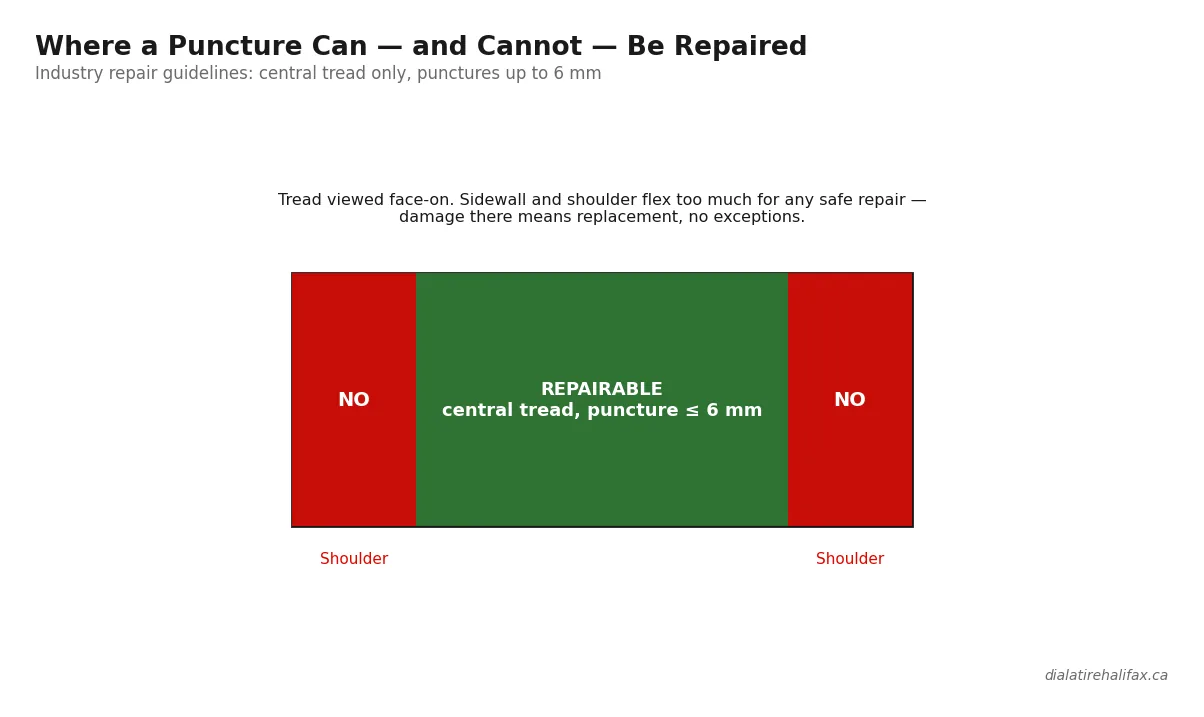
Sidewall and shoulder punctures are not repairable, full stop. The sidewall flexes with every revolution of the wheel — several hundred times per kilometre. Any repair in that zone would be subjected to constant bending stress and would eventually fail. The same applies to the shoulder, where the tread transitions into the sidewall. These areas are also the thinnest parts of the tire structure, with less rubber over the cords.
If a puncture is right on the edge of the repairable zone and our technician is not confident it’s clearly within the tread, we will say so. A borderline repair that fails on the 104 is not a service we are willing to provide.
Are Plug Kits from the Parts Store OK?
They are an emergency roadside tool, not a permanent repair.
The string plug kits sold at automotive parts stores are designed to get you from the shoulder of the road to a proper shop. The process involves reaming the hole and forcing in a sticky rubber string from outside the tire, without removing the tire from the wheel. It can hold air indefinitely in some cases, which creates a false sense of security. The problem is that you cannot inspect the inside of the tire without dismounting it, and the plug alone does not seal the inner liner properly or address any secondary damage the puncture may have caused.
A professional repair (the only kind we perform) is a combination plug-and-patch applied from inside the tire after it has been dismounted, inspected internally, and the damaged area cleaned and buffed. The plug fills the puncture channel and the patch seals the inner liner. That two-piece repair is what industry repair guidelines, distributed in Canada by the Tire and Rubber Association of Canada (TRAC), specify as the correct method. It is structurally sound and meant to last the life of the tire.
If you used a roadside plug kit to get yourself to the shop, that is exactly what it’s for, and well done. But please tell the technician. We will dismount the tire, inspect the inside, and either convert it to a proper repair or tell you if the puncture is not suitable for one.
Sealant Cans. Yes or No?
Many vehicles come from the factory with an aerosol sealant can instead of a spare tire. In a genuine roadside emergency it beats being stranded, but there is a caveat most people don’t know about: the sealant coats the inside of the tire and, critically, the Tire Pressure Monitoring System (TPMS) sensor mounted on your wheel. Sealant can clog the sensor’s pressure port or destroy it entirely. A costly fix.
If you use a sealant can, tell the shop immediately. It is not a structural repair; the tire still needs to come off for a proper internal inspection and the sealant cleaned out. Drive slowly (the label specifies a maximum speed and distance), and call ahead so we know what’s coming.
When Is Replacement Non-Negotiable?
Several situations mean the tire cannot be repaired and replacement is the only safe course. We will always explain which applies and why.
Run-flat damage. If the tire was driven significantly while flat, the sidewall may have folded repeatedly under load, cracking the internal cords and separating the belt from the carcass. This damage is invisible from outside. Once a tire has been run flat, replacement is required.
Sidewall or shoulder puncture. As covered above, not repairable by any legitimate method.
Large puncture. Anything over 6 mm or a jagged tear is beyond repair.
Multiple punctures. Punctures close together, or repairs that would overlap, generally mean the tire should be replaced. With more than one puncture we assess the number and spacing before agreeing to repair.
Worn or aged tires. If the tire is worn to 2/32″ (1.6 mm) or less (the Nova Scotia vehicle-inspection minimum) there is no value in repairing it. Tires over ten years old, or showing significant sidewall cracking, should also be replaced. The manufacture date is moulded into the sidewall as the last four digits of the Department of Transportation (DOT) code: week then year. A tire reading 2419 was made in the 24th week of 2019.
What This Means for Your Car
A flat tire is stressful, especially when it happens at an inconvenient moment. The main things to remember:
- If the nail is still in and the tire holds air, drive slowly and directly to a shop. Do not pull the nail out yourself.
- A proper repair is a plug-and-patch from inside, not a string plug from outside.
- Sidewall and shoulder punctures are never repairable. A shop that offers to patch a sidewall is not one you want to use.
- Sealant cans are emergency-only tools; tell the shop you used one so the TPMS sensor can be inspected.
- When replacement is required, ask about matching the remaining tires for consistent handling, especially on all-wheel-drive vehicles, where tread depth differences between axles can stress the drivetrain.
Dealing with a flat right now, or want a second opinion on whether your tire is repairable? Book an appointment or call either location. We’ll inspect it, give you a straight answer, and get you back on the road. Our tire rotation guide explains how routine rotations also surface slow leaks and developing wear before they become emergencies.
HALIFAX — Dial A Tire
308 Herring Cove Rd, Halifax, NS
902-475-3358
BEDFORD — Dial A Tire
70 Rosno Lane, Bedford, NS
902-444-3425
Open daily 8 AM–5 PM. Please call before coming.
Locally owned since 1994 · Red Seal technicians · Professional installation & precision balancing