
Your car talks. It does so through vibration in the steering wheel, hums that rise and fall with speed, thumps that show up on cold mornings, and squeals that appear out of nowhere in a parking lot. In the trade, the whole category has a name: Noise, Vibration, and Harshness (NVH). Understanding the language takes time, but some of the most common messages translate pretty directly, and knowing the difference between “book this week” and “pull over right now” is genuinely useful.
We field NVH questions in the shop constantly, and the same half-dozen symptoms come up again and again from Halifax and Bedford drivers. Here are the ones we hear most often, along with what we actually look for when a car comes in with each complaint.
My steering wheel shakes at 110 km/h. What is it?
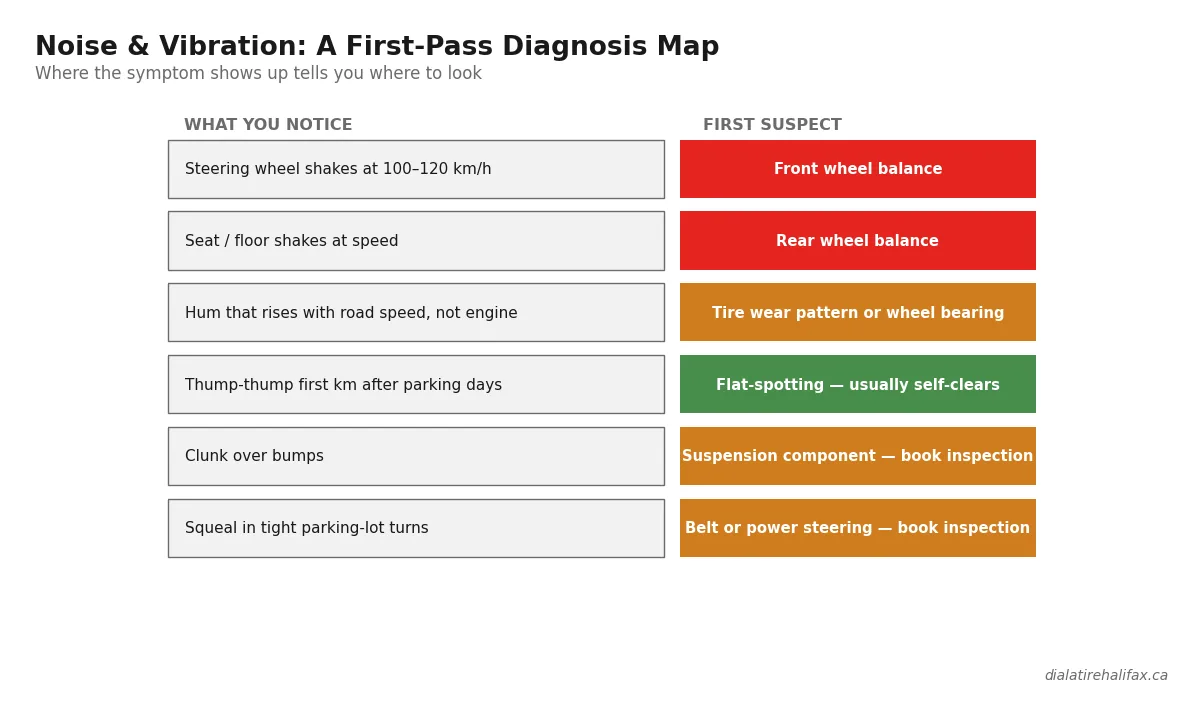
Steering-wheel vibration that appears at a specific highway speed band (most commonly 100–120 km/h) and then settles or worsens as speed changes is the classic symptom of a wheel balance issue. We see this weekly in the shop. One or more wheels has a small mass imbalance: a weight shifted, corroded off, or never quite right from the start. At lower speeds the effect is minor. As rotational speed rises, that small imbalance generates a force that cycles through the steering with every wheel revolution — well over a dozen times per second at highway speed. You feel it as a buzz or shake in the wheel.
Why 110 km/h specifically? A common explanation is resonance: the vibration tends to peak when the imbalance frequency comes close to a natural frequency of the front suspension. It will often reduce if you go faster or slower than that band, which confuses some drivers into thinking the problem has gone away.
A second possibility at similar speed ranges: a tire with a flat spot or out-of-round condition from a hard impact. In those cases, balancing alone may not fix it. We can inspect for bent wheels, tire damage, and other causes before recommending the next step.
If the shaking comes from the seat and floor rather than the steering wheel, the imbalance is more likely in the rear wheels. Our post on tire balancing vs wheel alignment explains how to read those distinctions in more detail.
The fix is usually a precision balance service at the shop. It is one of the more satisfying jobs. The car comes back feeling like new on the highway.
There’s a hum that changes with my speed but not with engine revs. What does that mean?
A hum that tracks vehicle speed rather than engine speed — one that rises when you accelerate and drops when you lift off, but stays constant if you coast at the same speed in neutral — is not coming from your engine or transmission. The noise source is rotating at wheel speed, not engine speed. That points to two main candidates: tires or a wheel bearing.
Tire hum is normal to a degree. Aggressive tread patterns, worn tires, or tires that have developed uneven wear (feathering, cupping) produce noticeably more noise than a new set of highway-oriented tires. If the hum appeared gradually as your tires aged, or if it showed up after a new set of winter tires, it is probably tread noise. Cupped tires (where the tread develops a scalloped, uneven wear pattern) are a common culprit and often point to worn shock absorbers or struts.
A wheel bearing hum has a different character. It tends to be more of a growl than a hum, and it often changes pitch when you gently swerve the car. Changing lanes on the highway works well for this test. When you load the bearing differently by turning, the noise shifts. A bad right-front bearing typically gets louder when you swerve left (loading that side) and quieter when you swerve right.
Tire noise is inconvenient but usually not urgent unless the tires are worn. A failing wheel bearing is a different matter. It will get worse, and a bearing that fails completely can cause serious handling issues. Have it diagnosed sooner rather than later.
There’s a thump-thump sound for the first minute after my car has sat a week. Is that serious?
Almost certainly not. What you are describing is flat-spotting, and it is a completely normal characteristic of rubber tires. When a car sits stationary for several days (particularly in cool weather, which Halifax provides abundantly) the section of tire resting on the pavement takes a slight set. The rubber in the contact patch cools and conforms to the flat road surface. When you first drive away, that momentarily flat-ish section of tire thunks against the road once per revolution until the rubber warms up and returns to its normal round shape.
Modern tires are less susceptible to this than older ones, and it resolves within a kilometre or two in most cases. If the thumping continues for several minutes or never fully goes away, that points to something else, possibly a steel belt shift inside the tire, or a tire that was run significantly underinflated for an extended period and has taken on a permanent deformation. In those cases the tire may need replacement.
Premium winter tires with softer compounds can flat-spot more noticeably when the car sits in very cold temperatures. This is normal behaviour. If the thump disappears completely after a short warm-up, you can stop worrying about it.
My car squeals when I’m turning slowly. What causes that?
A squeal when turning at low speed (in a parking lot or a tight driveway turn) can come from several places. A squeal that varies with steering angle often points to the power steering system: low fluid in an older hydraulic system, or a fault in an electric system. A chirp from the front tires on dry pavement during a slow turn can be normal — just the rubber slipping slightly in a tight manoeuvre. If it happens consistently and seems to come from a wheel rather than the steering column, it may indicate a binding brake caliper dragging as the suspension geometry shifts through the turn.
Any squeal accompanied by a pulling sensation, or that sounds like it is coming directly from a brake, should be diagnosed without delay. Our brake repair service covers caliper inspection and replacement along with pads and rotors.
When is a noise an emergency versus something I can book this week?
This is the most important question in Noise, Vibration, and Harshness (NVH) diagnosis. Here is how we sort it.
Pull over immediately or do not drive: loud grinding or clunking from a wheel; steering that suddenly pulls hard to one side; vibration that appears abruptly at normal speeds; any brake noise paired with increased stopping distance or a pedal heading toward the floor.
Book today or tomorrow: a new, consistent metallic squeal from the brakes (wear indicators telling you the pads are low); a hum that has been growing louder over weeks (bearing wear that will progress); any noise after a hard pothole impact. Halifax potholes in March are severe enough to crack wheels, bend tie rods, or damage struts.
Book this week when convenient: highway vibration at a consistent speed band that has been stable (likely a balance weight); occasional flat-spot thump on cold mornings (normal); tread noise from tires you already knew were aging out.
When in doubt, call us. An experienced technician can give you a reasonable read on urgency from a description alone. NVH complaints spike here every February through May. We expect it.
Book an Inspection at Dial A Tire
If your car is telling you something you cannot identify, bring it in. Our Red Seal technicians can diagnose NVH concerns across the full range: tires, wheel balance, bearings, brakes, and suspension components. You can book an appointment online at either location, or call us directly.
HALIFAX — Dial A Tire
308 Herring Cove Rd, Halifax, NS
902-475-3358
BEDFORD — Dial A Tire
70 Rosno Lane, Bedford, NS
902-444-3425
Open daily 8 AM–5 PM. Please call before coming.
Locally owned since 1994 · Red Seal technicians · Professional installation & precision balancing