Every time you drive down Herring Cove Road, merge onto the 102, or brake for a light on Bayers Road, the only things standing between you and the pavement are four patches of rubber roughly the size of a paperback book cover. That rubber (the tire rubber compound) is the product of decades of polymer chemistry, materials science, and competitive motorsport research. Most drivers never think about it. A few basics about how it works make every other tire decision easier to understand.
This post is the first in our engineering series. It is not a buying guide or a brand comparison. It is the background for the decisions that follow: why winter tires work when all-seasons don’t, why a worn tire is dangerous even if there’s plenty of tread left, and why heat is the quiet enemy of every set of tires on Halifax roads.
We’ve drawn on Paul Haney’s The Racing & High-Performance Tire. It is a respected plain-language treatment of tire science, and this article adapts its core ideas (along with established tire-engineering principles) for everyday drivers. Here’s how it works.
Why Rubber Grips: Two Mechanisms Working Together
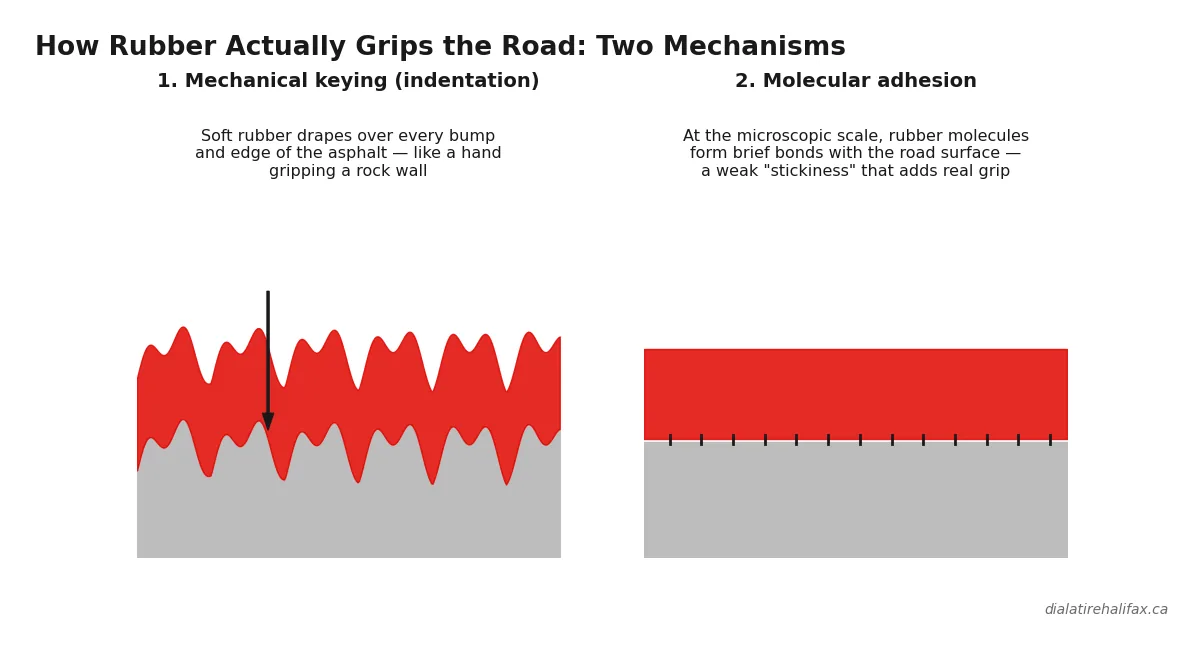
Tire grip comes from two separate physical mechanisms, and understanding both explains almost everything else about tire behaviour. The first is mechanical interlocking. Rubber is soft enough to deform around the microscopic peaks and valleys of the road surface, creating a vastly larger true contact area than the apparent footprint suggests. The second is molecular adhesion. Short-range intermolecular forces (van der Waals forces) act across the interface between rubber and road, contributing meaningfully to grip especially at low sliding speeds.
These two mechanisms don’t peak at the same conditions. Mechanical interlocking favours a softer, more deformable compound, one that flows into road texture readily. Adhesion favours a compound that is chemically “sticky” at the molecular level. Compound engineers are constantly balancing both, plus a third constraint: the compound must not wear away too quickly. Softer compounds that grip well tend to abrade faster. This trade-off (grip versus wear versus heat resistance) is the central tension in every tire compound ever made.
One important nuance: rubber grip is not simply friction in the classical physics sense. Classical friction is independent of contact area (Amontons’ laws). Rubber friction is area-dependent, speed-dependent, and temperature-dependent. A tire compound that grips well at 20°C may grip poorly at minus 15°C or at 80°C. This is why no single compound works well across all conditions, and why the “all-season” compromise exists and has real limits, as we’ll get to below.
Viscoelasticity: Why Rubber Is Neither Solid Nor Liquid
The word that unlocks tire science is viscoelastic. Materials can be elastic, springing back instantly after deformation like a steel spring, or viscous, flowing and dissipating energy like honey. Rubber is both, simultaneously, depending on how fast you deform it.
Deform rubber slowly and it behaves mostly elastically. It springs back. Deform it quickly and the polymer chains don’t have time to rearrange; the material resists, heats up, and some energy is lost as heat rather than returned as spring force. This energy loss is called hysteresis. Hysteresis is both the enemy and the ally of tire engineers: it’s what creates grip on a rough road (the rubber deforms, loses energy, grips), and it’s what generates heat inside a tire under sustained load (that heat is the enemy).
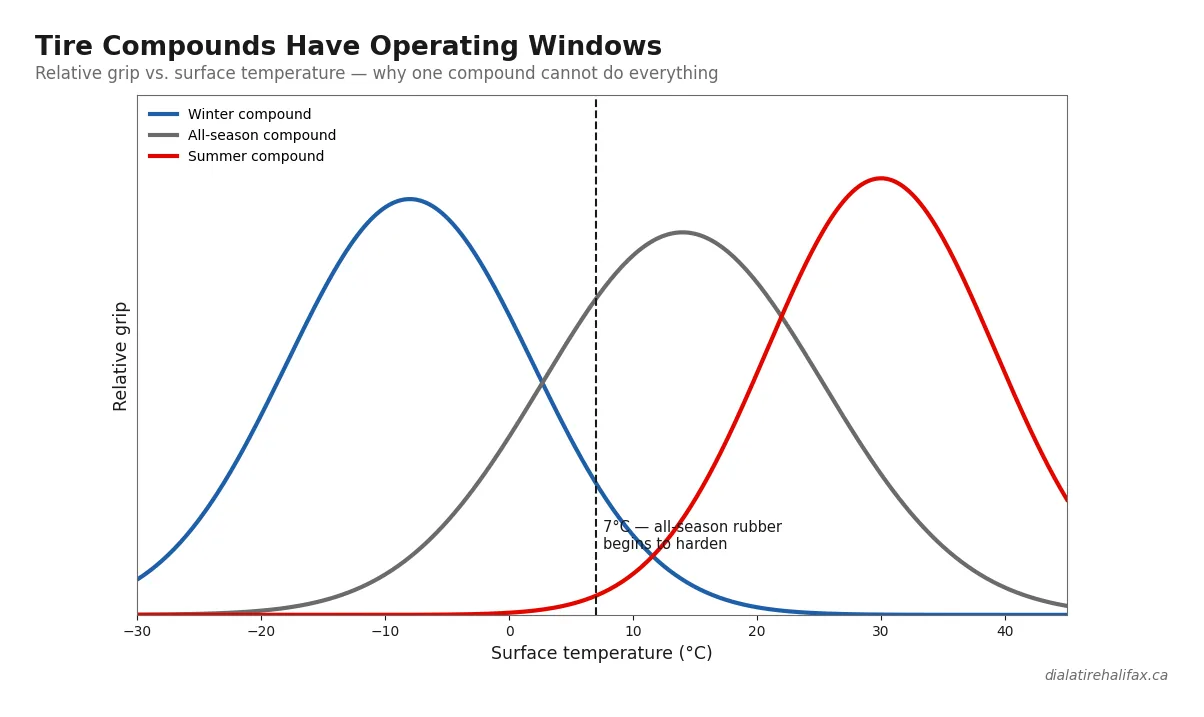
The key engineering parameter is the glass transition temperature (Tg). Below Tg, the polymer chains are essentially frozen in place. The rubber becomes hard and glassy, losing the ability to deform around road texture. Grip plummets. Winter compounds are formulated to stay flexible at substantially lower temperatures than all-season compounds, which in turn tolerate cold better than summer compounds. The exact glass-transition behaviour varies by manufacturer and formulation, because modern tread rubber is a blend of several polymers rather than one simple material. That ordering is why the industry rule of thumb says all-season rubber begins to stiffen noticeably as temperatures settle below about 7°C, and why so many Nova Scotia drivers run dedicated winter tires: the physics is real, not marketing.
What’s Actually in a Tire Compound
Modern tire rubber compounds are complex mixtures. The main ingredients, and what each does, are as follows.
Natural rubber (polyisoprene): Derived from the Hevea brasiliensis tree. Natural rubber has excellent tensile strength and tear resistance, which is why it still dominates in heavy-load applications like truck tires and in the specialized rubber compounds that coat and surround a passenger tire’s structural cords. It provides good low-temperature flexibility but softens quickly at high temperatures.
Synthetic rubbers, primarily Styrene-Butadiene Rubber (SBR) and Butadiene Rubber (BR): Styrene-Butadiene Rubber can be manufactured with a tunable styrene-to-butadiene ratio, which directly shifts the glass transition temperature. Higher styrene content raises Tg and improves grip at moderate temperatures; lower styrene content lowers Tg for winter performance. Butadiene Rubber improves wear resistance and low-temperature flexibility. Most compound formulations blend all three elastomers in proportions chosen for the tire’s intended climate and use case.
Carbon black: Added in large quantities (often 20–30 per cent of the compound by weight), carbon black reinforces the rubber matrix, dramatically improving tensile strength and abrasion resistance. It’s the reason most tires are black. Raw rubber is off-white. Carbon black improves wet grip somewhat but does relatively little to improve dry grip at lower temperatures.
Silica (silicon dioxide): The most significant compound innovation of the last 30 years. Silica filler, combined with a silane coupling agent that bonds silica particles to the polymer chains, achieves something carbon black cannot: it simultaneously improves wet grip and lowers rolling resistance. The mechanism involves better hysteresis at low temperatures (improving grip) while reducing unnecessary hysteresis at highway rolling frequencies (reducing heat and fuel consumption). The “green tire” revolution of the 1990s was built on silica technology. Today, all premium all-season and winter compounds use silica, and its proportion relative to carbon black is one of the key differentiators between budget and premium tires.
Plasticisers and oils: These lower the effective glass transition temperature and keep the compound pliable at low temperatures. Winter tire compounds use specialized low-temperature oils; summer compounds use different plasticiser systems chosen for heat resistance. As a tire ages, oxidation, heat exposure and gradual changes within the compound (including loss of some of these oils) stiffen the tread, which is one reason old tires lose performance even before they look worn.
Sulphur and vulcanisation accelerators: Vulcanisation is the cross-linking of polymer chains via sulphur bridges, converting raw rubber from a sticky, heat-sensitive material into the durable elastic solid you can mount on a wheel. The cross-link density (how tightly the polymer network is stitched together) has a large effect on hardness, heat resistance, and wear rate.
Summer, All-Season, and Winter Compounds: The Real Differences
Now that the chemistry makes sense, the performance differences between tire categories become predictable rather than mysterious.
Summer (performance) compounds are optimized for the temperature window of roughly 10°C to 50°C. They use compounds engineered for warm-weather grip, steering response and heat stability, paired with larger, stiffer tread blocks and minimal siping. Below 7°C they harden noticeably; below freezing they become genuinely dangerous. No one in Halifax should be running summer tires in October through April.
Winter compounds are engineered around cold performance. They use high proportions of butadiene rubber and specialized low-temperature plasticisers, with a Tg well below the coldest temperatures a Nova Scotia winter produces. The compound stays pliable and grippy where summer rubber would be hard as plastic. The trade-off is that winter compounds are softer, wear faster on warm pavement, and generate more heat under sustained high-speed running. Running winter tires through a Halifax summer will wear them significantly faster than the winter seasons will, one reason the spring changeover matters even if it’s still cold enough.
All-season compounds are an honest compromise. The compound engineers select a mid-range Tg (often around minus 10 to minus 15°C), blend natural rubber, SBR, and BR in balanced proportions, and use silica filler for year-round wet performance. The result is a tire that works adequately across a broad temperature range but is not optimal anywhere in the range. For a driver who logs modest kilometres in Halifax’s urban core and never needs to navigate a steep rural road after an ice storm, all-seasons may be adequate. For the many Nova Scotia drivers who run dedicated winter tires, the physics backs up that choice entirely.
All-weather tires, which carry the Three-Peak Mountain Snowflake (3PMSF) symbol indicating they’ve passed a standardized snow traction test, use a compound that tries to push the winter direction while retaining year-round usability. They’re a meaningful upgrade over all-seasons for cold-weather grip, at a cost in warm-weather wear rate. We’ll examine them in detail in a separate post.
Why Heat Is the Quiet Enemy of Your Tires
Heat degrades tire compounds in several ways, and the damage accumulates invisibly over the life of the tire.
At a molecular level, sustained heat accelerates oxidation of the polymer chains (a reaction with atmospheric oxygen), which increases cross-link density beyond the design target, making the compound harder and more brittle. It also drives out the plasticising oils that keep the compound flexible, permanently shifting the effective Tg upward. A tire that was soft and grippy at 7°C when new may feel noticeably harder at that temperature after five summers of regular use, even if the tread depth looks fine.
The practical result is that heat cycling (repeated heating and cooling over years of driving) ages tires regardless of how many kilometres they’ve covered. This is why tire age matters even for lightly-used tires. Many vehicle and tire manufacturers recommend careful annual inspection once a tire passes six years from its manufacture date, and replacement by about ten years regardless of remaining tread; check your tire maker’s guidance and your owner’s manual. The manufacture date is moulded into the sidewall as a four-digit code. The last four digits of the Tire Identification Number (TIN), where the first two digits are the week and the last two are the year (e.g., “2419” means week 24 of 2019).
On the road, sustained high-speed driving generates the most heat. At 120 kilometres per hour, the flexing frequency of the sidewall is high enough to generate substantial hysteretic heat in the compound. This is why speed ratings matter: a tire rated S (maximum sustained speed of 180 km/h in laboratory conditions) has less heat-resistant compound and construction than one rated V (240 km/h). The speed rating is partly a heat management specification as much as a performance one.
For Halifax drivers, the most common heat-related damage comes from a less dramatic source: sustained highway driving in summer on underinflated tires. An underinflated tire flexes more with each rotation. Its sidewalls work harder, generating more heat. The combination of Halifax’s freeze-thaw roads and plenty of short winter trips around HRM (Halifax, Bedford, Dartmouth, Sackville, Spryfield) and summer temperatures means that chronic underinflation shortens tire life measurably. Checking pressure monthly, and always cold (before the car has been driven more than a couple of kilometres), is the single most effective tire maintenance habit.
What the Tread Pattern Is Really Doing
The rubber compound determines the raw grip potential; the tread pattern determines how that grip is maintained in wet and contaminated conditions, and how heat is managed.
The circumferential grooves (the channels running around the tire) are the primary water evacuation channels. At speed in rain, the contact patch encounters water that must be displaced before rubber can touch road. The grooves channel water rearward and laterally; the lateral grooves and sipes complete the evacuation to the sides. A tire with adequate tread depth can evacuate several litres of water per second. A worn tire cannot, which is why wet grip and hydroplaning resistance decline steadily as tread wears, long before a tire reaches the inspection minimum.
Sipes (the fine slits cut into tread blocks) serve a different function. Each sipe creates a wiping edge that helps clear the thin water film remaining on the road surface after the grooves have done their work. Winter tires have many more sipes than summer tires, which is one reason they grip on cold wet pavement even when temperatures haven’t dropped enough for ice. The sipes also allow tread blocks to deform slightly, improving the mechanical interlocking with road texture on compacted snow.
Tread void ratio (the proportion of the contact patch that is groove or sipe rather than rubber) is a compromise. High void ratio (lots of grooves) improves wet weather performance but reduces dry grip, increases noise, and can reduce wear life. Performance summer tires run very low void ratios (sometimes close to slick in the central tread zone) to maximize rubber contact area in dry conditions. Winter tires run high void ratios for water and slush management. All-season tires are, again, a compromise.
What This Means for Your Car
Understanding compound chemistry won’t change your tires for you. But it changes how you think about the decisions that do matter.
When you’re choosing between a budget and a premium tire, the premium tire often buys you more advanced compound and tread engineering. Depending on the model, that can mean better wet braking, cold-weather grip, rolling resistance, noise or tread life; independent test results are the way to confirm it for a specific tire. That translates to measurably shorter wet stopping distances and better cold-weather grip, more than a brand name. For a driver putting regular kilometres on Nova Scotia roads, that gap has real safety implications.
When a tire is six or more years old, compound degradation is real even if the tire looks fine. The tread depth gauge will not catch a tire whose oils have migrated out and whose polymer network has stiffened with age. If you’re not sure how old your tires are, find the Tire Identification Number on the sidewall and count back from the manufacture date.
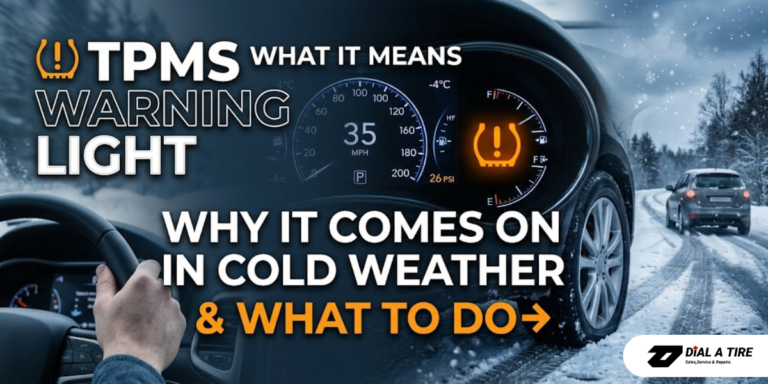
When your Tire Pressure Monitoring System (TPMS) light comes on, check your pressures promptly: a significantly underinflated tire runs hotter, wears unevenly and handles worse, often before you feel anything from the driver’s seat. Understanding what your TPMS warning light means is a good next step after this post.
And when you’re due for a seasonal changeover, the compound chemistry is the real reason timing matters, not habit, not calendar convention. When temperatures settle around 7°C and below, winter rubber starts offering a meaningful advantage in flexibility and grip. The 7°C figure is a practical changeover guideline used across the industry, not a hard chemical cutoff. The case for dedicated winter tires in Nova Scotia runs deeper than most people realize.
🔧 Engineering Corner
Tire grip is governed by a viscoelastic frequency-temperature equivalence: a compound behaves the same way at low temperature as it does at high deformation frequency. Formally, the relationship is captured by the Williams-Landel-Ferry (WLF) equation, which maps temperature shifts to frequency shifts on the master curve of the loss modulus. In practical terms: a tire compound that loses grip at minus 10°C because the polymer chains can’t move fast enough would show the same loss if you drove the same tire at an impossibly high speed at room temperature. This is why compound engineers tune the glass transition temperature Tg directly: every 10°C shift in Tg shifts the cold-weather usable temperature window by approximately the same amount. A well-designed winter compound stays in its optimal operating window across the entire range of Nova Scotia winter temperatures. A summer compound with Tg near 0°C is below its optimal window on virtually every Halifax winter morning.
Ready to talk tires? Our team has been matching drivers to the right compound and construction for Nova Scotia roads since 1994. If you’re shopping for a new set, wondering about your current tires’ age, or due for a seasonal tire changeover, we’re open daily and happy to walk you through the options without any pressure. You can also browse tires online before you come in.
HALIFAX — Dial A Tire
308 Herring Cove Rd, Halifax, NS
902-475-3358
BEDFORD — Dial A Tire
70 Rosno Lane, Bedford, NS
902-444-3425
Open daily 8 AM–5 PM. Please call before coming.
Locally owned since 1994 · Red Seal technicians · Professional installation & precision balancing