The question comes up at both of our shops dozens of times a week every fall: studded or studless this year? It sounds simple. It isn’t. The answer depends on where you drive, how you drive, and what kind of winter Nova Scotia hands you, which can swing from bare pavement to sheet ice to wet slush and back again in the same commute.
Short version: studded tires deliver a real, measurable advantage on glare ice and hard-packed snow. Studless winter tires have closed that gap dramatically in recent years and outperform studs on nearly every other surface. For most drivers in the Halifax Regional Municipality (HRM), a quality studless tire is the better all-round tool. For rural drivers, those on steep hillside driveways, or commuters on ungroomed back roads, studs can still be the right call.
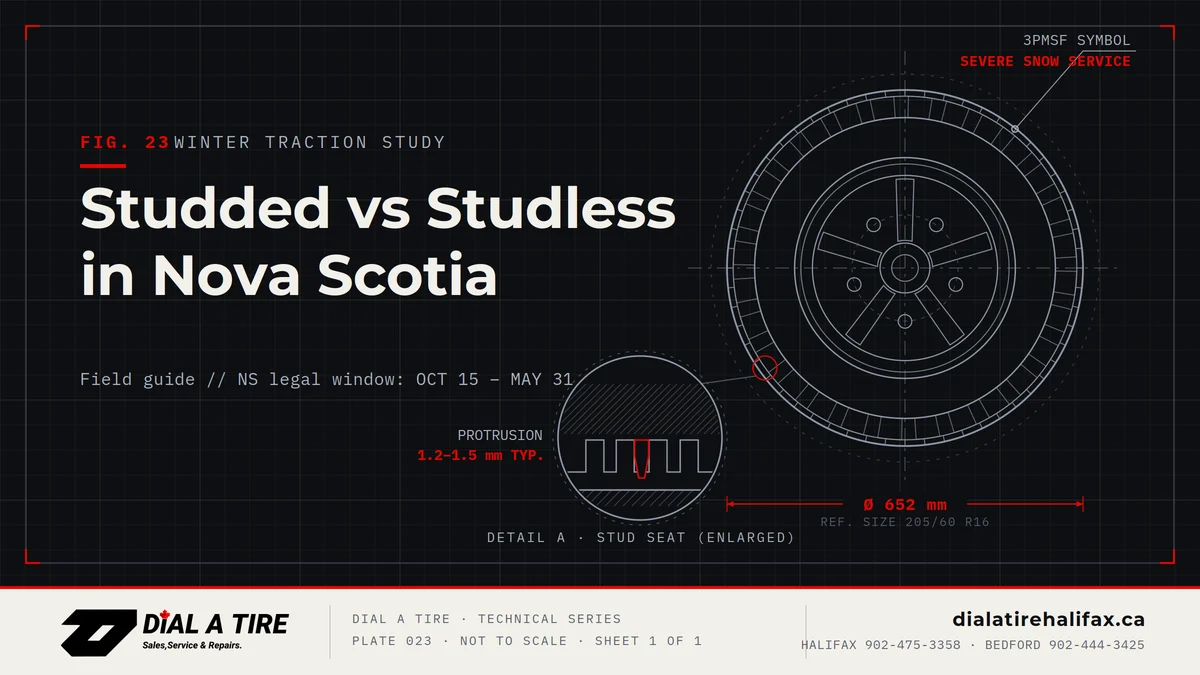
Nova Scotia law sets the window for studded tires at October 15 through May 31. Running studs outside that window is an offence under provincial motor vehicle legislation; you can confirm current rules at novascotia.ca. Within that window, the decision is entirely about which tire type suits your roads and habits. We cover the legal window, and the May 31 removal deadline, further down this page.
How Studs Actually Create Grip on Ice
A studded tire grips ice roughly the way a boot crampon grips a frozen trail, by physically puncturing and interlocking with the surface. Each tungsten carbide stud protrudes slightly beyond the tread face, digging in to give a mechanical anchor no rubber compound fully replicates. On a mirror-smooth sheet of ice, studs deliver shorter stopping distances and more confident side-to-side control.
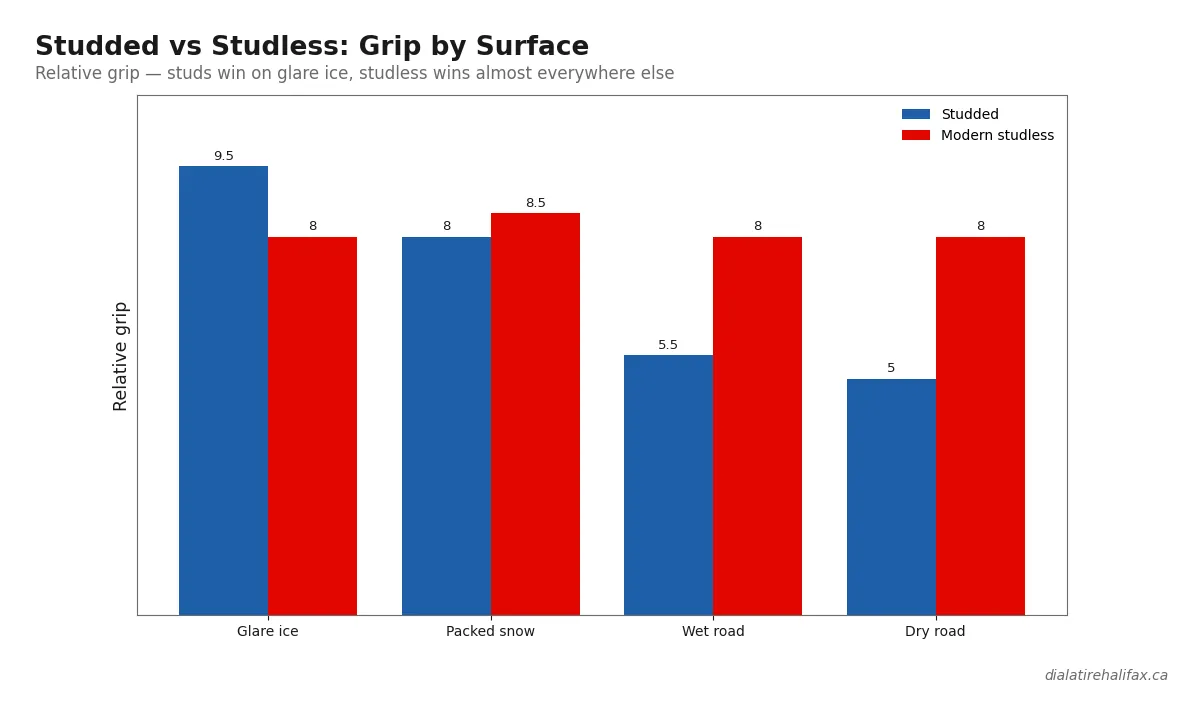
The limitation shows up the moment conditions change. On wet ice near 0°C, a thin water film lubricates the surface and reduces stud penetration. On bare pavement, wet or dry, studs are elevated above the surface on their metal bodies, which shrinks the rubber contact patch and actually lowers grip compared to a studless tire sitting flat. Every kilometre on bare road grinds the studs down too, reducing their ice-gripping depth over time.
🔧 Engineering Corner
A studded tire’s grip on ice comes mostly from mechanical adhesion: stud hardness, penetration depth, stud count, and contact area per stud, working together. On a bare dry road, those same studs act as rigid spacers lifting the tread rubber slightly off the pavement, shrinking the real contact patch, which is the direct reason studless tires tend to brake shorter on wet and dry surfaces. As Paul Haney writes in The Racing & High-Performance Tire, the contact patch is where all tire forces originate; anything that shrinks it costs grip.
How Modern Studless Tires Have Caught Up
Twenty years ago, studless tires on glare ice were a clear second choice. Today the gap has narrowed considerably, and for mixed-condition driving studless is now the more practical default for most drivers, for three reasons.
Silica-enhanced compounds. Older winter rubber used carbon black as its reinforcing filler. Modern studless tires use silica instead, which bonds differently with the polymer chains and stays flexible at temperatures far below where all-season rubber turns hard and glassy.
Sipes. The hundreds of tiny slits cut across every tread block are sipes. On ice, each one opens slightly under load, creating a biting edge, and they also act as micro-squeegees, channelling the thin water film on ice away from the contact area.
Micro-pore compounds. Some premium studless tires use microscopic cells in the tread that wick away the ice’s water film through capillary action, though the effect fades as tread wears.
In braking tests on packed snow and wet pavement, quality studless tires consistently match or beat studded tires. On hard, cold glare ice specifically, studs still hold an edge, though a shrinking one.
Deciding for HRM Conditions: Hills, Ice, and Your Commute
HRM sees bare salted pavement, sheet ice, and wet slush inside the same week, sometimes the same commute, so the right call comes down to which of those your regular route actually hits.
Hill starts on untreated grades. The South End’s steeper streets, the Purcells Cove Road hills, or a shaded Bedford driveway that ices before anyone salts it are the scenario studs were built for.
City streets versus highway. HRM’s arterials and highways are salted and brined often enough that bare and wet pavement dominates even mid-winter, studless territory. A rural commute on infrequently treated roads tips the other way.
Freeze-thaw or steady cold. The harbour keeps temperatures hovering near freezing more than well below it, producing wet ice and slush rather than the hard glare ice where studs shine. Inland communities that stay colder longer see more of the conditions studs are built for.
Noise and wear. Studs rumble on bare pavement and wear down with every kilometre driven on it, a real ongoing cost if most of your winter driving happens on cleared roads.
Weigh those honestly and most HRM drivers land on studless. Drivers on rural back roads, steep untreated driveways, or routes that ice before crews arrive tend to land on studs.
Nova Scotia Law: The October 15 – May 31 Window
Studded tires are legal in Nova Scotia from October 15 to May 31, a window covering the realistic winter driving season. Outside those dates, studded tires are prohibited on public roads. The restriction exists partly to protect road surfaces, since studs are abrasive and accelerate asphalt wear, particularly as pavement softens in spring.
Studless winter tires carry no such restriction. You can mount them once conditions call for it, generally once temperatures settle below 7°C, and keep them on into spring without any legal concern. Our guide on when to switch to winter tires in Halifax covers that timing in more detail.
One more point, and it’s a safety one rather than a legal one: run the same type of tire on all four corners. Mixing studded and studless on the same vehicle can produce unpredictable handling, particularly under braking and cornering. Mount a matching set of four.
Who Should Choose Studded Tires
Studs make sense for a fairly specific profile of Nova Scotia driver. Consider studs if most of this describes you:
- You commute on rural roads that are infrequently ploughed or treated, where glare ice forms and sits.
- Your driveway is steep, shaded, and ices over before crews get to it.
- You regularly travel to a ferry terminal where the approach or dock area ices up before treatment arrives.
- You’re often driving early morning, before brine has had time to work, on untreated routes.
- You’re in an inland community, Truro, Antigonish, Kentville, where temperatures stay lower and conditions hold longer.
If most of your driving is in HRM on salted arterials and highways, studs are unlikely to offer a meaningful safety benefit and will cost you grip on the wet and bare pavement that dominates your winter driving.
Who Should Choose Studless Tires
Studless winter tires are the right choice for most Halifax and Bedford drivers. HRM’s road network is salted and brined aggressively, roads are often bare and wet even mid-winter, and studless tires outperform studded ones in that mix. They’re quieter, wear more evenly, and carry no date restrictions to track. For highway driving on Highway 102 or the Circumferential, studless tires from a reputable brand offer strong packed-snow and wet performance without penalizing you on the bare pavement stretches between treated sections.
If you’re on the fence, picture your worst-case scenario: regular untreated glare ice, or a snowy but ploughed highway? For most HRM drivers it’s the latter, and a good studless tire handles that with confidence. Our guide on winter tires vs all-season tires in Nova Scotia covers the broader case, and our post on buying winter tires early in Halifax covers timing your purchase before stock and appointments tighten up.
What “Studless” Does Not Mean
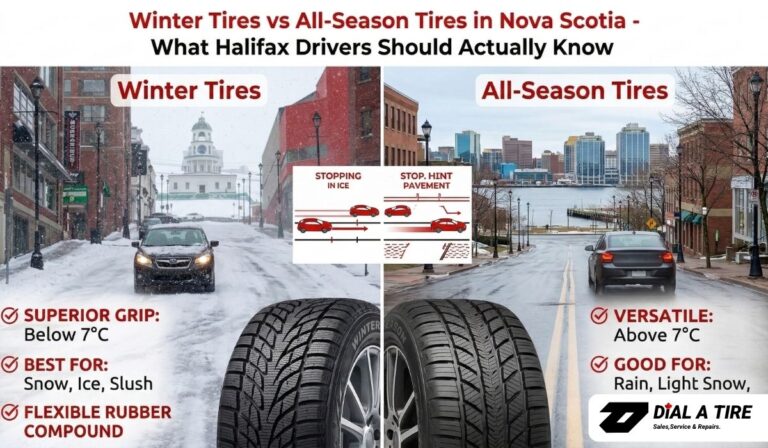
A common mix-up: “studless winter tire” doesn’t mean “all-season tire.” All-season tires are a mild, four-season compromise, and their rubber begins to harden below roughly 7°C, right when winter conditions arrive. Studless winter tires are purpose-built, with a different compound, tread architecture, and siping density. They aren’t interchangeable with all-seasons in winter.
Similarly, the Three-Peak Mountain Snowflake (3PMSF) symbol moulded into the sidewall means a tire passed a standardized snow-traction test, and it’s the mark to look for when buying a studless winter tire. The older M+S (Mud and Snow) label is just a tread-pattern classification and doesn’t guarantee winter performance.
What This Means for Your Car
If you drive primarily in HRM, Halifax, Bedford, Dartmouth, Sackville, a quality studless winter tire is almost certainly the better choice: stronger grip on the wet and bare pavement that dominates your winter driving, no date restrictions, less noise.
If you drive rural routes, steep unmaintained driveways, or back-country roads where glare ice sits untreated, studs still offer a genuine safety advantage that studless tires haven’t fully closed. Mount them within the legal window, run a matched set of four, and expect the trade-off of reduced grip on wet and bare pavement.
Whatever you choose, compare within the winter tire category, a mid-range studless tire will outperform a budget studded tire in almost every condition. Ask us at the shop and we’ll walk you through the options, or browse our tire buying page.
Ready to make the switch for the 2026/27 season? Book your winter tire installation online, or give us a call. Both locations are open daily including weekends, and early booking is a good idea before the calendar fills through October and November.
Frequently Asked Questions
When do studded tires have to be off in Nova Scotia?
May 31. Studded tires must be removed by that date each year; running them past it is an offence under provincial motor vehicle legislation, and the window reopens on October 15 the following fall.
Are studded tires legal in Nova Scotia?
Yes. Studded tires are legal in Nova Scotia from October 15 through May 31 each year. Running them outside this window is an offence. Studless winter tires carry no date restrictions.
Do studded tires perform better than studless on ice?
On hard glare ice below roughly −5°C, studded tires still deliver shorter stopping distances. On wet ice near 0°C, wet pavement, and dry pavement, quality studless tires match or outperform studded tires because the full rubber contact patch is available for grip.
Who should use studded tires in Nova Scotia?
Studded tires make the most sense for drivers on rural, infrequently ploughed or treated roads, steep icy driveways, or ferry-route approaches where hard glare ice sits untreated. Most HRM drivers, who travel frequently salted arterials and highways, are better served by quality studless winter tires.
Can I mix studded and studless tires on the same vehicle?
No. Mixing studded and studless tires on the same vehicle creates unpredictable braking and handling behaviour because each axle generates different grip levels. Always mount a matching set of four tires of the same type.
HALIFAX — Dial A Tire
308 Herring Cove Rd, Halifax, NS
902-475-3358
BEDFORD — Dial A Tire
70 Rosno Lane, Bedford, NS
902-444-3425
Open daily 8 AM–5 PM. Please call before coming.
Locally owned since 1994 · Red Seal technicians · Professional installation & precision balancing