Every autumn, Halifax drivers face the same decision: dig out the winter set, or leave one set on year-round. All-weather tires promise to answer that question, and they’re genuinely different from what many drivers think they’re buying.
The first thing worth knowing: “all-weather” and “all-season” aren’t the same product. They look similar on a shelf and both promise year-round capability, but they sit on opposite sides of a meaningful performance line.
All-Weather vs. All-Season: Why the Name Difference Matters
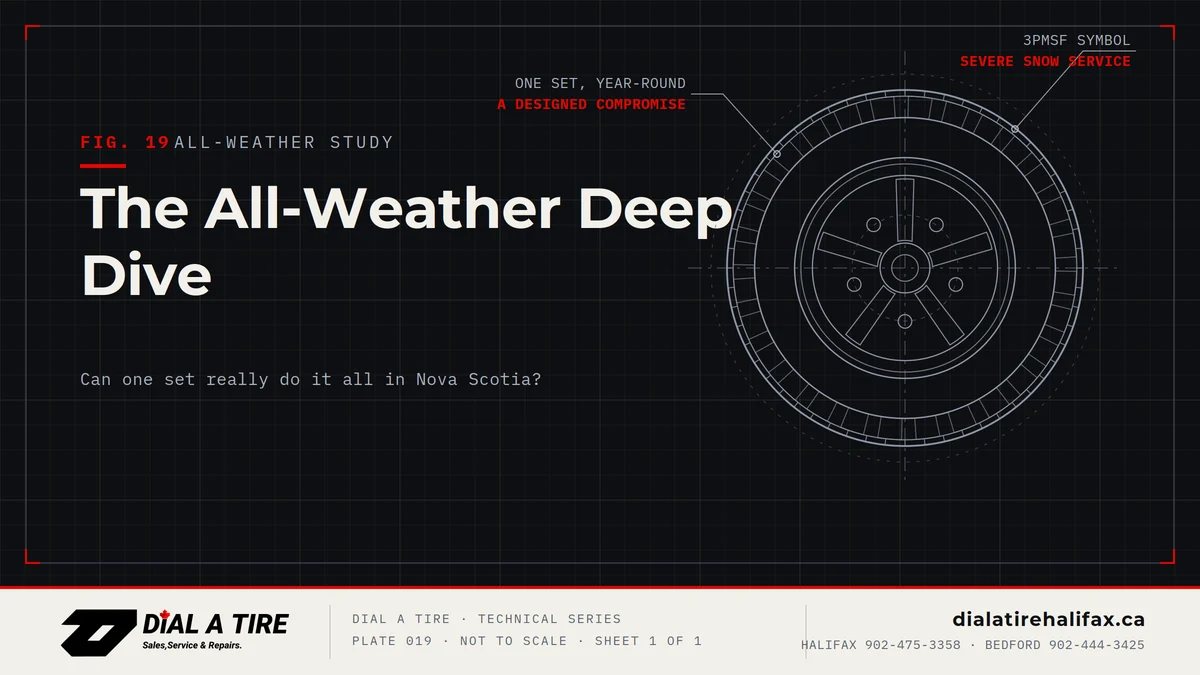
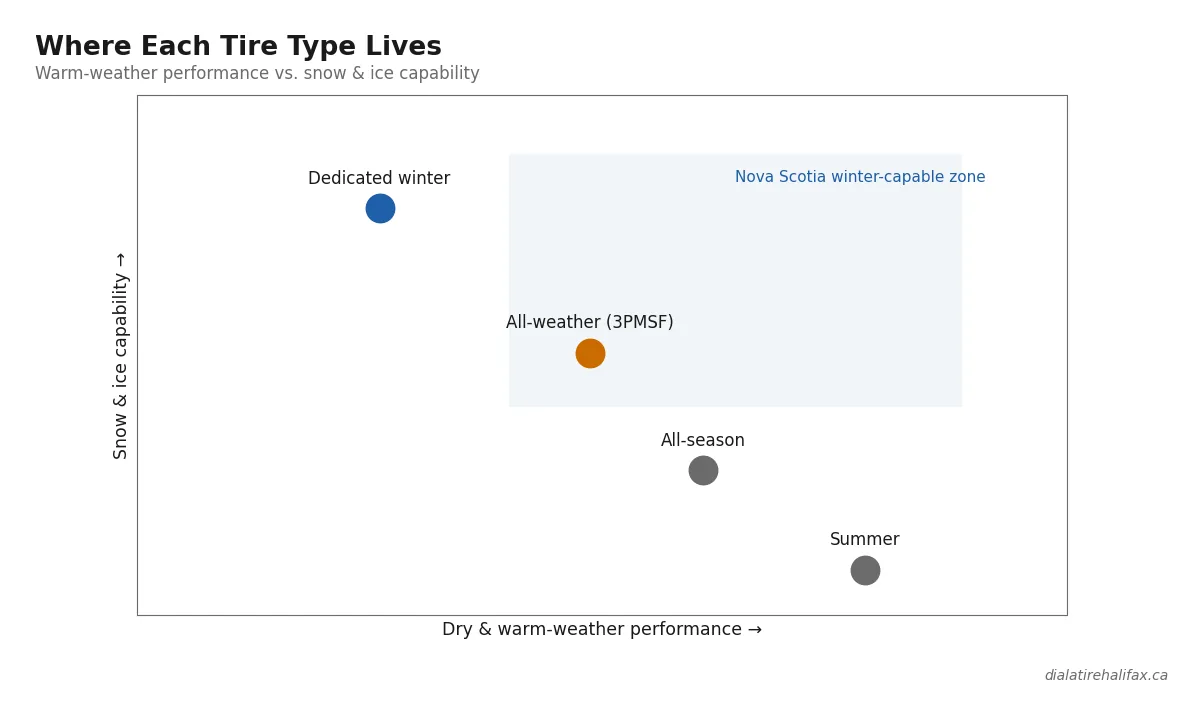
An all-weather tire carries the Three-Peak Mountain Snowflake (3PMSF) symbol, the same badge on dedicated winter tires, confirming it passed a standardized snow-traction test. An all-season tire typically doesn’t carry that symbol, even when it’s sold in four-season packaging.
All-season tires, particularly the grand-touring type common on sedans and crossovers, can harden noticeably below roughly 7°C and lose grip on packed snow before a single flake falls. All-weather tires use a compound formulated to stay more pliable in cold weather while still holding up in summer heat.
What all-weather tires give up is specialization at the extremes. A proper winter tire on a January Halifax commute outperforms an all-weather in wet snow, ice, and deep cold. A summer tire in August outperforms an all-weather in dry cornering and braking. All-weather sits deliberately in the middle, a strength for some drivers and a real compromise for others.
What the 3PMSF Symbol Does and Doesn’t Guarantee
The 3PMSF certification tells you a tire passed a snow-traction test under controlled conditions. It doesn’t tell you how the tire handles ice, deep wet snow, or sustained sub-zero temperatures.
Ice traction is a different test entirely, and most all-weather tires aren’t optimized for it. Dedicated winter tires use fine tread slits called sipes and compounds that grip well below −20°C. All-weather compounds also have to survive summer heat cycling, pushing the formula toward a warmer-temperature bias than a purpose-built winter tire.
Provincial road-safety guidance in Nova Scotia points drivers toward winter tires for winter conditions, and that reflects genuine local experience with what works on ice-covered side streets in Dartmouth, rural roads in Lunenburg County, and the exposed highway approaches around Cape Breton. The 3PMSF mark is a meaningful credential, not just a marketing badge, but it’s the floor of the winter-capable category, not the ceiling.
The Compound Compromise
All-weather tires use a compound that has to stay flexible in the cold while resisting heat buildup on summer highways, a wider operating window that costs peak performance at either end.
The ingredients that keep rubber soft at very low temperatures tend to wear quickly in summer heat. All-weather formulations blend silica and carbon black to find a workable middle ground: silica for wet grip and low-temperature flexibility, extra sipes for biting edges in light snow. The result is competent in October slush and February flurries, but with a real gap behind dedicated winters on the packed-snow and ice days that define the worst of a Halifax winter.
🔧 Engineering Corner
Rubber stiffness is characterized by the glass transition temperature (Tg), the point where a polymer shifts from flexible to rigid. Winter tire compounds are formulated with a Tg far lower than any all-season rubber reaches, keeping them pliable on the coldest January morning. All-weather compounds sit in a narrower, less extreme range, cold enough to stay workable through most Maritime winters, but not as deeply low-temperature-stable as a purpose-built winter tire. Every degree of shift to accommodate summer heat costs some winter flexibility; no compound chemistry closes that trade-off entirely.
Who All-Weather Tires Actually Suit
All-weather tires fit a specific type of Nova Scotia driver, not every driver.
Urban Halifax and Bedford commuters with short, paved routes get the most out of an all-weather tire. If your daily drive is short and mostly on salted main roads, it handles most of what you’ll encounter, and the city salts early and often, so the worst ice tends to clear quickly on the arterial roads.
Drivers without storage space often find all-weather tires the practical answer. A seasonal changeover needs somewhere to put the off-season set, and apartment or condo dwellers without a heated garage skip that problem entirely, no spring and fall appointments to work around.
Low-annual-kilometre drivers also do well here, since the wear compromise matters less when you’re not putting many kilometres on the tire over a year. And on the Halifax peninsula or along the waterfront, where winters tend to run milder than in the Annapolis Valley or highland Cape Breton, the gap between all-weather and dedicated winter narrows further still.
Who Should Not Choose All-Weather Tires
For a few specific groups, all-weather is the wrong trade-off, and the shortfall shows up exactly when it matters most.
Steep-hill commuters feel it first. If your regular route includes a grade that ices over before crews reach it, whether that’s a South End street or a shaded driveway in Bedford, the extra bite of a dedicated winter tire is worth having on hand every morning, not just on the worst days.
Rural and highway drivers face a different risk profile too. Anyone regularly on the Trans-Canada, Highway 102, or Highway 104 at speed sees the wet-snow and ice braking gap amplified by higher speeds, and rural stretches get salted less often than HRM’s arterials.
High-annual-kilometre drivers feel the compromise compound. All-weather tires run duty twelve months a year, so more kilometres means faster wear, and more of your driving spent in the conditions where the compound trade-off costs you the most.
Drivers with rear-wheel or older all-wheel drive have the clearest case of all. All-wheel drive (AWD) helps with acceleration, not braking, and on a vehicle without intelligent torque distribution, the tire compound doing the gripping matters enormously; a dedicated winter set on a rear-wheel-drive vehicle can outperform an all-weather set on an AWD vehicle when it’s time to stop on ice.
What we see at the shop: drivers switching from all-seasons to all-weather feel the upgrade immediately in October and November. Drivers switching from dedicated winters to all-weather sometimes feel the gap on the worst days of February.
The Seasonal Changeover Trade-Off
The strongest argument for all-weather tires is time and logistics. A seasonal tire changeover takes your car off the road for a morning and requires storing the second set. All-weather tires skip the changeover and the risk of getting caught in an early snowstorm still on all-seasons. Nova Scotia weather doesn’t announce itself politely; snow before Thanksgiving and again into April isn’t unusual.
The counter-argument: money saved on changeovers may be offset by slightly faster wear from twelve months of duty, plus the performance gap on the worst winter days. Our spring timing guide for winter tires is relevant context too: drivers on dedicated winters need to swap by late April to avoid premature summer wear.
What This Means for Your Car
All-weather tires solve a real problem for a specific group of Halifax and Bedford drivers. What matters is whether they fit how you actually drive, not whether they’re “good” in some general sense. We’re happy to talk that through with you based on your vehicle, your routes, and how you use the car through the year.
For a closer look at the studded-versus-studless decision within the winter tire category itself, see our studded or studless guide for Nova Scotia. If you’re leaning toward a dedicated winter set and want to time the purchase right, our post on buying winter tires early in Halifax covers stock and booking timing, and our guide to when to switch to winter tires covers the temperature trigger.
When you’re ready to explore options, our tire selection tool is a good starting point, and you can book an appointment at either location to have the conversation in person.
Frequently Asked Questions
What is the difference between all-weather and all-season tires?
All-weather tires carry the Three-Peak Mountain Snowflake (3PMSF) certification, confirming they’ve passed a standardized snow-traction test. All-season tires typically don’t carry this symbol. All-weather compounds are formulated to stay pliable below 7°C, while all-season compounds can harden in cold weather and lose grip on snow and ice.
Do all-weather tires work in Nova Scotia winters?
All-weather tires handle the moderate conditions many Halifax urban drivers face: light snow, slush, cold wet pavement. They carry the 3PMSF certification, but they don’t match dedicated winter tires in ice traction, packed snow, or sustained sub-zero cold. Highway commuters and rural drivers typically benefit more from a dedicated winter set.
Who should use all-weather tires instead of winter tires?
All-weather tires suit urban commuters with short paved routes, drivers without storage space for a second set, and low-kilometre drivers. They’re a practical choice for year-round capability without seasonal changeovers, provided you mostly drive on salted city roads.
Who should not choose all-weather tires?
Steep-hill commuters, rural and highway drivers covering significant distance, and high-annual-kilometre drivers generally see a bigger benefit from dedicated winter tires. The performance gap on ice and packed snow matters more the further and faster you’re driving.
Are all-weather tires legal and safe for winter driving in Nova Scotia?
Yes. All-weather tires carrying the 3PMSF symbol meet the recognized standard for winter-capable tires. Nova Scotia does not legally mandate winter tires, and 3PMSF-certified all-weather tires are considered winter-appropriate. For the most severe conditions, dedicated winter tires provide additional margin.
HALIFAX — Dial A Tire
308 Herring Cove Rd, Halifax, NS
902-475-3358
BEDFORD — Dial A Tire
70 Rosno Lane, Bedford, NS
902-444-3425
Open daily 8 AM–5 PM. Please call before coming.
Locally owned since 1994 · Red Seal technicians · Professional installation & precision balancing