
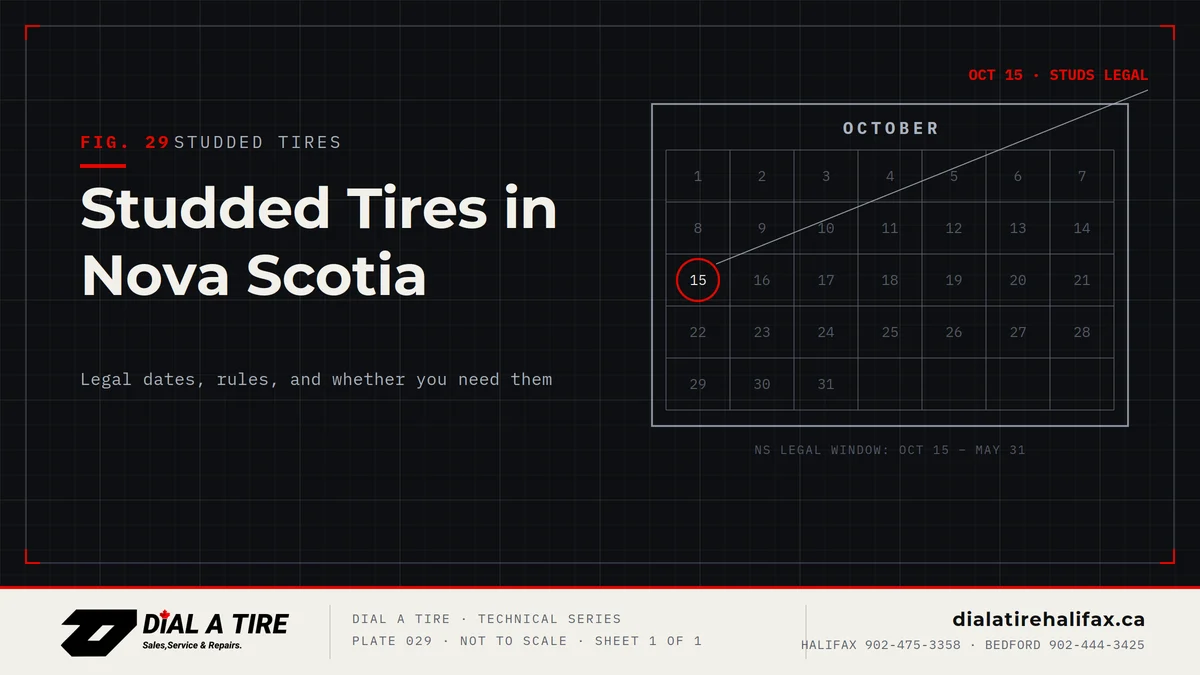
Nova Scotia allows studded tires from October 15 to May 31, inclusive. Outside that window, they’re illegal on public roads in the province. That’s the first thing to know before anything else in this post.
Every October the same question comes up at our counter: should I go with studs this year? It’s a fair question. If you’ve ever crept down a glazed hill on a cold morning, the idea of metal biting into ice is appealing. But studs come with real trade-offs, and for a lot of Halifax drivers, they’re not the right call. Here’s the law, how studs actually work, and who genuinely benefits from them in the Halifax Regional Municipality (HRM).
What the Law Says
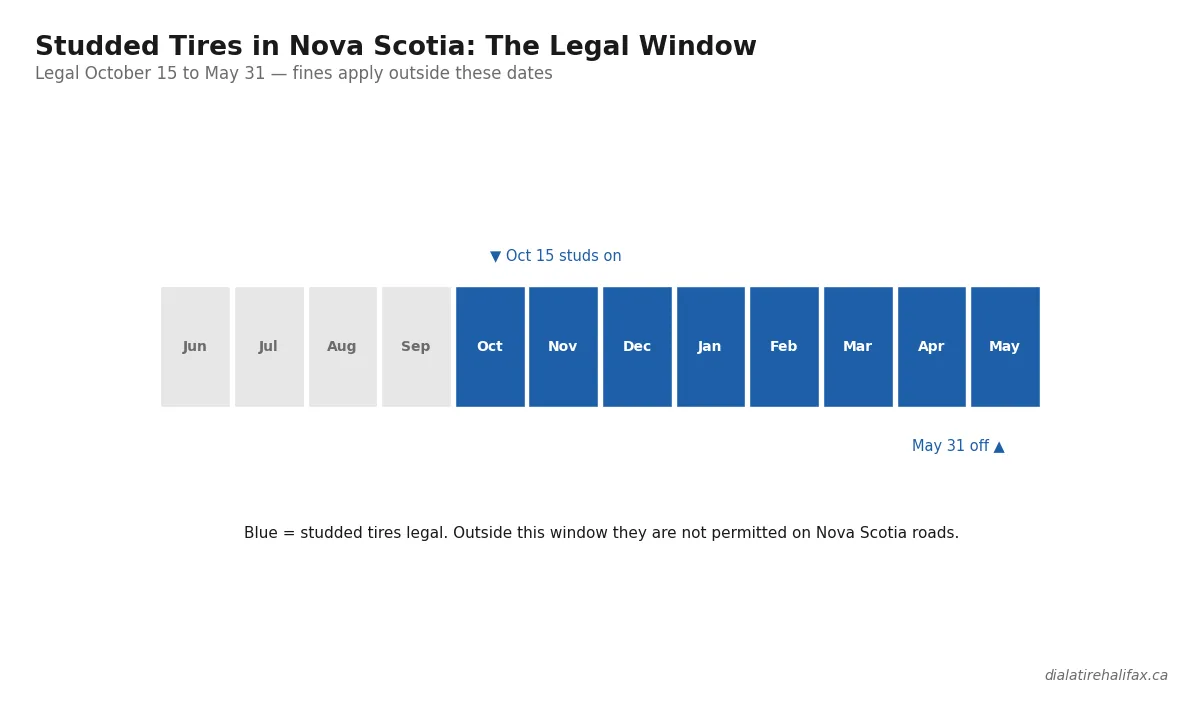
The Nova Scotia Motor Vehicle Act regulations set the October 15 to May 31 window. Run studs outside those dates and you’re subject to a fine.
The October 15 start lines up reasonably well with when ice can first appear here, though most Halifax winters don’t see serious glaze ice until late October or November. The May 31 end date gives rural drivers a buffer for late-season ice in sheltered valleys and shaded roads north of the city. A quick mark-your-calendar note: that May 31 deadline comes around fast once winter is over, and we’ll have more detail on the spring removal timing closer to the date.
If you’re driving into other provinces with studs on, check first. Quebec, Ontario, and New Brunswick each set their own windows and restrictions.
How Studded Tires Actually Work
A studded winter tire starts as a regular winter tire, built with the same cold-weather compound as a studless one, with small tungsten carbide pins pressed into the tread. On glare ice and hard-packed snow, those pins puncture the surface and provide mechanical grip that rubber alone can’t match.
The trade-off shows up on bare pavement, which is what most Halifax roads are most of the time, even in January. There the studs act like tiny stilts, lifting the rubber slightly off the road. That reduces the contact patch that actually grips the asphalt, lengthens braking distances on dry and wet pavement, and adds road noise. Testing by tire makers has repeatedly shown that modern studless winter tires match or outperform studded tires on wet pavement and packed snow, and close much of the gap on clean ice too.
Who Actually Benefits From Studs in HRM
Studs earn their keep in specific situations, and most of them aren’t everyday Halifax city driving.
Rural driveways and roads with shade ice. A north-facing driveway or road that barely sees sun between November and March can hold glare ice for weeks. Studs help most when you’re stopping and starting on a steep grade with no run-up.
Ungroomed secondary roads. Inland valleys, Shore roads, and Cape Breton highlands can carry hard-packed ice that gets little treatment. Drivers who regularly travel those routes, especially early morning before the sun softens the surface, have a real case for studs.
Early-morning commuters ahead of the plows. If you’re regularly on untreated roads before 6 AM in January and February, studs may be worth it.
Anyone who genuinely feels safer with them. There’s a legitimate quality-of-life argument here. If studs reduce anxiety and driver error for you, that has real value, even if a premium studless tire performs similarly in testing.
Who Doesn’t Need Them
Most drivers commuting within HRM on treated roads, Quinpool Road, Bayers Road, the Circumferential Highway, the 102 corridor, are unlikely to see a practical benefit from studs in a typical winter.
Halifax has a maritime climate. Winters are cold but rarely as sustained as inland Canada, and the city treats roads aggressively with brine and salt. Bare and wet pavement is the norm far more often than pure glaze ice, and that’s exactly where studs are at a disadvantage: longer stopping distances on wet roads, more noise, more rolling resistance. Halifax also runs through frequent freeze-thaw cycles rather than staying deeply cold, which means a lot of slush and wet snow, conditions where studless tires with siped tread blocks handle very well. On slush, studs contribute little.
There’s also a road-wear cost. Studs gradually damage asphalt, which is why some jurisdictions restrict or ban them. Nova Scotia allows them seasonally, but if your driving conditions don’t actually call for studs, a quality studless winter tire is a meaningful way to avoid that cost.
None of this means studs are wrong for HRM drivers. It means the decision should match your actual commute, not a general sense that metal on ice must be safer. A driver in Spryfield who takes the highway to an office downtown has a very different winter than a driver on an unpaved road outside Musquodoboit.
Deciding for Yourself
- Where do you actually drive? If most of your kilometres are on treated Halifax streets, studs are unlikely to help you in a typical year.
- Do you commute on unlit rural roads or steep ungroomed surfaces? If yes, studs may genuinely add a margin of safety.
- What traction aids does your vehicle already have? Anti-lock brakes (ABS), traction control, and stability control already manage wheel slip well. They work with the tire, not instead of it, but they narrow the scenarios where a stud advantage is decisive.
- Have you driven quality studless winters recently? Many drivers who switch are surprised by how capable modern studless rubber has become. If your last studded experience was several years ago, the gap has narrowed.
Running Studs Legally and Well
Respect the window. Install no earlier than October 15, remove by May 31. Shops get busy near those dates, so book your changeover early. Our seasonal tire changeover service is available daily, including weekends.
Studs on all four, always. Never mix studded and studless tires on the same vehicle. Mismatched grip front-to-rear creates dangerous handling, particularly under braking and cornering.
Allow a break-in period. New studs need roughly 500 km of driving to seat properly in the tread. Drive conservatively during that stretch and avoid hard braking or sharp cornering; proper seating extends stud retention.
Check stud condition each season. Studs can be lost, especially if a tire runs underinflated or the tread wears down. Have a technician check retention at your seasonal changeover.
Watch inflation. Pressure drops roughly 1 pound per square inch (psi) for every 5–6°C. An underinflated studded tire deforms in ways that accelerate stud loss. Check pressure when tires are cold, at least monthly through winter.
The Bottom Line
If you drive primarily on treated Halifax streets, a quality studless winter tire will serve you well through a typical Nova Scotia winter, and it’ll outperform a studded tire on the wet and bare pavement that makes up most of your driving. If you regularly cover rural, steep, or ungroomed roads with sustained ice, studs may be worth the trade-offs.
Either way, the bigger decision is getting proper winter tires on before the temperature drops below 7°C, when all-season rubber starts to harden. Studs versus studless is a secondary question to whether you’re running winter tires at all; our guide to switching to winter tires in Halifax covers that timing decision in full. Our technicians at both locations can help you pick the right tire for your driving pattern and install it correctly, browse options on our tire services page any time.
Ready to book your winter changeover or talk through your tire options? Book an appointment online or give either location a call.
Frequently Asked Questions
Are studded tires legal in Nova Scotia?
Yes, from October 15 through May 31. Run them outside that window and you’re looking at a fine under the Motor Vehicle Act. If you’re heading into another province, check first, since Quebec, Ontario, and New Brunswick each set their own rules.
Do Halifax city drivers need studded tires?
Most don’t. Halifax roads get salted and brined heavily, and the freeze-thaw pattern here means more wet pavement and slush than sustained glare ice, exactly the conditions a good studless winter tire handles well.
Who benefits most from studded tires in Nova Scotia?
Drivers dealing with shaded rural driveways that hold ice for weeks, anyone on ungroomed secondary roads inland or in Cape Breton, and early commuters who are out on untreated roads before the plows come through.
Can I mix studded and studless tires on the same car?
No. Running different types front-to-rear throws off your grip balance and can make the car unpredictable under braking or in a corner. All four tires should match.
Do studded tires need a break-in period?
Yes, roughly 500 km of easier driving so the studs seat properly in the tread. Go easy on hard braking and sharp turns during that stretch, it pays off in how long the studs last.
HALIFAX — Dial A Tire
308 Herring Cove Rd, Halifax, NS
902-475-3358
BEDFORD — Dial A Tire
70 Rosno Lane, Bedford, NS
902-444-3425
Open daily 8 AM–5 PM. Please call before coming.
Locally owned since 1994 · Red Seal technicians · Professional installation & precision balancing