Every September the same questions come across our counter: tire size for winter, whether you need a second set of rims, and whether steel beats alloy once the salt trucks are out. Are any of those worth changing from what came on the car? They’re decisions that affect how your car handles in snow, what a changeover costs you every year, and how long your tires and wheels last.
This guide walks through the real decision: should you downsize, and what wheels should carry the tires. Getting winter tire sizes and wheel choice right matters more than most drivers realize heading into their first changeover season.
Should You Downsize Your Winter Tires?
Downsizing means moving to a smaller-diameter wheel and a narrower winter tire than your factory summer setup, where your vehicle supports it. In Halifax, the answer is often yes.
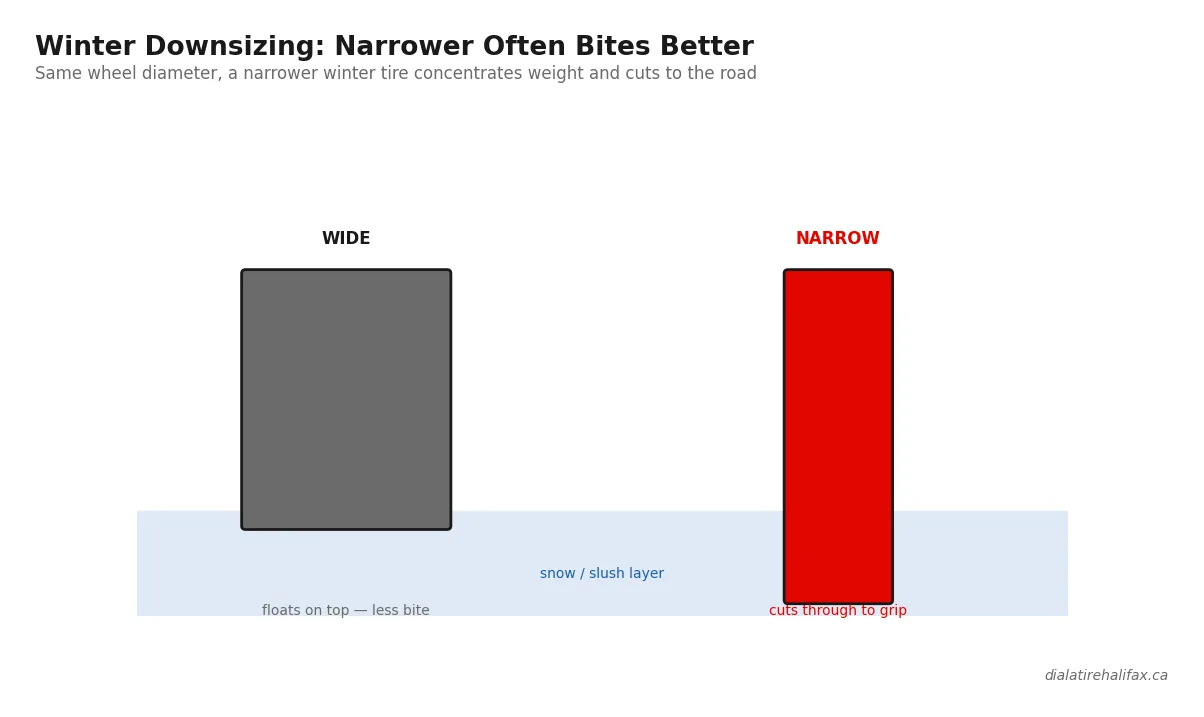
A narrower tire puts the same vehicle weight into a taller, more focused contact patch, the part of the tire actually touching the road. That narrower footprint cuts through loose snow rather than floating on top of it the way a wide performance tire can. Think ski versus snowshoe: for cutting through packed snow or slush, narrow wins. Downsizing can also cost less, since a smaller wheel is usually paired with a less expensive tire.
Three checks decide whether downsizing works for your vehicle:
- Overall diameter. Stay within roughly 3% of your original size so your speedometer reads correctly and clearances aren’t affected.
- Fit on the rim. The tire has to seat properly — you can’t go narrower than the rim allows.
- Load index. The number on the sidewall showing how much weight each tire can carry has to meet or exceed what your vehicle requires.
A common example: a vehicle running 235/55R18 summer tires might move to a 215/60R17 or 225/60R17 winter setup on a smaller steel rim. The overall diameter stays close, the narrower section bites into snow better, and 17-inch winters typically cost less than 18-inch winters.
Downsizing isn’t right for every vehicle. Some have tight suspension or brake clearances, or steering feel calibrated tightly enough that a size change is noticeable. Call either shop and we’ll tell you honestly whether it makes sense for your car.
New Rims, or Swap Tires on Your Existing Wheels?
You don’t need a second set of rims. We can unmount your all-season tires and mount winter tires on the same wheels twice a year. But a dedicated set, usually steel, makes the changeover faster and easier on your tires and your Tire Pressure Monitoring System (TPMS) sensors.
Every unmount and remount wears the bead, the edge of the tire that seals against the rim. It’s also an opportunity to knock a TPMS sensor out of calibration or damage it outright, since most vehicles built in the last decade or so carry them inside the wheel. With a dedicated wheel set, changeover becomes a straightforward bolt-on swap: torque to spec, check pressures, done.
Whether a rim set pays for itself depends on how long you keep the vehicle. Ask us to walk through the math for your specific car. Our tire change service page covers what a changeover visit involves either way.
Steel or Alloy for Winter: The HRM Salt-Season Call
Steel wheels are heavier, less expensive, and shrug off winter abuse. Alloy wheels are lighter, better looking, and costlier to replace if damaged. For a dedicated winter set, most of our customers choose steel, and in Halifax that’s usually the practical call.
Winter here means road salt, brine spray, pothole impact, and the occasional curb strike on a slick morning. Steel takes a hit and bends back into shape, or gets replaced cheaply if it doesn’t. Cold alloy is more brittle and can crack on a hard pothole strike, and a cracked alloy wheel is usually done for good.
Steel is also inexpensive enough that pairing it with your winter tires often makes the whole dedicated-set strategy pay for itself faster, while keeping your good summer alloys out of the salt entirely.
Alloy still makes sense in a few cases: if looks matter to you year-round, if your vehicle is light enough that unsprung weight matters, or if tight brake clearance rules out a steel wheel. We’ll confirm what fits when you come in.
Brake Clearance and Matching Your Set
If you’re downsizing, brake clearance is the constraint that decides how far you can go. The wheel has to clear the brake caliper through turning, suspension travel, and the thermal expansion that follows hard braking. Larger performance brake packages often rule out downsizing altogether; a standard-brake sedan or crossover usually has more room to work with. We check this before ordering anything, since a wheel that clears cold, static brakes can still contact a hot caliper after a highway run.
Whatever size you land on, all four tires should match: same size, same model, ideally the same production run. Mixed sizes or models change rolling circumference and grip enough to confuse your stability control and anti-lock braking system (ABS), and on an all-wheel-drive (AWD) vehicle they can stress the differential and transfer case over time. If one winter tire is significantly more worn than the other three, replacing all four is the better call rather than adding one new tire to a worn set.
Timing your changeover matters as much as sizing does. Our guide to switching to winter tires in Halifax covers when to book so you’re not deciding on sizes and rims under time pressure.
Quick Answers
Can I run a narrower winter tire than my summer size?
Yes, in many cases. Keep the overall diameter within roughly 3% of your original size and confirm the load index meets your vehicle’s requirement. We check both before ordering.
Do I need a second set of rims?
No, but a dedicated set, usually steel, makes changeovers faster and protects your tires and TPMS sensors from repeated mounting and dismounting.
Are steel or alloy wheels better for winter?
Steel is the practical choice for most Halifax drivers. It’s cheaper and tolerates salt and pothole impact better than alloy.
Will smaller winter rims clear my brakes?
It depends on your caliper size. We confirm clearance before ordering, since it’s a safety question, not just a fit question.
Do all four winter tires need to match?
Yes, same size and model on all four. Mismatches interfere with ABS and stability control and can stress an AWD drivetrain.
Have a question about your specific vehicle? Call either location, we talk through winter tire decisions every day during changeover season.
Ready to get sorted before the rush? Book an appointment online or browse our tire selection to get started.
HALIFAX — Dial A Tire
308 Herring Cove Rd, Halifax, NS
902-475-3358
BEDFORD — Dial A Tire
70 Rosno Lane, Bedford, NS
902-444-3425
Open daily 8 AM–5 PM. Please call before coming.
Locally owned since 1994 · Red Seal technicians · Professional installation & precision balancing