Dial A Tire Q&A #6
Buying tires brings people into the shop with more confusion than almost any other service we offer. The tire industry generates an enormous volume of marketing material, star ratings, proprietary compound names, acronym-heavy feature lists, and very little of it tells you how the tire actually performs in a measured test. We get the same questions every week, so we’ve pulled the most common ones together here and answered them the same way we would over the counter: plainly, without the hype.
Are Expensive Tires Actually Better?
Generally yes, but the relationship is not linear, and the premium tier is not always meaningfully better than the mid-tier for everyday Nova Scotia driving. Here’s the honest breakdown.
Premium-tier tires (the top product lines from Michelin, Bridgestone, Continental, Pirelli) tend to lead in three areas: wet braking distance, rolling resistance, and longevity. Independent testing consistently shows the best premium all-season tires stopping several metres shorter in wet conditions than budget alternatives, and at highway speeds, several metres is the difference between stopping before a crosswalk and not. That gap is real and it matters.
Mid-range tires from reputable manufacturers, Toyo, Hankook, Falken, Cooper, Nokian, typically sit within a few metres of the premium tier in controlled tests while costing noticeably less. The gap between mid-range and premium is often smaller than the gap between budget and mid-range. Budget tires from unfamiliar brands can look identical to premium tires on a spec sheet but perform significantly worse in wet conditions and tend to wear faster, which eliminates the price advantage over the life of the tire.
The practical answer: for most Halifax drivers, a well-tested mid-range tire is excellent value. If you’re doing significant highway driving, have a heavier vehicle, or drive in demanding winter conditions, the premium tier earns its price difference through the measurable safety margins. We’re always happy to talk through what makes sense for your specific vehicle and how you use it, browse our tire options or give us a call.
How Do I Read Online Tire Reviews Without Being Fooled?
This is the question we wish more people asked before they arrived with a set already ordered online. Most consumer reviews, even thousands of them, are not reliable guides to tire performance. Here’s why, and what to look at instead.
Consumer reviews reflect impressions. A driver who has owned one tire cannot tell you how it compares to anything else. Few drivers can accurately perceive a three-metre difference in wet stopping distance while driving normally. Reviewers report what they notice: road noise, ride comfort, tread life, all useful to some degree, but none of them tell you whether the tire will stop your car safely in the rain.
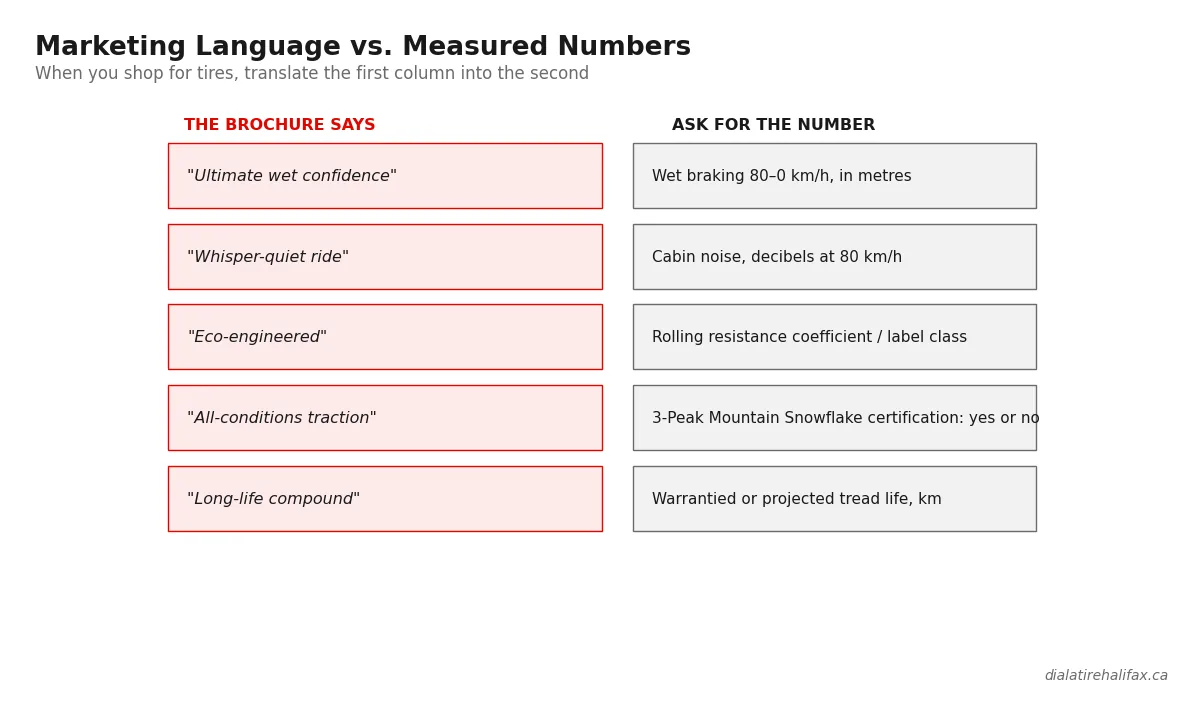
Independent measured tests are what to look for. Publications and testing organizations that publish actual numbers: wet braking distance in metres, aquaplane resistance speed in kilometres per hour, dry lap times, rolling resistance coefficients, give you something objective. Tire Rack in the United States conducts and publishes professional test data including braking distances measured on a closed course. European automotive publications (Auto Bild, Auto Express, Autobild Allrad) conduct large annual tire tests and publish ranked results with measured distances. These are the sources worth consulting.
When reading any test, pay attention to the test conditions. Wet braking tests conducted at 80 km/h on a specific test track tell you something real. “Feel” scores or editor’s choice awards without underlying data tell you very little. Look for the number of metres each tire took to stop from a given speed in the wet: that is the single most safety-relevant metric in any tire test.
What Do Those EU-Style Labels and Ratings Mean?
The European Union tire label system, which you will sometimes see referenced on tire product pages, rates tires on three characteristics: fuel efficiency, wet grip, and external rolling noise. Each is scored on a scale from A (best) to E (worst) for fuel and grip, with a decibel rating for noise.
Wet grip is the most safety-relevant of the three. An A-rated wet grip tire stops significantly shorter in wet conditions than an E-rated tire: braking from 80 km/h, the gap across the full scale can exceed 18 metres — roughly four car lengths. When comparing two tires at a similar price point, a wet grip rating of A or B is a meaningful differentiator worth paying attention to.
Fuel efficiency on the label reflects rolling resistance: A-rated tires require less energy to roll, translating to modestly lower fuel consumption. Noise is rated one to three sound waves (one = quietest) and has no safety implication, just comfort. Canadian tires don’t carry the EU label by regulation, but many tire product pages list equivalent ratings, and the same testing data underlies both systems.
Mid-Range vs Premium vs Budget: What Are the Honest Differences?
Premium tier: Best wet braking in independent tests. Lowest rolling resistance. Longest projected tread life. Higher initial cost, but lowest cost-per-kilometre over the tire’s full life. Worth the investment if wet-road performance is a priority or you keep vehicles long-term.
Mid-range tier: Within a few metres of premium in most wet braking tests, the gap is real but smaller than the price difference suggests. Brands with strong testing track records include Toyo, Hankook, Falken, Nokian, and Cooper. This is where we point most customers.
Budget tier: Significantly longer wet stopping distances across multiple independent tests. Faster tread wear means the price advantage narrows or disappears over the tire’s life. We stock entry-level options only from established manufacturers with real testing data behind them, not unknown-brand imports.
One more thing: the right tire type for your car matters as much as the tier. A premium all-season on a car that needs a dedicated winter tire for a Nova Scotia winter is the wrong choice regardless of its ratings. Our guide on winter tires vs. all-season tires in Nova Scotia covers that decision in detail.
What Matters Most for Nova Scotia Specifically?
Nova Scotia drivers have a specific combination of demands that narrows the tire choice decision somewhat.
Wet grip is paramount. Halifax’s rainfall and road salt residue in shoulder seasons create slippery conditions more often than in many parts of Canada. We’d rather see a customer on a B-rated wet grip tire than an A-rated dry grip tire for everyday Halifax driving.
Winter capability is a separate and significant question. Many Nova Scotia drivers run dedicated winter tires, and for good reason: 7°C is the industry’s changeover guideline, and Halifax temperatures sit below it for much of late October through April, where all-season compounds give up grip. If you’re considering all-weather tires, those carrying the Three-Peak Mountain Snowflake (3PMSF) symbol, which certifies they meet a minimum snow traction standard, be aware they are a compromise rather than a replacement for dedicated winters on a rural highway commute or a steep driveway. We’ll cover all-weather tires in more depth in an upcoming post.
Load capacity matters more than many drivers realize. If you regularly carry full passenger loads, tow a trailer, or load cargo for camping trips, checking that the tire’s load index matches the requirements on your vehicle’s door jamb placard is not optional: it’s a safety check. The load index question comes up often enough that we covered it in our tire size and sidewall guide.
Tread life under Halifax driving patterns also deserves a mention. Halifax drivers put plenty of kilometres on hard, freeze-thaw roads, which means tread wear projections based on lower-mileage assumptions may not apply. A tire rated for 80,000 kilometres under test conditions may deliver less under real-world Halifax use with seasonal changeovers, urban stop-and-go, and the abrasive effect of salt-treated roads.
Ready to Buy? We’ll Help You Choose
When you’re ready to buy tires, bring your questions to the counter. We’ll pull up the test data for the options that fit your vehicle, talk through what you actually need for how you drive, and give you a straight answer, not a sales pitch. Book an appointment or call either location to get started.
HALIFAX — Dial A Tire
308 Herring Cove Rd, Halifax, NS
902-475-3358
BEDFORD — Dial A Tire
70 Rosno Lane, Bedford, NS
902-444-3425
Open daily 8 AM–5 PM. Please call before coming.
Locally owned since 1994 · Red Seal technicians · Professional installation & precision balancing