Most drivers know they should get a wheel alignment, but very few know what an alignment actually adjusts. The short answer: three angles called camber, caster and toe. These are the wheel alignment angles that determine how each tire sits against the pavement, how the steering feels in your hands, and how evenly your rubber wears over the next 20,000 kilometres. Get them right and your car tracks straight, steers crisply, and your tires last. Let them drift, which Halifax roads are very good at causing, and you’ll be buying new rubber far sooner than you should.
None of this is mysterious. Alignment is geometry, not magic. Once you understand what each angle does, the symptoms of a drifting alignment become easy to read. This guide walks through all three angles with plain-English metaphors, explains what happens when each goes wrong, and tells you what to watch for after a season of Halifax potholes and frost heaves.
What Is Camber, and Why Does a Leaning Tire Wear Unevenly?
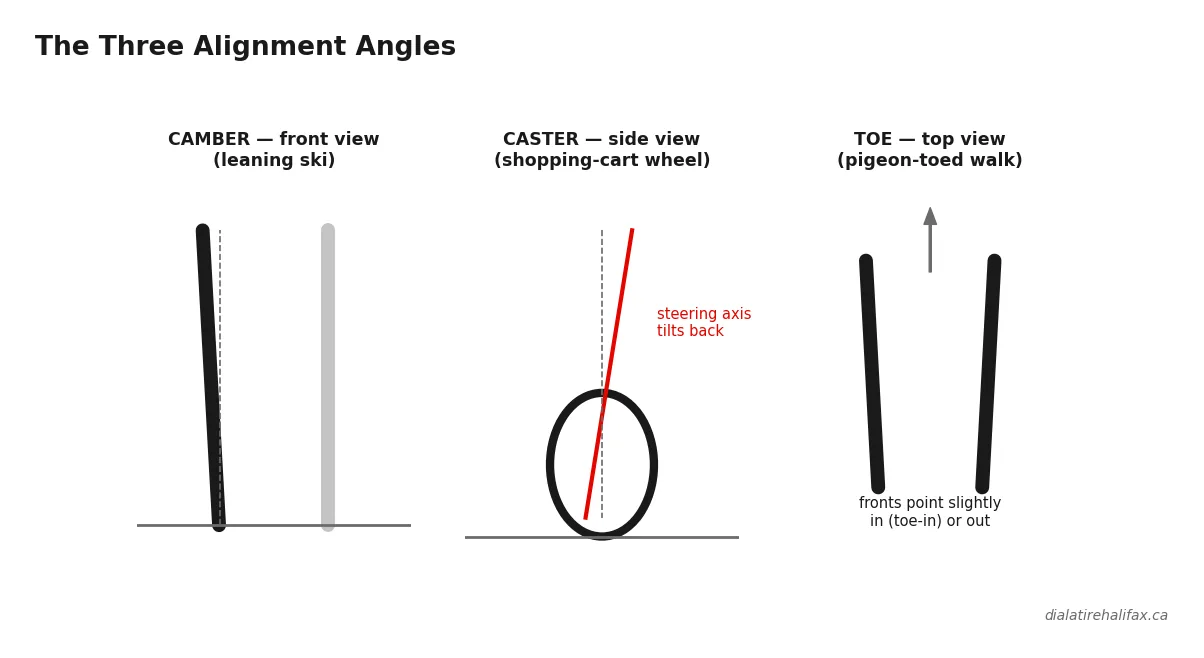
Camber is the tilt of the wheel when you look at the car head-on. Zero camber means the wheel stands perfectly vertical. Positive camber means the top of the wheel leans outward, away from the car. Negative camber means the top leans inward, toward the engine bay. Think of a downhill skier carving a turn: they tip their skis onto an edge to engage a tight arc. That’s negative camber doing useful work, but only for a moment, at the corner’s apex.
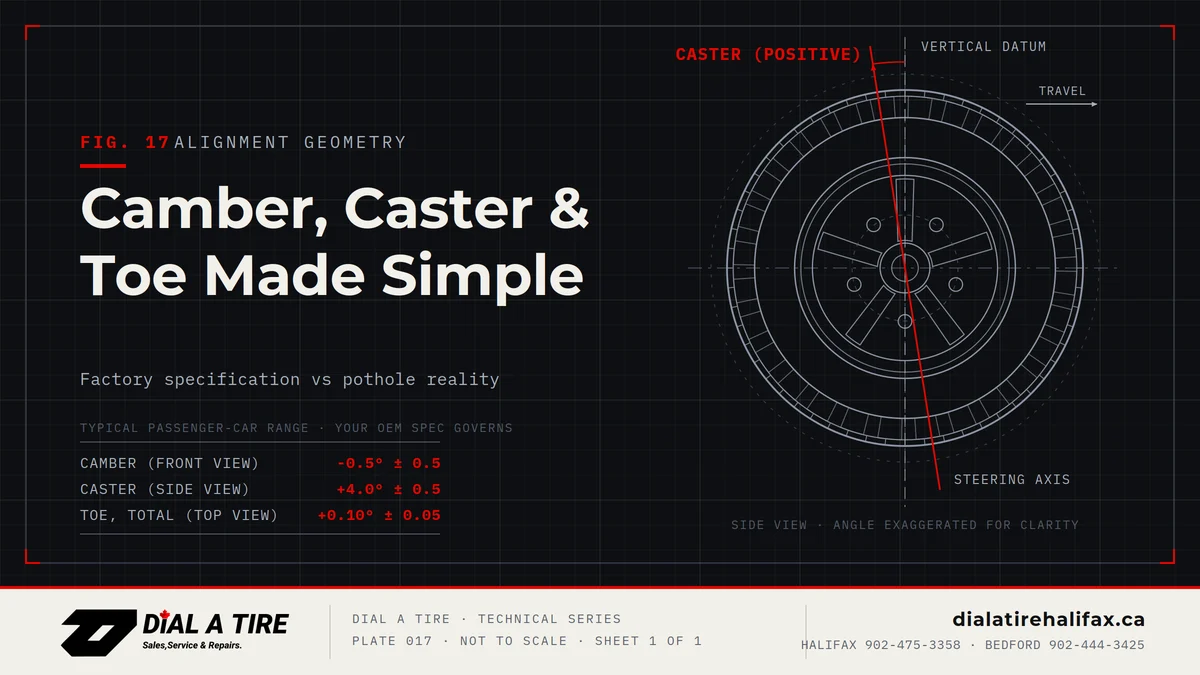
On a road car, excessive negative camber wears the inside shoulder of the tire far faster than the rest of the tread. Excessive positive camber wears the outside shoulder. Either way, you’re losing tread life on one edge while the centre of the tire still looks new. The ideal camber for most street vehicles is close to zero, with a small degree of negative dialled in to compensate for body roll during cornering: typically somewhere in the range of 0° to –1° depending on the manufacturer’s specification for that vehicle.
Camber drifts when suspension components shift, wear, or bend. A hard pothole hit or curb strike can push a wheel out of spec immediately. Worn ball joints and control arm bushings let camber creep gradually over months, slowly enough that many drivers don’t notice until the inside tread edge is nearly gone.
What Is Caster? The Angle You Can’t See but Definitely Feel
Caster is the tilt of the steering axis when you look at the car from the side. Picture the front wheel of a shopping cart: the pivot point sits ahead of where the wheel contacts the ground. That offset is why the cart’s wheel trails behind and self-centres: it’s a stability mechanism built into the geometry. Your car’s steering works on the same principle.
Positive caster means the steering axis tilts rearward at the top (the more common setup on modern vehicles). This gives the tire a trailing action that naturally returns the steering wheel toward centre after a turn and makes the car feel planted and stable at highway speeds. Negative caster, top of the axis tilted forward, does the opposite: the car feels darty, requires constant small corrections, and the steering has a vague, disconnected quality that is tiring on long drives.
Unequal caster side-to-side, say, left at +3.5° and right at +2.0°, pulls the car toward the side with less positive caster. If your car drifts on a straight, level road with relaxed hands, unequal caster is one of the first things a technician will check. On many modern vehicles, caster cannot be adjusted without aftermarket hardware, but measuring it is still essential to diagnosing a pull.
What Is Toe, and Why Does It Eat Tires the Fastest?
Toe is the angle of the wheels when viewed from directly above. Toe-in means the fronts of the tires point slightly toward each other, like a person walking slightly pigeon-toed. Toe-out means the fronts of the tires point slightly away from each other. Both are measured in millimetres of difference between the front and rear edges of the rim, or in fractions of a degree.
Of the three alignment angles, toe has the most dramatic and immediate effect on tire wear. Even a few millimetres of toe error means the tire is constantly being dragged sideways across the pavement as the car moves forward, like an eraser dragged across paper at a slight angle. The result is a feathered or sawtooth wear pattern across the tread. Run significant toe error for a few thousand kilometres and you can ruin a set of tires.
Toe also affects straight-line stability. A small amount of toe-in on the front axle is intentional on many rear-wheel-drive vehicles, providing a natural tendency to track straight. Front-wheel-drive vehicles often run a touch of toe-out to compensate for the way drive forces pull the front wheels inward under acceleration. These specifications are tight, often within a fraction of a degree, which is why a calibrated alignment rack matters and eyeballing it does not.
🔧 Engineering Corner
Toe wear is governed by the slip angle the tire is forced to run continuously. Even 0.5° of toe error means the contact patch is always scrubbing at a small angle to the direction of travel. Tire lateral force per degree of slip angle, the cornering stiffness coefficient, is typically 800–1,200 N/degree for a passenger-car tire. At 0.5° of continuous toe-out, that works out to roughly 400–600 N of sustained scrub force per tire, every kilometre you drive. Plain-English version: even a tiny toe error never rests. It grinds your tire a little more with every metre you travel.
Why Alignment Angles Drift on Halifax Roads
Halifax does not have gentle roads. The combination of freeze-thaw cycles, road salt, and a coastal climate means potholes open up in late February and don’t always get filled until May. Frost heaves push sections of pavement up and down over the winter. The result is that a car driving local roads year-round takes far more impact load through its suspension than a car in a milder climate.
Every time a wheel drops into a pothole, the suspension absorbs a force spike that can be several times the normal load. Repeated hard hits compress the rubber bushings that locate control arms. Once a bushing loses its precision fit, the arm can shift by a millimetre or two, enough to take camber or toe outside of spec without any single dramatic event to point to. Curb strikes are another common culprit, particularly for the rear axle: a hard parallel-parking tap can shift rear toe enough to cause a noticeable pull. Because rear alignment damage often goes unnoticed until a tire is showing edge wear, a four-wheel alignment check is worth doing whenever the front is being adjusted.
Suspension wear compounds the problem over time. As race engineers have long emphasized, the geometry of any suspension system only works as intended when every component is at the dimension it was designed to operate at. Worn ball joints, sagging coil springs, and degraded control arm bushings all shift the effective geometry away from the manufacturer’s specification, and no amount of alignment adjustment can fully compensate for components that are no longer holding their design position. If your alignment keeps drifting back out of spec within a few months, worn suspension parts are the likely cause rather than a second pothole strike.
Reading the Symptoms: What Each Misaligned Angle Feels Like
Camber problems show up in tire wear, not steering feel. Worn inside tread edges point to too much negative camber; worn outside edges suggest positive camber, less common but possible after a hard outer-wheel impact. Caster problems show up in handling: unequal caster pulls the car to one side; insufficient positive caster makes the steering feel light and vague at highway speed, as though the wheel won’t return to centre on its own.
Toe problems show up in both wear and handling at once. Toe-out makes the car feel nervous and over-responsive; toe-in makes it feel stable but sluggish to turn. The physical evidence is a feathered tread wear pattern. Run your hand across the tread blocks from side to side: if they feel sharp on one edge and rounded on the other, like saw teeth, toe error is the likely culprit. Our post on why tires wear unevenly covers this pattern in more detail.
How Often Should You Check Alignment in Nova Scotia?
The general recommendation is to have alignment checked once a year or every 20,000 kilometres, whichever comes first. In Nova Scotia, that guideline should be treated as a minimum rather than a target. Given the road conditions from November through April, most vehicles benefit from an alignment check at the spring seasonal tire changeover, right when the winter damage is fresh and before it has had months to chew through new summer tire edges.
Specific events should trigger an immediate check regardless of schedule: any pothole strike you felt through the steering wheel, any curb hit hard enough to jolt the car, any low-speed collision, and any time the steering wheel sits crooked on a straight road. Waiting until the next scheduled service means driving on compromised geometry for weeks. Also check alignment after any suspension repair, replacing struts, control arms, ball joints, or tie rod ends, so the new components start life at the correct position. For more on how balancing and alignment work together, see our guide on tire balancing vs. wheel alignment.
What This Means for Your Car
Alignment is one of the cheapest maintenance items relative to what it protects. A set of quality tires represents a significant investment. A set of tires worn to the shoulder in 15,000 kilometres instead of 60,000 because alignment was neglected is a preventable cost. Beyond the tires themselves, misalignment puts asymmetrical side loads through steering and suspension components, loads they were not designed to carry continuously, which accelerates wear in wheel bearings, ball joints, and tie rod ends.
A check after each winter, or after any significant road impact, catches most problems early, when the correction is straightforward and before tire wear has occurred. Think of it as a once-a-year geometric health check for a system working hard every time you drive.
Book Your Wheel Alignment in Halifax or Bedford
If your car is pulling to one side, the steering wheel sits crooked on a straight road, or you’ve noticed uneven tire wear on the inner or outer edges, it’s time for a professional alignment check. Our technicians use a four-wheel alignment rack to measure all three angles at each corner of the car, compare them against your vehicle manufacturer’s specifications, and adjust to bring everything back into tolerance. Book a wheel alignment at either of our Halifax or Bedford locations, we’re open daily including weekends.
HALIFAX — Dial A Tire
308 Herring Cove Rd, Halifax, NS
902-475-3358
BEDFORD — Dial A Tire
70 Rosno Lane, Bedford, NS
902-444-3425
Open daily 8 AM–5 PM. Please call before coming.
Locally owned since 1994 · Red Seal technicians · Professional installation & precision balancing