There is a stretch of Herring Cove Road in the spring, after the salt trucks have finished and before the patching crews arrive, where you can feel each wheel working independently under the car. One front wheel drops into a crack, the body barely moves, and the wheel comes right back up. That is your suspension doing exactly what it was designed to do: isolate the body from the road surface so the tire stays planted rather than bouncing across the pavement. When car suspension works well, you barely notice it. When it starts to fail, the consequences range from uncomfortable to genuinely unsafe.
Halifax is particularly hard on suspension components. The freeze-thaw cycle that defines a Nova Scotia winter — water seeping into pavement cracks, expanding as ice, then heaving the asphalt into broken lips and craters — creates some of the most punishing road conditions in the country. Add road salt accelerating corrosion on every metal component underneath the car, and suspension parts that might last 150,000 km in a milder climate are often worn significantly sooner here.
Understanding what your suspension actually does, in plain language, without workshop jargon, means you can recognize the warning signs before they become expensive repairs or safety problems.
The Two Jobs of Your Suspension: Spring and Damper
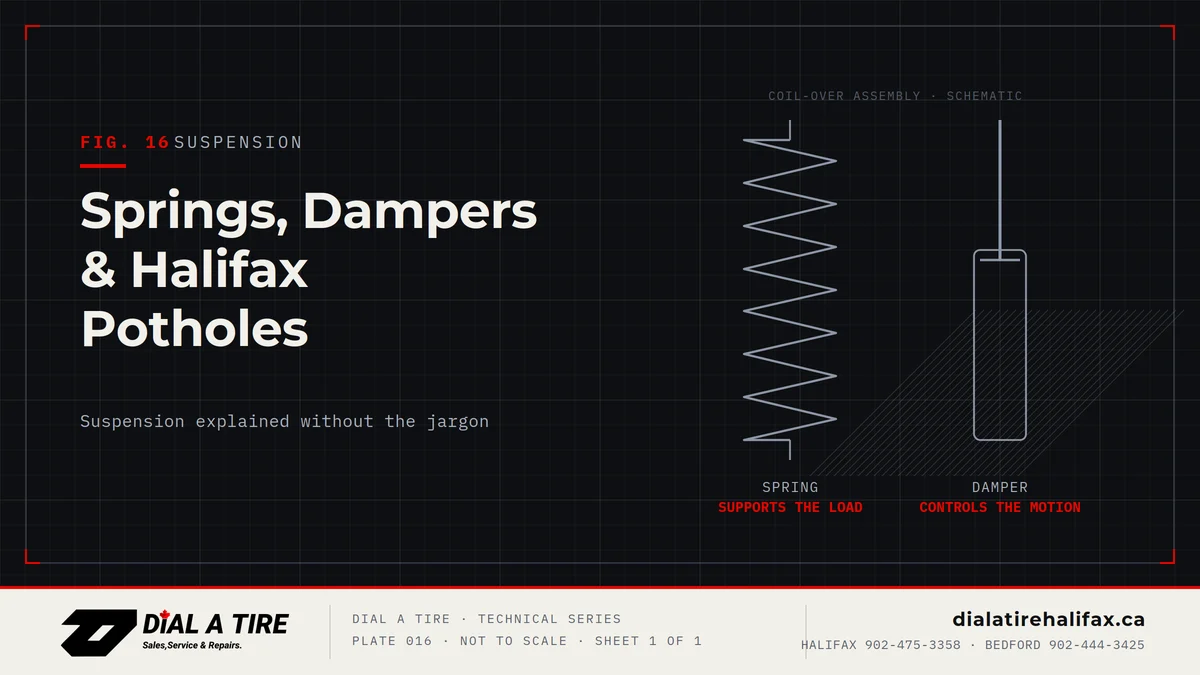
Every suspension system, regardless of design complexity, performs two distinct jobs using two distinct components: the spring holds the car up, and the damper (the part most people call the shock absorber or strut) controls what the spring does after it is disturbed.
The spring’s job is energy storage. When a wheel hits a bump, the spring compresses, absorbing the impact energy. When the wheel passes the bump, the spring extends again, returning the wheel toward the road. Without a spring, every bump would be a direct hit transmitted straight into the car body, and the passengers.
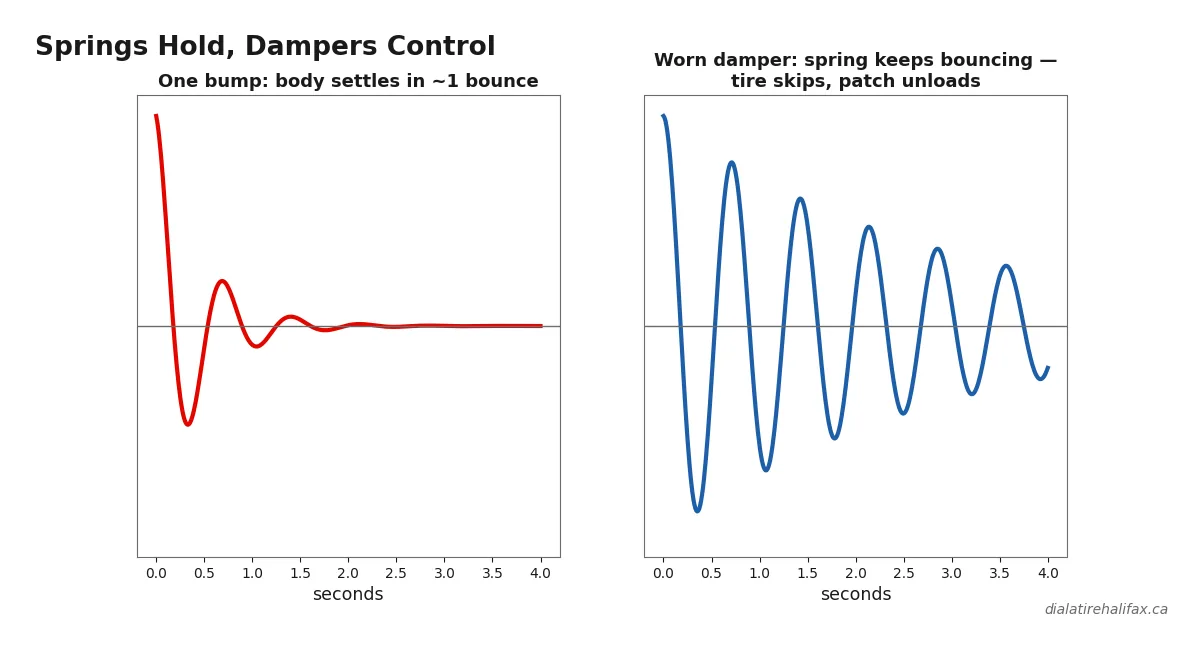
The damper’s job is energy dissipation. A spring on its own, once set in motion, keeps bouncing. If you have ever sat in a car with completely failed shock absorbers, you will recognize the sensation: hit one bump and the car oscillates up and down for several seconds afterward, like a boat on a wave. The damper, filled with hydraulic fluid and calibrated orifices, converts that kinetic energy into heat, typically settling the oscillation within a cycle or two. That controlled motion is what keeps the tire in contact with the road.
The tire only grips when it is touching the road. A suspension that lets the tire bounce free, even briefly, even a few millimetres, has temporarily lost all braking, steering, and cornering force at that corner. Comfort is a side effect; grip maintenance is the real job.
Struts vs Shock Absorbers: What Is the Difference?
Both struts and shock absorbers are damping devices, but they serve different structural roles in the suspension system.
A conventional shock absorber is a stand-alone damping unit mounted between the suspension arm and the body. The spring is a separate coil spring elsewhere in the assembly. Many rear suspension systems and some older front systems use this arrangement.
A MacPherson strut, the most common front suspension design on modern passenger cars, combines the damper and a structural load-bearing function into a single unit. The strut is the pivot point for the wheel when steering; it carries lateral loads as well as vertical ones. This is why a strut failure can affect steering feel, not just ride quality. It is also why strut replacement is a more involved job than replacing a simple shock absorber, and why the alignment typically needs to be checked after strut work: the geometry of the steering changes when the strut is disturbed.
What Halifax Potholes Actually Do to Suspension Components
A pothole is an abrupt edge, followed by a drop, followed by another abrupt edge coming back up. At road speed, the sequence of forces is violent.
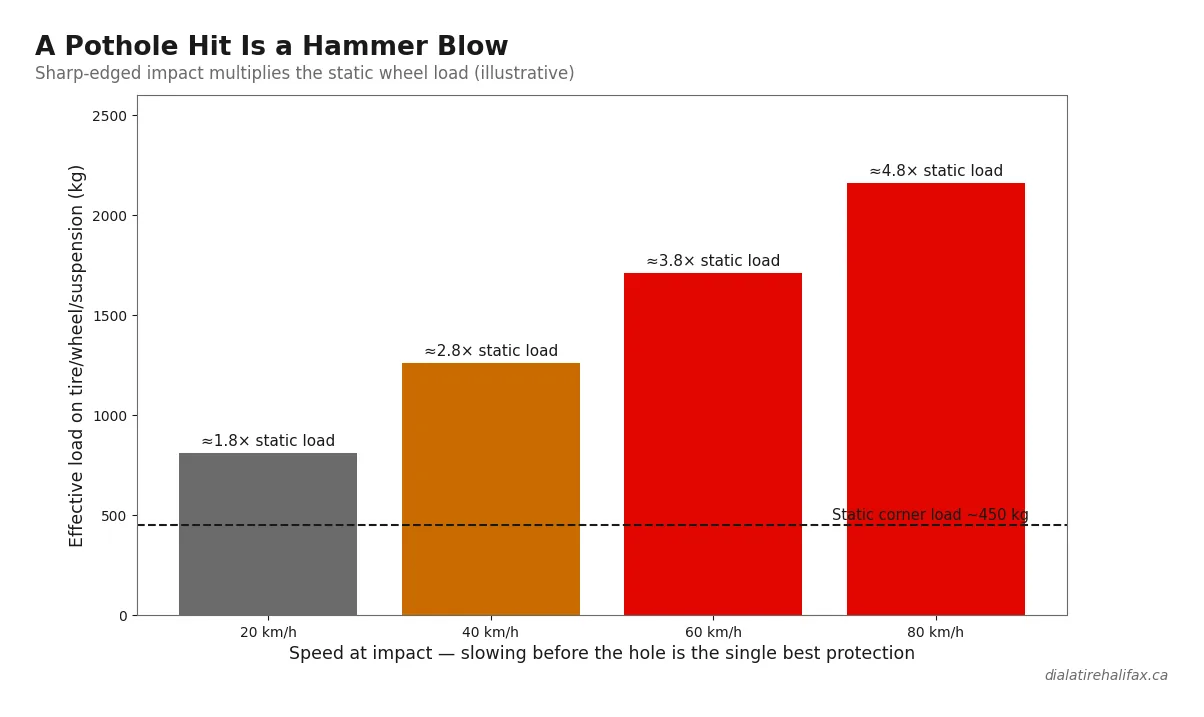
When a tire drops into a pothole at 50 km/h, the wheel and suspension have a fraction of a second to react before hitting the far edge. For a brief instant, the load on that wheel can spike to several times what it carries when the car is sitting still. The strut or shock absorber must absorb that spike. Ball joints, tie rod ends, and subframe bushings all feel it too.
A single severe pothole hit can cause immediate damage: bent wheel, cracked tire sidewall, displaced alignment. More commonly, repeated smaller impacts accumulate damage over time. Damper seals weaken, hydraulic fluid leaks slowly, and the damper loses its ability to control spring rebound. The car does not dramatically fail; it gradually becomes less controlled, less predictable, and less safe, in a way that is easy to normalize if the change happens slowly enough.
Halifax’s freeze-thaw cycle is relentless from roughly November through April — close to half the year of pothole-season road conditions. Combined with road salt attacking metal components, suspension wear happens faster here than drivers from milder climates typically expect.
How Worn Suspension Connects to Tire Wear
One of the clearest indicators of suspension problems that comes through the door with every car is the tire itself. A damper that can no longer control spring rebound allows the wheel to bounce rather than roll. Each of those small bounces scrubs a patch of rubber from the tread in a rhythmic pattern. This is called cupping or scalloping: a series of shallow, evenly spaced wear patches around the circumference of the tire, their spacing set by the rhythm of the wheel’s bounce.
Cupped tires are noisy — there is a characteristic drumming or droning sound at speed — and they give a rougher ride. But the more important issue is that cupped wear means the tire is already past the point where the suspension was failing it. By the time you see cupping, both the tire and the damper need attention.
Our post on why tires wear unevenly in Halifax covers the full range of wear patterns and what each one points to: suspension, alignment, inflation, or combinations of all three. If your tires are showing uneven wear, starting with a suspension inspection is often the right diagnostic step before buying new rubber.
Signs Your Suspension May Need Attention
Suspension wear is gradual, but there are reliable signals to watch for.
The bounce test. Press down firmly on each corner of the car and release. A car with healthy dampers settles in one motion: one compression, one rebound, done. If the car bounces twice or more before settling, the damper at that corner is not controlling the spring properly.
Nose-dive under braking. When you brake firmly and the front of the car dips excessively before stopping, the front dampers are not resisting that transfer of weight quickly enough. Modern vehicles have some nose-dive built in by design, but pronounced diving is a sign of worn front struts. It also means your braking is less effective than it should be. Weight transfer forward compresses the front suspension and unloads the rear, shifting the braking balance.
Body roll in corners. Every car leans in a corner, but a car with worn shocks and struts leans significantly more than it should, and recovers slowly when the corner straightens out. This is the suspension failing at its most basic task: keeping the contact patch loaded through a change of direction.
Steering wander or vagueness. If the car feels like it needs constant small corrections on a straight road, or if the steering feels disconnected from what the front wheels are doing, worn struts and bushings are often involved. Front struts are structural components of the steering geometry; they do not just absorb bumps.
Noise. Clunking or knocking over bumps points toward worn ball joints or bushings. A thudding noise from one corner when you go over a speed bump often means a failed strut mount or bearing plate at the top of the strut. These are components worth investigating promptly: a failed ball joint, in particular, can cause sudden loss of wheel control.
Suspension and Your Alignment: The Hidden Connection
Wheel alignment, the precise angular relationship of the wheels to each other and to the road, is determined by the geometry of the suspension components. Worn ball joints, sagging springs, and deteriorated bushings all change that geometry, even without a specific impact event to blame.
A car that keeps pulling to one side after a fresh alignment, or that returns to the shop with the same alignment drift within a few months, is often telling you that a suspension component is worn and needs replacement before the alignment will hold. Aligning a car with a worn ball joint is like straightening a picture on a crooked nail: it looks right initially, but the underlying problem means it will not stay that way.
Our wheel alignment service includes a visual inspection of the suspension components that affect alignment. If something looks worn enough to compromise the alignment, we will tell you before proceeding.
What This Means for Your Car
The practical upshot is straightforward. After a rough winter or a particularly bad pothole season, which in Halifax means every spring, it is worth doing a visual check and the bounce test yourself. Listen for noises over bumps. Pay attention to how the car behaves under braking. If you have been noticing a rough ride that has come on gradually, do not normalize it. Gradual changes are easy to accept, but they represent real degradation in safety and tire life.
If your tires are showing uneven wear, or if you have hit a particularly deep pothole and felt something that did not feel right, have the suspension looked at before putting new tires on. New rubber on worn suspension is a false economy: the tires will cup and wear unevenly again within months, and you will have replaced the symptom without treating the cause.
The Bosch Automotive Handbook provides the engineering detail on suspension kinematics for those who want to understand the geometry at a deeper level, but for everyday purposes, the signals above are what to watch for.
Book a Suspension Inspection in Halifax or Bedford
If you are noticing any of the signs above: bouncing, nose-dive, body roll, steering vagueness, unusual tire wear, or suspension noise, our Red Seal technicians can inspect the full system at either location. We also check suspension condition as part of any seasonal tire changeover, since that is when the wheels come off and everything is accessible. For a dedicated inspection, book an appointment online or give us a call. Explore our suspension service page for more on what we inspect and repair.
HALIFAX — Dial A Tire
308 Herring Cove Rd, Halifax, NS
902-475-3358
BEDFORD — Dial A Tire
70 Rosno Lane, Bedford, NS
902-444-3425
Open daily 8 AM–5 PM. Please call before coming.
Locally owned since 1994 · Red Seal technicians · Professional installation & precision balancing