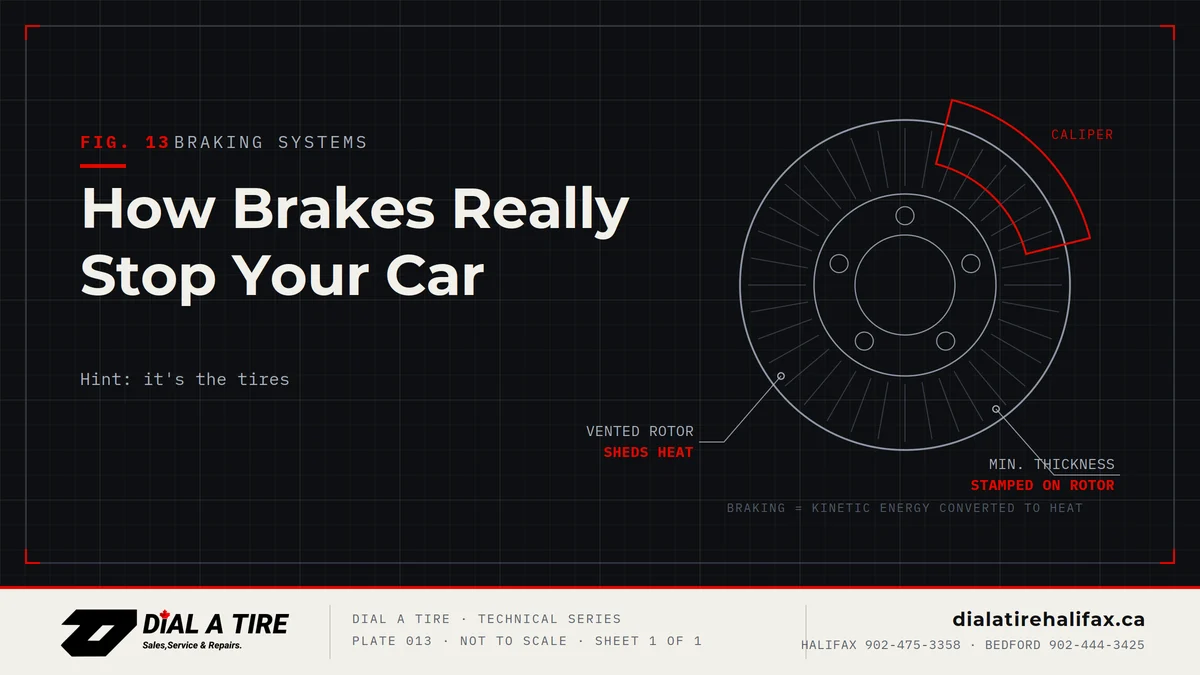
You press the brake pedal and your car slows down. Simple enough. But here is what actually happens: your brake pads clamp the rotors, your wheels slow their spin, and then (only then) do your tires drag against the road surface to absorb your speed. The brakes convert kinetic energy into heat. The tires convert that deceleration into friction between rubber and pavement. Take away the grip, and even the best brakes in the world cannot stop you any faster. Braking distance, ultimately, is a tire problem.
We see the consequences of this in the shop regularly. A customer comes in with brand-new brake pads, fresh rotors, the whole job, and they’re still nervous about stopping distances on a wet autumn morning on the Bicentennial Highway. The brakes are fine. The tires are four years old and worn to the wear bars. That’s the real issue. Understanding why changes how you think about your whole vehicle.
This is the physics behind stopping, and why every kilometre of Halifax’s stop-and-go traffic, every slick crosswalk on Barrington Street in October, ultimately comes down to four palm-sized patches of rubber.
What the Brake System Actually Does
Your brake system’s job is to convert the kinetic energy of a moving vehicle into thermal energy (heat) as quickly and controllably as possible. When you press the pedal, hydraulic pressure pushes the brake pads against the spinning rotors. The friction at that interface creates enormous heat. Modern discs can exceed 400°C in a single hard stop, and repeated hard braking (say, descending the Cobequid Pass with a loaded car) can push them considerably higher.
None of that, however, slows the car by itself. The wheel must transfer that braking torque to the road. If the wheel stops spinning entirely — the locked-wheel skid that was common before the Anti-lock Braking System (ABS) became standard — you lose directional control and, counterintuitively, often extend your stopping distance. A sliding tire has less grip than a rolling one at the edge of its limit. That is the entire reason ABS was developed.
It helps to picture braking as a chain: hydraulic system → caliper → rotor → hub → tire → road. Every link matters. But the last link (rubber on asphalt) sets the ceiling that nothing upstream can exceed.
Stopping Distance Has Two Parts
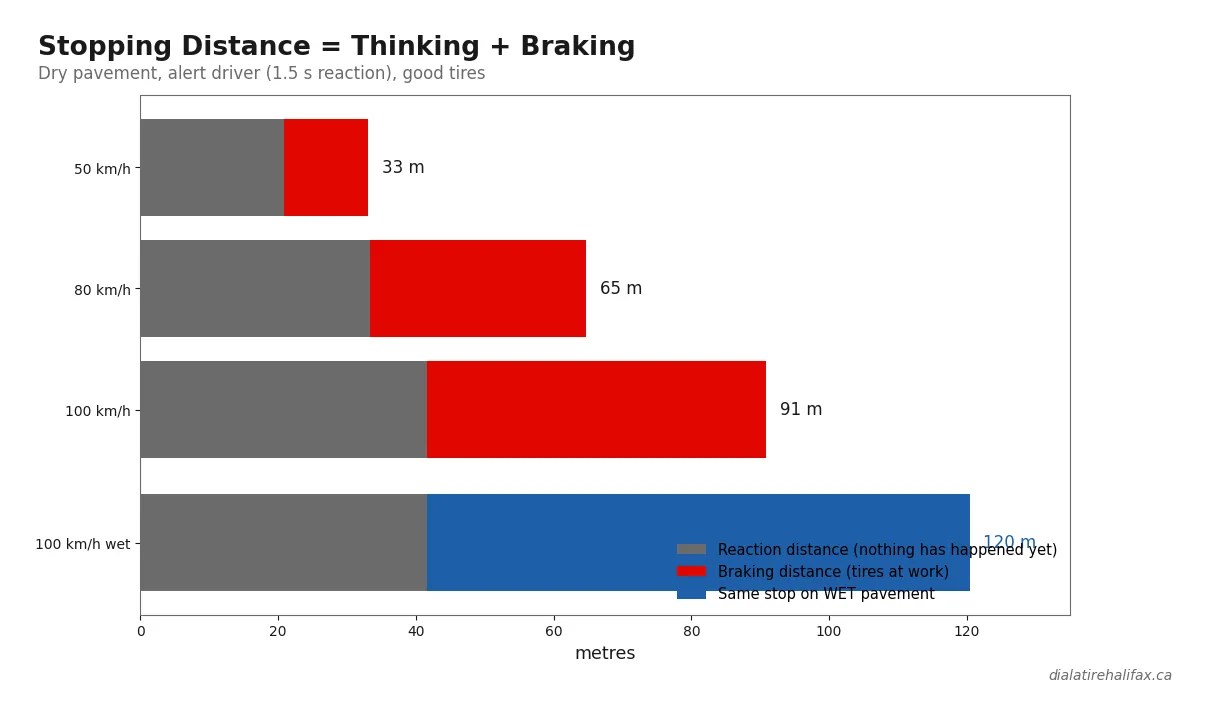
Total stopping distance is always the sum of two distinct phases, and drivers routinely underestimate the first one. The reaction distance is how far you travel between perceiving a hazard and the moment your foot actually makes contact with the pedal. At 100 kilometres per hour, you cover roughly 28 metres every second. Driver reaction time is commonly estimated at around 1.5 seconds, which puts pre-brake travel at over 40 metres — before any braking has begun at all.
The braking distance is what follows: the distance needed to decelerate from current speed to a full stop once the brakes engage. This phase is almost entirely governed by tire grip and vehicle weight. On dry pavement with good tires in good condition, a modern passenger car can achieve deceleration rates approaching 1 g (9.8 metres per second squared). On wet pavement with worn tires, that figure drops dramatically.
The old “two-second rule” for following distance gets discussed constantly. The physics says it is a minimum, and that minimum assumes alert reaction times, properly inflated tires with adequate tread depth, and dry road conditions. On a rainy Halifax afternoon in November, you need considerably more.
How ABS Keeps You at the Grip Limit
Anti-lock Braking System (ABS) works by monitoring wheel speed at each corner. The moment a wheel decelerates faster than the others (a sign it is about to lock) the system briefly reduces hydraulic pressure at that wheel, lets it spin back up, and then reapplies pressure. This happens many times per second and keeps the tire operating in its zone of maximum grip rather than sliding across the surface.
A common misunderstanding is that ABS shortens stopping distances on all surfaces. On dry pavement, ABS often produces slightly longer stopping distances than a very skilled driver at the limit. But it preserves steering control, which is the real safety benefit. On gravel or loose snow, locked wheels can actually stop you faster because the tire digs into the surface. But on wet pavement, which is what Halifax’s 1,400+ millimetres of annual precipitation delivers regularly, ABS consistently outperforms locked-wheel braking for the average driver.
The critical point: ABS can only work with the grip the tire actually has available. It optimizes the use of that grip. It cannot manufacture more of it. A worn tire with low tread depth has less grip, and ABS cannot change that fundamental limit.
Why Worn Tires Double Wet Stopping Distance
On dry pavement, a worn tire still makes reasonable contact with the road. There is relatively little water to displace, and rubber-to-asphalt friction remains fairly high. That is why worn tires can feel perfectly adequate on a dry summer day. Wet pavement is where the difference becomes stark and dangerous.
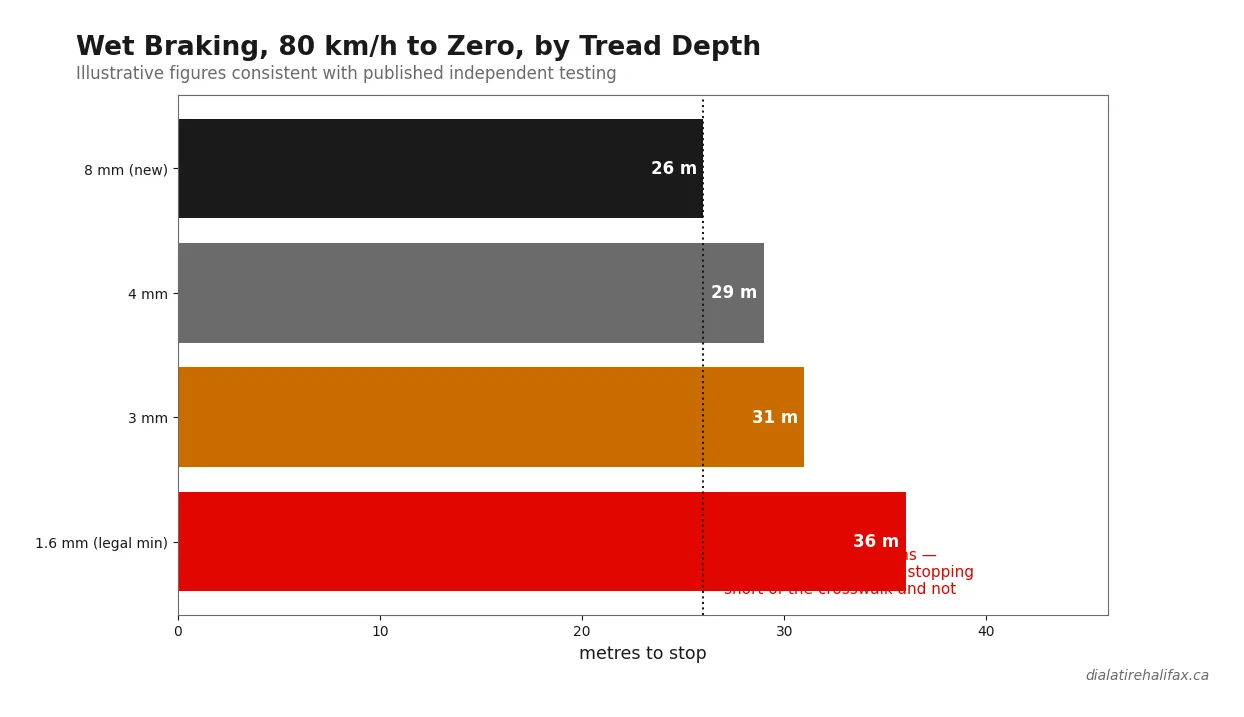
Tire tread grooves exist to channel water away from the contact patch. A new tire at roughly 8–9 mm of tread depth can evacuate several litres of water per second at highway speed. As tread wears down toward the 1.6 mm legal minimum, and really, toward the 3–4 mm point where wet-weather performance starts degrading meaningfully, the water cannot be evacuated fast enough. A thin film forms between rubber and road. Grip drops. The tire hydroplanes at lower speeds than a new tire would.
Independent tire testing — including the kind published by Tire Rack — routinely shows that tires at legal minimum tread depth require anywhere from 30 to 50 percent more distance to stop on wet pavement compared to the same tire when new. In urban terms: a car stopping from 80 km/h on a wet road that would normally halt in 35 metres may need closer to 50 metres with worn tires. That extra distance is several car lengths.
If your tires are nearing 3 mm or below, wet stopping distance is already compromised. You can check tread depth with a coin or a dedicated tread-depth gauge. Our guide to why tires wear unevenly also covers what uneven wear patterns tell you about your vehicle’s condition.
🔧 Engineering Corner
Stopping distance from a given speed is governed by the relationship: d = v² ÷ (2 × a), where d is braking distance, v is initial speed, and a is deceleration rate. Because speed is squared, doubling your speed quadruples your braking distance, not doubles it. A car travelling at 100 km/h (27.8 m/s) achieving a deceleration of 8 m/s² (roughly what good tires on wet pavement can manage) needs approximately 27.8² ÷ (2 × 8) = 772 ÷ 16 ≈ 48 metres of braking distance alone, before reaction time is added. Reduce the deceleration to 5 m/s² (as a worn tire on wet pavement might allow) and that figure climbs to roughly 77 metres. To a first approximation, the deceleration rate, a, is proportional to the coefficient of friction between tire and road. The tire is the variable, not the brakes.
Tire Inflation and Braking: The Connection Most Drivers Miss
Correct tire pressure affects braking in ways that are easy to overlook. An underinflated tire deforms more under load, which can alter the shape and distribution of the contact patch — the actual footprint of rubber on road. In some cases mild underinflation can increase contact patch area, which sounds beneficial. The problem is that the deformed contact patch is not loaded evenly. The edges of the patch carry disproportionate load while the centre unloads. The result is inconsistent grip across the patch width and accelerated shoulder wear.
More importantly, an underinflated tire runs hotter. Heat degrades rubber compound and accelerates internal structural fatigue. Over time, this reduces the tire’s ability to grip consistently. Our post on Tire Pressure Monitoring System (TPMS) warning lights covers how the system works and why Halifax’s dramatic seasonal temperature swings (from -15°C in February to +28°C in July) cause pressure to shift by several pounds per square inch (psi) through the year, even without a slow leak.
Check pressure cold, monthly. Use the value on your door jamb sticker, not the maximum moulded into the sidewall. This is one of the simplest things you can do for both braking performance and tire longevity.
Brake Condition Matters Too — But There Is an Order of Operations
None of this diminishes the importance of healthy brakes. Worn pads reduce clamping force. Scored rotors reduce rotor-interface friction. Brake fluid that has absorbed moisture can boil under sustained hard braking, giving a spongy pedal precisely when you need a firm one. These are all real problems worth addressing.
The point is simply that tire condition and brake condition are both necessary and neither is sufficient alone. In our experience, the tire is more often the limiting factor, particularly in the wetter months. Halifax drivers put plenty of kilometres on hard, freeze-thaw roads, and tires wear accordingly. When a customer tells us their car “doesn’t stop as well as it used to,” we inspect tires and brakes together. Often the tires are the answer. Sometimes both need attention.
What This Means for Your Car
Your tires set the maximum stopping performance your entire system can achieve. Brakes, ABS, Electronic Stability Control (ESC). All of it operates within the grip envelope your tires provide. Worn, underinflated, or age-hardened tires shrink that envelope. Modern safety systems cannot restore what the rubber no longer offers.
Check tread depth at least twice a year. Swapping seasonal tires is a natural prompt. Check inflation monthly. If your steering pulls under braking, the pedal feels different, or wet stopping distances seem longer than they once were, book an inspection. Do not wait for something to feel dramatically wrong before acting.
Book Your Brake Inspection in Halifax or Bedford
If you have questions about your brakes, tires, or stopping performance, our technicians at both Dial A Tire locations can inspect the full system and give you an honest assessment. We check pads, rotors, calipers, and tires together, because they work together. You can book an appointment online or call either location directly. Our brake repair service covers the full range of brake maintenance and replacement, and we can advise on tires at the same visit if needed.
HALIFAX — Dial A Tire
308 Herring Cove Rd, Halifax, NS
902-475-3358
BEDFORD — Dial A Tire
70 Rosno Lane, Bedford, NS
902-444-3425
Open daily 8 AM–5 PM. Please call before coming.
Locally owned since 1994 · Red Seal technicians · Professional installation & precision balancing