Electric vehicles (EVs) are arriving on Halifax roads in growing numbers, and they bring a characteristic that catches many new owners off guard: they eat through tires noticeably faster than the gas-powered cars most of us grew up with. Owners switching from a conventional sedan to an electric crossover sometimes find themselves replacing tires several thousand kilometres sooner than their previous vehicle’s interval suggested. It is not a defect. It is physics, and understanding it helps you manage the cost.
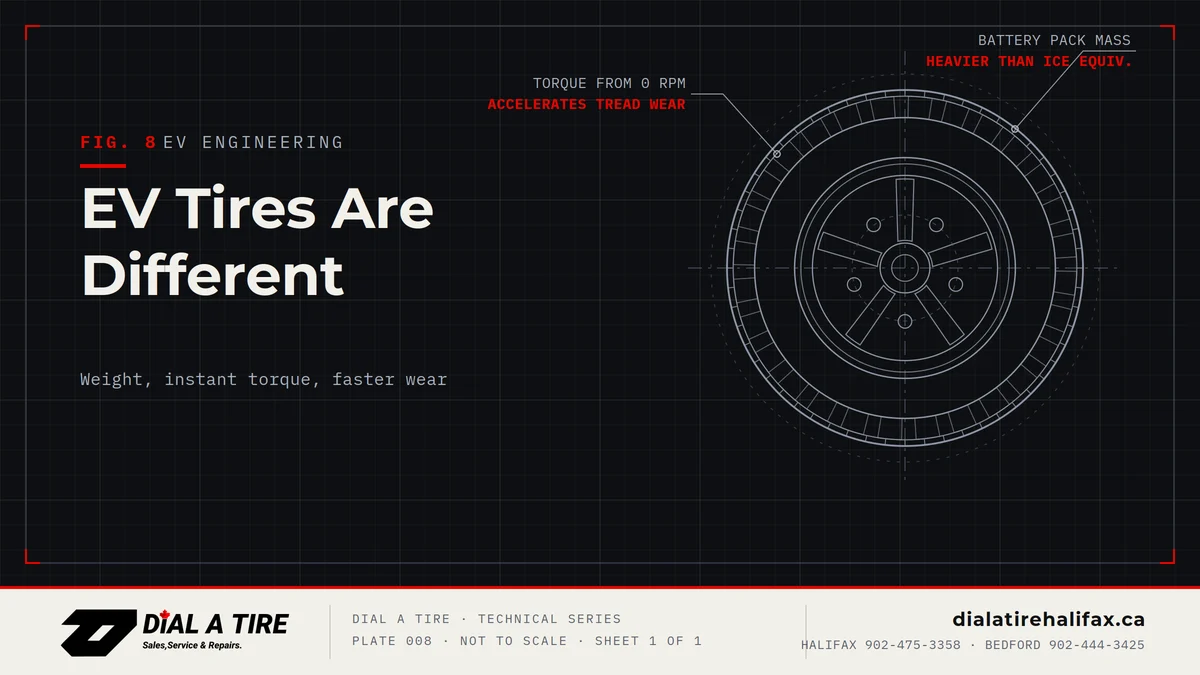
Three engineering realities combine to make EV tires work harder: the vehicles are significantly heavier than gas equivalents, the electric motor delivers its full torque instantaneously from a standstill, and the quieter powertrain makes road noise from tires far more noticeable to passengers. Each of these factors has practical consequences for how EV tires are constructed, how fast they wear, and what maintenance schedule you should follow.
This post works through each factor, covers regenerative braking and its effect on wear patterns, and ends with the practical maintenance habits that matter most for EV owners in Halifax.
Why EVs Are So Much Heavier, and What That Does to Tires
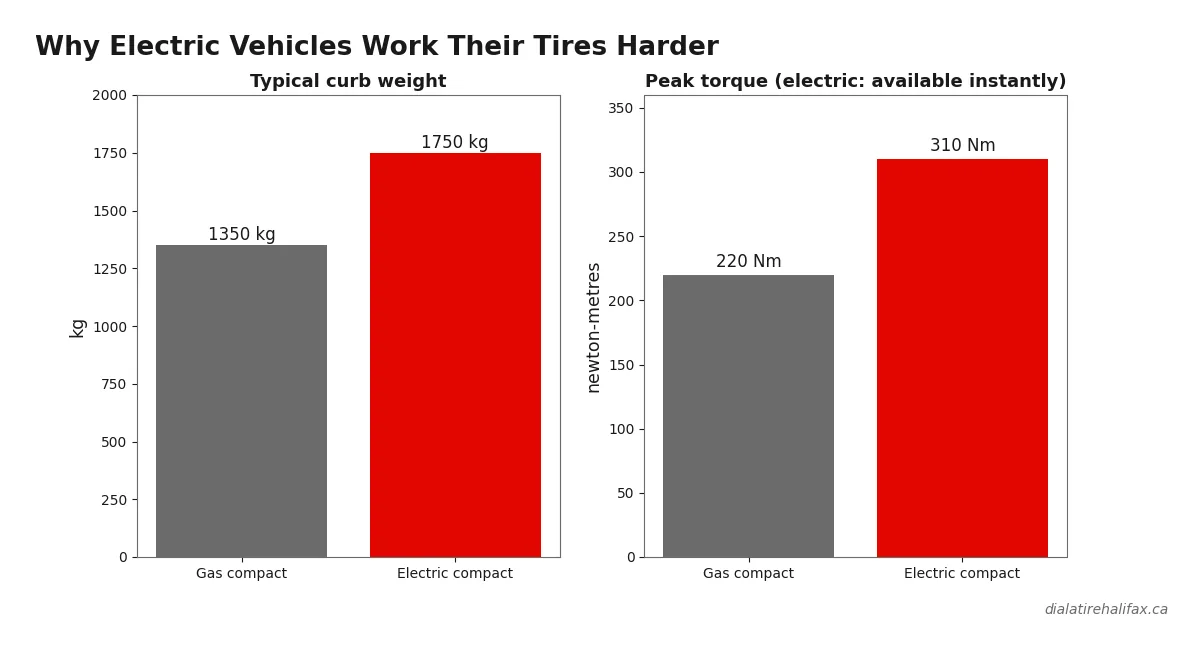
A large lithium-ion (Li-ion) battery pack is dense and heavy. A mid-size electric crossover typically carries a battery weighing 400–600 kg, and that mass cannot be designed around. It is the energy source. The result is that most electric vehicles are 300–600 kg heavier than the closest gas-powered equivalent. A popular electric crossover might weigh 2,100–2,300 kg where its gas sibling weighs 1,600–1,700 kg. That is not a rounding error; it is a meaningful structural load difference.
Tire load capacity is defined by the load index. The number stamped on the tire sidewall alongside the speed rating. Each load index number corresponds to a maximum load in kilograms that the tire can safely carry at the speed indicated by the speed rating. When a vehicle is heavier, the load on each tire is higher, the contact patch deforms more, and the tire flexes through a larger angle with each revolution. More flex means more heat generation inside the rubber, and heat is a major driver of accelerated tire wear and internal degradation.
EV-specific tires, offered by most major tire manufacturers under designations like “EV” or “Electric” in their product lines, are typically built with stiffer sidewall construction and higher load ratings than standard tires of the same size. They are engineered to manage the sustained load of a heavy vehicle without the excessive heat buildup that would shorten their service life on a lighter car. Fitting standard-load tires on an EV is not always impossible but does mean you may not be getting the service life the tire is capable of providing.
Instant Torque: What It Is and Why It Shears Tread
Internal combustion engines (petrol and diesel) build torque as engine speed rises. Maximum torque typically arrives somewhere between 1,500 and 4,500 revolutions per minute (RPM), meaning the engine has to rev before it can push hard. This gives the tire a brief moment to load up gradually before peak force arrives at the contact patch.
Electric motors work completely differently. They produce maximum torque at zero RPM. From a standstill, the instant the accelerator is pressed. There is no rev-up delay. Full torque hits the driven wheels immediately and at full magnitude. For the tire, this means the contact patch goes from rest to maximum shear stress in a fraction of a second rather than over a graduated ramp.
Shear stress is the force that acts parallel to the road surface. The force that propels the car forward by using friction between tread and pavement. When that force arrives instantaneously at its maximum value, the rubber at the contact patch has to deform and grip without the gradual load build-up a combustion engine provides. On wet roads, loose gravel, or cold pavement, the instant-torque characteristic makes wheelspin easier to provoke. Even when traction control (TC) intervenes to limit wheelspin, the rapid cycling of full torque, partial slip, and recovery puts more cumulative strain on the tread surface than the same distance covered in a combustion vehicle.
The cumulative effect is measurably faster wear on the driven axle. Typically the front or rear depending on drivetrain layout, or both in all-wheel-drive (AWD) configurations. Industry data from tire manufacturers and large fleet operators suggests EV tire wear runs roughly 20–30% faster than on comparable gas vehicles, though conditions and driving style vary significantly. That number matters when you are planning a maintenance budget.
🔧 Engineering Corner
The load numbers: Tire load is expressed as the vehicle’s weight distributed across each corner. A 1,700 kg compact car places roughly 425 kg on each tire at rest. A 2,200 kg electric crossover places roughly 550 kg on each tire. A 29% increase in static load per corner. Cornering and braking multiply these loads further through weight transfer. The load index on the tire sidewall is the maximum load in kilograms that tire can safely carry; exceeding it (even on a vehicle that came with that tire size) creates heat buildup and structural fatigue.
The torque picture: Traction force (F) at the contact patch equals torque (T) divided by tire radius (r). An electric motor producing 400 Newton-metres (Nm) of torque through a tire with a 0.33 m radius delivers approximately 1,212 Newtons of horizontal force to the road surface — instantly, at zero RPM. (This is a first approximation that leaves out drivetrain gear reduction; the real forces at the wheel are higher, but the relationship holds.) A petrol engine producing the same peak torque at 3,500 RPM delivers that force gradually as engine speed rises from idle. The tire has to absorb the same peak force in both cases, but the EV delivers it with no ramp time.
Plain English: heavier car, higher load per tire; instant torque, no grace period for the tread. Both factors accelerate wear.
Regenerative Braking and Its Effect on Wear Patterns
Most electric vehicles use regenerative braking as their primary means of slowing down. Instead of pressing the brake pedal to activate friction brakes, the driver lifts off the accelerator and the electric motor switches into generator mode. Converting the car’s kinetic energy back into electricity and slowing the vehicle in the process. Many EV drivers use the friction brakes only for the last few metres of a stop, or in emergency situations.
This changes the wear pattern across the tire in two ways. First, because the driven wheels are doing most of the deceleration work through the motor, those tires experience more cumulative stress than on a conventional car where friction brakes share the load evenly across all four corners. Second, because the rear brakes on a conventional car contribute significantly to overall braking force, the front-to-rear wear ratio on an EV can be different from what non-EV experience predicts. On some single-motor front-wheel-drive (FWD) EVs, the front tires do double duty: they both drive (taking full instant torque) and brake (bearing the regenerative braking load). Accelerated front tire wear is a known characteristic of these configurations.
The practical consequence is that tire rotation intervals become more important on an EV, not less. The wear differences between axles can develop faster than they would on a gas car, and letting them go uncorrected means you will eventually need to replace a full set before all four tires are worn. A waste of money and rubber. The general guidance from most EV manufacturers is to rotate tires every 10,000–12,000 km rather than the 12,000–15,000 km often suggested for conventional vehicles, though you should always follow your owner’s manual specification. Our guide to tire rotation intervals in Halifax explains the mechanics in more detail.
Noise: Why the Quiet Cabin Changes What You Hear From Your Tires
A petrol engine at highway speed produces a broad spectrum of sound (intake roar, exhaust note, valvetrain noise) that masks a significant amount of road and tire noise reaching the cabin. Remove that engine soundtrack and passengers hear their tires in a way they never did before. For many new EV owners, the transition from a petrol car to an electric one makes it seem as though the tires are suddenly noisier. In most cases, the tires are not noisier. The masking noise is gone.
The practical response from tire manufacturers has been acoustic foam: a ring of open-cell polyurethane foam bonded to the inside of the tire that absorbs resonance in the tire cavity and reduces structure-borne noise into the cabin. The foam does not affect pressure, load capacity, or structural performance, but it does require a technician who knows it is there. It must not be damaged during mounting, and the wheel must be balanced accounting for its presence. We are familiar with foam-lined construction at both locations.
EV-Specific Tire Lines: What Makes Them Different
Over the past several years, most major tire manufacturers (Michelin, Bridgestone, Continental, Goodyear and others) have introduced tire lines specifically developed for electric vehicles. These differ from standard tires in several meaningful ways beyond the foam liner mentioned above.
Higher load ratings. EV tires are typically rated one or two load index steps higher than standard tires of the same dimensions, reflecting the heavier vehicle they are designed to carry. Using the correct load rating is important for long-term durability and safety.
Lower rolling resistance. Electric vehicles are sold on their range, and range is partially determined by how much energy the tires consume through rolling resistance. The energy lost to rubber flexing and deformation with each revolution. EV tire compounds are optimized to minimize this energy loss, which extends range. The tradeoff is sometimes a slightly reduced wet grip performance compared with the most aggressive all-season compounds, though modern EV tires manage this balance well. Natural Resources Canada identifies rolling resistance as a factor in vehicle energy consumption, and on an EV that energy comes straight out of range.
Stiffer construction. To manage the higher loads and instant-torque stress cycles, EV tires often use stiffer sidewall construction than equivalently sized standard tires. This stiffness helps manage heat generation under load but can produce a firmer ride than some drivers expect.
Whether to specify an EV-designated tire or a high-quality standard tire of the correct load rating is a question worth discussing with a knowledgeable technician. The answer depends on your driving patterns, the specific EV model, and the tire options available in your size. When you are ready to shop, our tire selection tool covers the available options for your vehicle.
Wheel Alignment Is Just as Critical. Maybe More So
Because EV tire wear already runs faster than on a comparable gas vehicle, any additional wear caused by misalignment compounds the problem significantly. A wheel alignment (the precise geometry of how each wheel is angled relative to the road and to the other wheels) that is off by even a small amount accelerates uneven wear across the tread face. On a gas car running at standard wear rates, a misalignment might shorten tire life by 10,000–15,000 km. On an EV where the baseline wear rate is already higher, the same misalignment may eliminate an even larger fraction of the tire’s remaining life.
EVs are not especially prone to alignment drift, but the heavy battery pack means pothole impacts exert more force on suspension components, and Halifax’s freeze-thaw pothole cycles provide plenty of opportunities. A post-winter alignment check is sensible for any vehicle; for an EV owner with faster baseline wear, it is particularly worthwhile. Our wheel alignment service in Halifax sets all angles to manufacturer specification, and if you want to understand what misalignment looks like on the tread face, our uneven tire wear guide shows you what to look for.
Winter Tires on EVs: The Same Rules Apply, With One Caveat
Nova Scotia winters demand winter tires, and that applies equally to electric vehicles. The cold-weather flexibility of winter tire compounds — the basis of the industry’s roughly 7°C changeover guideline — benefits an EV exactly as it does a combustion vehicle. If anything, the instant-torque characteristic of an EV makes winter traction even more important: a petrol car that spins a wheel during a standing start on ice has a brief moment before peak torque arrives; an EV delivers full torque immediately, making wheelspin on slippery surfaces easier to provoke before the traction control can intervene.
The one caveat is range. Winter tires have higher rolling resistance than summer or all-season tires, and cold temperatures reduce battery capacity. EV owners will see a more noticeable range reduction in winter than petrol drivers see in fuel economy terms. That is a real tradeoff, but it does not change the safety calculus. Winter tires are appropriate for Nova Scotia from October through April, and many Nova Scotia drivers already run them. Our winter versus all-season tire guide covers the Nova Scotia-specific case in detail.
What This Means for Your EV in Halifax
If you drive an electric vehicle in Halifax, the practical summary is straightforward: expect tires to wear faster than on a gas car, rotate more frequently, stay on top of alignment after rough winters, and look for tires with the correct load index for your vehicle’s weight. The technology is evolving quickly (EV tire lines are improving every year) but the physics of weight, torque, and friction are not going to change.
Halifax drivers put plenty of kilometres on hard, freeze-thaw roads. At that mileage, faster-wearing tires mean the replacement cycle arrives sooner than it would in a lower-mileage city. Factoring that into your vehicle budget (and staying current with rotation and alignment) is the most cost-effective approach.
Book Your EV Tire Installation or Inspection in Halifax or Bedford
We install tires on electric vehicles the same way we install them on any vehicle: with the right equipment, the correct torque specification, and a pressure check to the manufacturer’s cold inflation target. If you are shopping for a new set of tires for your EV, have questions about load ratings, or want to book a rotation and alignment check, we are available daily at both locations. Book an appointment online or call. No appointment is wasted when you call ahead.
HALIFAX — Dial A Tire
308 Herring Cove Rd, Halifax, NS
902-475-3358
BEDFORD — Dial A Tire
70 Rosno Lane, Bedford, NS
902-444-3425
Open daily 8 AM–5 PM. Please call before coming.
Locally owned since 1994 · Red Seal technicians · Professional installation & precision balancing