If we had a dollar for every time someone came into the shop saying, “I think I need an alignment,” when they actually needed balancing or vice versa we’d have enough for another alignment rack.
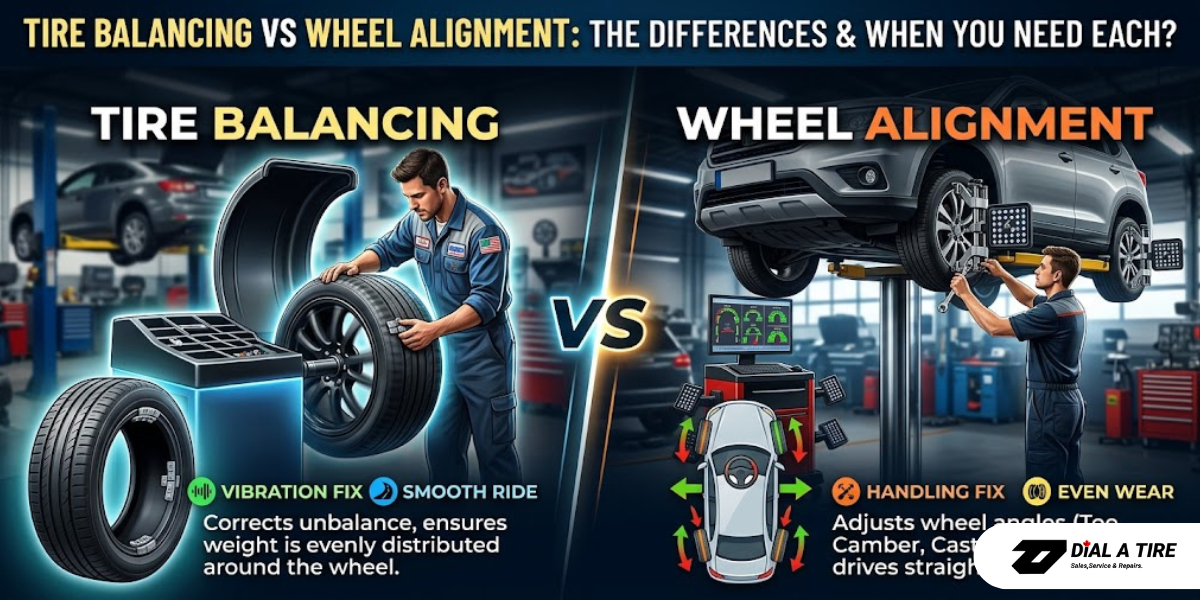
Tire balancing and wheel alignment are two completely different services. They fix different problems, use different equipment, and are triggered by different symptoms. But because they both involve tires, wheels, and the general feeling that “my car doesn’t feel right,” people mix them up constantly.
No shame in that it’s confusing if nobody’s ever explained the difference.
And in Halifax, this confusion happens even more often because potholes and rough winter roads can trigger both problems at the same time. A hard pothole impact can knock a wheel out of balance, shift alignment angles, or sometimes both in a single hit.
So let’s clear it up.
Tire Balancing: What It Is And What It Fixes?
The Problem Balancing Solves
No tire-and-wheel assembly is perfectly uniform. There are always tiny variations in weight distribution slightly thicker rubber in one spot, a valve stem adding mass, or a wheel that’s fractionally heavier on one side. These differences are tiny and completely normal.
But at highway speed, your wheel is spinning hundreds of times per minute. At that speed, even a small imbalance creates centrifugal force that makes the wheel want to wobble. You feel that wobble as vibration usually in the steering wheel (front tire imbalance) or through the seat and floor (rear tire imbalance).
What The Balancing Service Involves?
The technician mounts each tire-and-wheel assembly on a computerized balancing machine, which spins the wheel and identifies where the heavier spots are.
Small balancing weights are then attached to precise locations on the wheel to counteract those heavier areas. The result is a wheel that spins smoothly with vibration minimized.
When You Need Tire Balancing?
Vibration At Highway Speed
Usually starts around 80–100 km/h. This is the classic balancing symptom.
After Installing New Tires
New tires should always be balanced at installation. If a shop mounts new tires without balancing them, that’s a red flag.
After Hitting A Pothole Or Curb
A hard impact can knock balancing weights off or slightly shift the tire on the rim very common in Halifax.
After A Tire Repair
A plug or patch adds a small amount of mass that may require rebalancing.
During Seasonal Tire Changes
Especially when mounting tires onto wheels instead of swapping pre-mounted wheel-and-tire assemblies.
When Vibration Develops Over Time
As tires wear, weight distribution changes slightly. If vibration develops after many kilometres, rebalancing may help.
What Balancing Does NOT Fix?
Balancing does not:
- correct pulling or drifting
- straighten a crooked steering wheel
- fix uneven tire wear from alignment problems
- correct suspension geometry
If the vehicle pulls left or right, balancing usually isn’t the solution.
Also important: if vibration happens only while braking, that’s often a brake rotor issue not balancing or alignment.
Wheel Alignment: What It Is And What It Fixes?
The Problem Alignment Solves
Wheel alignment adjusts the angles at which your tires contact the road.
Vehicle manufacturers design specific alignment settings for:
- proper tire wear
- straight tracking
- predictable handling
- steering stability
Over time, those angles shift due to:
- potholes
- curb impacts
- worn suspension components
- normal road wear
- Halifax winters being Halifax winters
When alignment angles move out of specification, the tires stop rolling perfectly straight. They begin dragging slightly sideways or leaning incorrectly, which leads to:
- uneven tire wear
- pulling
- wandering
- off-centre steering
- reduced stability
The Three Main Alignment Angles
Camber
The inward or outward tilt of the tire viewed from the front.
- Negative camber = top tilts inward → inside-edge wear
- Positive camber = top tilts outward → outside-edge wear
Toe
Whether the tires point inward or outward when viewed from above.
Toe problems are one of the biggest causes of:
- feathering wear
- unstable highway feel
- wandering
Caster
The angle of the steering axis viewed from the side.
Caster mainly affects:
- steering feel
- steering return-to-centre
- directional stability
It’s less commonly adjustable, but it still affects how the vehicle tracks.
What An Alignment Service Involves?
The vehicle is placed on an alignment rack and sensors are attached to each wheel.
The alignment system measures the current wheel angles and compares them against manufacturer specifications. The technician then adjusts the suspension geometry using the vehicle’s built-in adjustment points.
On most modern vehicles, a four-wheel alignment is the proper approach because rear-wheel alignment angles affect how the vehicle tracks overall.
When You Need A Wheel Alignment?
The car pulls left or right
On a flat, straight road with properly inflated tires.
The steering wheel sits crooked
Even though the car is moving straight.
Uneven tire wear
Especially inside-edge or outside-edge wear.
The vehicle wanders at highway speed
Feels unstable or requires constant correction.
After a pothole or curb impact
This is probably the #1 alignment trigger we see in Halifax.
After suspension or steering repairs
Tie rods, ball joints, control arms, struts all affect alignment geometry.
After buying new tires
Starting fresh tires on a misaligned vehicle is one of the fastest ways to destroy them early.
As a routine annual check
Especially after winter pothole season. We usually recommend checking alignment during spring tire changeover season.
What Alignment Does NOT Fix?
Alignment does not:
- fix vibration at speed
- correct an unbalanced wheel
- repair bent rims
- solve tire defects
If the car is shaking rather than pulling, balancing is usually the first thing to investigate.
Quick Diagnostic: Which One Do You Probably Need?
| Symptom | Most Likely Issue |
| Steering wheel vibration at highway speed | Tire balancing |
| Vibration through the seat/floor | Rear tire balancing |
| Car pulls left or right | Wheel alignment |
| Steering wheel crooked while driving straight | Wheel alignment |
| Uneven inside-edge tire wear | Alignment |
| Vehicle wanders at highway speed | Alignment |
| Vibration only during braking | Brake rotor issue |
| Shake immediately after pothole hit | Balancing, alignment, or bent rim |
| Vibration after installing new tires | Tire balancing |
When You Probably Need BOTH
Sometimes the answer is both services especially in Halifax.
Common scenarios:
- Major pothole impact
- Installing new tires
- Long time since either service
- You notice both vibration and pulling
- Uneven wear plus highway shake
A pothole can absolutely:
- knock balancing weights off
- shift toe/camber angles
- damage suspension components
- bend a rim
…all in one hit.
Why Halifax Drivers Need These Services More Often
In cities with smoother roads, drivers may go years between alignment checks and only rebalance during tire installation.
Halifax is not one of those cities.
The combination of:
- freeze-thaw potholes
- frost-heaved pavement
- salt corrosion
- rough winter roads
- heavy spring pothole season
…means local vehicles take a beating.
The result:
- alignment angles drift more often
- balancing weights get knocked loose
- suspension components wear faster
- tire wear accelerates if issues go unchecked
That’s why Halifax drivers benefit from:
- annual alignment inspections
- balancing whenever vibration appears
- alignment checks after major pothole impacts
What These Services Typically Cost
We won’t quote exact pricing here because costs vary by vehicle and setup, but generally:
Tire balancing
Usually priced per wheel and often included during:
- new tire installation
- seasonal changeovers
- tire packages
Wheel alignment
Four-wheel alignments cost more than front-only alignments, but on modern vehicles they’re usually the better long-term value.
In both cases, the service cost is far lower than replacing tires early from uneven wear or vibration-related damage.
One alignment costs less than prematurely replacing even a single tire.
Bottom line
Balancing fixes vibration.
Alignment fixes pulling and uneven wear.
Different symptoms, different causes, different equipment, different fixes.
Sometimes you need one. Sometimes the other. And after a Halifax winter, needing both is more common than most drivers realize.
If you’re not sure which service you need, just describe what the vehicle is doing. We’ll inspect it, explain what’s actually causing the issue, and recommend only the service you need no guesswork and no unnecessary work.
At Dial-A-Tire, we perform both wheel balancing and wheel alignment services in Halifax using modern equipment and experienced technicians who understand local road conditions.
Book online or call 902-475-3358 for tire balancing or wheel alignment in Halifax. We’ll help your vehicle track straight, ride smoothly, and protect your tires from premature wear.
FAQs
Q1. What’s The Difference Between Tire Balancing And Wheel Alignment?
Answer: Tire balancing corrects weight imbalances in the tire-and-wheel assembly that cause vibration. Wheel alignment adjusts the angles at which the tires contact the road, fixing pulling, wandering, and uneven tire wear.
Q2. How Do I Know If I Need Balancing Or Alignment?
Answer: Vibration at highway speed usually points to balancing. Pulling to one side, uneven tire wear, or a crooked steering wheel usually points to alignment. After a pothole impact, you may need both.
Q3. How Often Should I Get a Wheel Alignment In Halifax?
Answer: At least once a year is a smart guideline for Halifax drivers, especially after winter pothole season. Alignment checks are also recommended after suspension repairs or significant pothole impacts.
Q4. Do I Need Balancing Every Time I Get New Tires?
Answer: Yes. New tires should always be balanced during installation to prevent vibration and uneven wear.
Q5. Can a Pothole Cause Both Balancing And Alignment Problems?
Answer: Absolutely. A pothole can knock balancing weights off, shift alignment angles, bend a rim, or damage suspension components all at once.
Also Read:
Signs Your Winter Tires Are Worn Out – Check Before Next Season
Buying Used Tires in Halifax Smart Move or Risky? Red Flags to Watch
Winter Tires vs All-Season Tires in Nova Scotia – What Halifax Drivers Should Actually Know
Both services affect how your tires wear and how your car handles, but they solve different problems. The Tire and Rubber Association of Canada (TRAC’s tire safety tips) recommends checking alignment annually, especially after a harsh winter — and Halifax winters qualify. For technical context on how imbalance creates vibration vs. how misalignment creates pull, the Tire Rack balancing and alignment explainer is the clearest reference available. If you’ve just come through a Halifax season of frost heaves and potholes, our post on balancing vs alignment — when you need each goes deeper, and tire rotation scheduling pairs naturally with both services. Our wheel alignment service in Halifax covers all passenger and light-truck vehicles — book an appointment to get checked.
Frequently Asked Questions
What’s the difference between tire balancing and wheel alignment?
Balancing corrects weight imbalances in the tire-and-wheel assembly that cause vibration, usually felt through the steering wheel at highway speeds. Alignment adjusts the angles of your wheels relative to each other and to the road so the car tracks straight and tires wear evenly. You can need one without needing the other.
How do I know if I need balancing or alignment — or both?
Vibration at 80–110 km/h that disappears at lower speeds usually points to balancing. Pulling to one side, a steering wheel that sits off-centre, or uneven tire wear typically points to alignment. If you hit a significant pothole or curb, both are worth checking at the same time.
How often should Halifax drivers get a wheel alignment?
Once a year is a reasonable baseline, but after every winter season is smarter given Halifax road conditions. Frost heaves, potholes, and the general state of HRM roads from November through April can knock alignment out of spec even on a well-maintained vehicle. A post-winter alignment check is one of the best investments you can make in tire longevity.
Can bad alignment damage new tires quickly?
Yes — even a small misalignment accelerates wear dramatically. A vehicle with toe angle off by just 3 mm can scrub the equivalent of dragging a tire sideways for hundreds of kilometres every year. This is why alignment should always be confirmed before or immediately after fitting new tires.
Updated June 2026.