Every fall, we have the same conversation at the counter about a dozen times a week:
“My winter tires should be good for another season, right?”
And sometimes they are. But more often than we’d like, we pull them out of storage, measure the tread, inspect the rubber and the answer is: they’re done. Or they’re close enough to be done that you’ll get through half a winter before you’re shopping for replacements anyway, except now you’re shopping in December when prices are higher and the good sizes are sold out!
The best time to assess your winter tires is before you need them. September. Early October. While you still have time to shop around, compare prices, and get your preferred brand and size without the pressure of a storm bearing down on Halifax.
Here’s how to actually evaluate whether your winters have another season in them.
Sign #1: Tread Depth Is Below The “Winter Effective” Threshold
This is the big one, and it’s the one that trips up the most people because “legal” and “effective” are not the same thing.
The legal minimum for tire tread in Nova Scotia is above 1.6 mm (2/32″). Below that, your tires fail an MVI inspection and shouldn’t be on the road.
The winter-effective minimum is more like 4-5 mm (5/32″ to 6/32″). Here’s why.
Winter tires don’t just rely on rubber compound for grip they depend heavily on tread depth for mechanical traction. The deeper grooves channel slush and snow away from the contact patch so the rubber can actually touch the road. The sipes (those thousands of tiny slits in each tread block) need depth to flex and create biting edges on ice.
As a winter tire wears down toward 4 mm, all of those features become progressively less effective. The tire still “works” in the sense that it rolls down the road. But the performance gap between it and a fresh winter tire or even a decent all-season starts to shrink. By the time you’re at 3 mm, you’ve got a winter tire that’s lost most of what makes it a winter tire. You’re essentially running a soft, noisy all-season at that point.
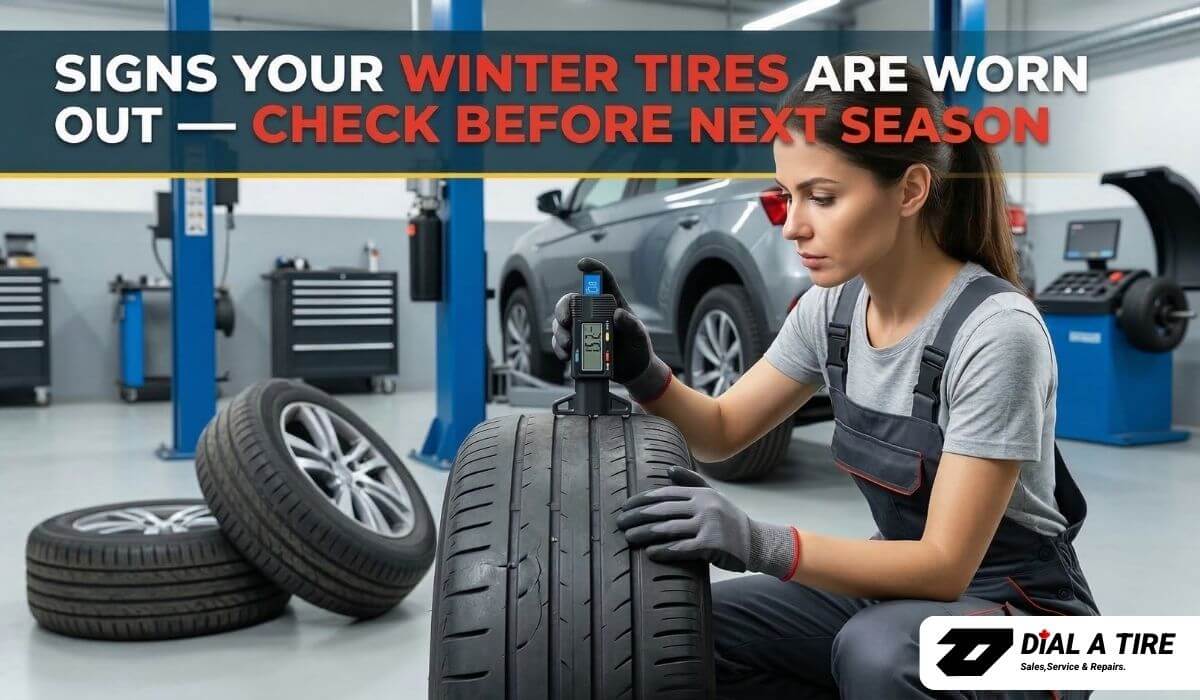
How to check: Use a tread depth gauge (available at any auto parts store for a few dollars) or the classic coin test. Insert a Canadian quarter into the tread groove with the caribou nose pointing down. If the tread reaches the tip of the caribou’s nose, you’ve got approximately 6 mm good to go. If the tread only reaches the letters, you’re around 4 mm getting close. If you can see most of the caribou, it’s time.
Measure in multiple spots. Don’t just check one groove on one tire. Measure the inner edge, centre, and outer edge of each tire. Uneven wear means the lowest reading is the one that counts.
Sign #2: The Tread Wear Indicators Are Showing
All tires including winter tires have built-in tread wear indicators (TWIs). These are small raised bars that sit in the main grooves of the tread, typically just above 1.6 mm height (the legal minimum).
When the surrounding tread wears down to the level of these bars, the tread surface looks almost flat across the groove the bars “connect” the tread blocks visually. That’s the tire telling you it’s done.
On a winter tire, though, you shouldn’t be waiting until the TWIs are flush. By that point, you’ve been driving on a compromised winter tire for months. If the TWIs are approaching flush say, only a millimetre or so above that tire is not going to deliver meaningful winter performance next season.
Sign #3: The Rubber Is Hardened Or Aged Out
Rubber degrades over time, even if the tire has been sitting in storage with decent tread depth. UV exposure, ozone, temperature cycling, and simple oxidation all cause the compound to harden and lose flexibility.
For a winter tire, compound flexibility is the critical performance attribute. A winter tire with hardened rubber has lost the fundamental thing that makes it work in cold conditions. It may still look fine. The tread depth might also measure okay. But the grip below 7°C won’t be there, the way it was when the tire was newer.
General guideline: Most tire manufacturers and safety organizations recommend replacing winter tires that are more than 5-6 seasons old (and some say sooner for tires stored in poor conditions). If you’ve been running the same set since 2019 or 2020, it’s worth a serious evaluation even if the tread looks decent.
Visual clue: Look at the sidewall rubber. Fine surface cracking like tiny veins or crow’s feet is the first sign of aging. Deeper cracks, chalky-looking rubber, or a generally dried-out appearance all indicate the compound is past its prime.
The feel test: This one takes some experience, but if you press your thumbnail into the tread rubber and it doesn’t yield much if it feels stiff and plasticky rather than pliable the compound has hardened. Compare it against a newer tire if you can. The difference is noticeable.
Sign #4: Visible Damage Bulges, Cuts, And Chunks
Damage from a Halifax winter is common. We see it constantly.
- Sidewall bulges: The most serious. A bulge means the internal belts or cords are broken, usually from a pothole impact. The tire can fail suddenly blowout territory. A bulged tire is done, regardless of tread depth. No repair, no “one more season.”
- Chunks missing from the tread: Sometimes large pieces of tread break away from impacts or running over debris. If the missing section is small and doesn’t expose belts, it may be okay for another season. If it’s large or deep, replace the tire.
- Deep cuts on the sidewall: Any cut on the sidewall that goes beyond surface-level is a structural compromise. Sidewalls flex with every rotation a weakened sidewall is a ticking clock.
- Embedded objects: If you stored your tires with a nail or screw still in them, don’t assume the tire is fine just because it held air in October. Have the puncture properly inspected and repaired (if repairable) before reinstalling.
Sign #5: Uneven Or Irregular Wear Patterns
We covered this in our spring checklist article, but it’s worth emphasizing here because uneven wear is a two-problem situation:
Problem 1: The tire itself has reduced performance. An inside edge that’s worn down while the outside has plenty of tread means you’ve got good grip on half the tire and poor grip on the other half. That’s not a recipe for predictable handling on ice.
Problem 2: The cause is still there. Uneven wear on your winter tires means something alignment, worn suspension, incorrect inflation was wrong all winter. If you reinstall those tires without fixing the underlying cause, they’ll continue wearing unevenly and won’t last the season.
Common patterns and what they mean:
- Inside edge wear → alignment (Example – excessive negative camber) the most common one we see post-winter
- Outer edge wear → alignment or chronic underinflation (worn on both outer edges)
- Centre wear → chronic overinflation
- Cupping/scalloping → worn shocks or struts
- Feathering (each tread block worn smooth on one edge, sharp on the other) → toe alignment
Sign #6: They Were The “Just Get Me Through” Tires When You Bought Them
This one’s less about physical inspection and more about honesty.
We see it a lot: someone needed winter tires in a hurry a few years ago, grabbed the cheapest set they could find, and they’ve been “fine.” But “fine” on a budget tire that started with modest tread depth and a less durable compound means “nearly done” after 2-3 seasons.
There’s no shame in budget tires we sell them and they serve a purpose. But they don’t last as many seasons as a premium set, and trying to squeeze a fourth or fifth winter out of a tire that was designed for two or three is a false economy.
The “One More Season” Gamble
Here’s the math that most people don’t think through:
If your winter tires are borderline let’s say 4 mm of tread, 4 years old, maybe a little uneven you can probably get through most of next winter on them. But you’ll have reduced performance from day one, and by January they’ll be approaching the point where you’re effectively running all-seasons with extra road noise.
The alternative: buy new winter tires in late August or September. Full selection, no rush, potentially better prices before the fall demand spike. Install them in October on fresh tread. They’ll perform significantly better from day one and last you 3-4 more seasons.
The gamble is: do you save one season of cost by running borderline tires, or invest now and get years of full winter performance?
We’d never tell someone what they “must” do. But we can tell you what we’ve seen after 30 years: the people who replace on time spend less on tires overall than the people who squeeze every last kilometre out.
How We Evaluate Your Winter Tires At Dial-A-Tire?
If you’re not sure and want a professional opinion, bring your winter tires by. We’ll:
- Measure tread depth at multiple points on each tire
- Check for uneven wear patterns and what they indicate
- Inspect for damage sidewall bulges, cuts, cracking, embedded objects
- Assess rubber age and condition
- Give you a straight answer: good for another season, borderline, or time to replace
There’s no charge for this kind of look, and no pressure to buy. If they’re fine, we’ll tell you they’re fine.
Most consultations and changeovers at Dial-A-Tire are done in about 30 minutes fast, but never rushed. Call us or book online and we’ll give you an honest read on your rubber.
FAQs
Q.1 What The Minimum Tread Depth For Winter Tires?
Ans: The legal minimum in Nova Scotia is above 1.6 mm (2/32″), but winter tires lose most of their cold-weather effectiveness below about 5/32″. We recommend planning replacement once you reach that range.
Q.2 How Many Seasons Do Winter Tires Last?
Ans: It depends on the tire quality, your driving, and storage conditions. Most quality winter tires last 3-5 seasons. Budget options may only deliver 2-3 effective seasons. Rubber also degrades with age even with good tread, tires older than 5-6 years should be evaluated.
Q.3 Can I Just Replace Two Winter Tires Instead Of Four?
Ans: We recommend replacing in pairs at minimum (same axle), and ideally all four. Mismatched tread depth front-to-back creates unpredictable handling in winter conditions.
Q.4 When Is The Best Time To Buy Replacement Winter Tires?
Ans: Late summer to early fall (August-September). Inventory is starting to come in, sizes are available, and you beat the October rush. Some manufacturers also run early-season rebate programs.
Q.5 How Do I Check The Age Of My Tires?
Ans: Look for the DOT code on the sidewall. The last four digits indicate the week and year of manufacture for example, “2325” means week 23 of 2025.
Also Read:
When to Switch to Winter Tires in Halifax (2026/2027) – The 7°C Rule + Local Booking Window
Spring Tire Swap Checklist – What to Inspect After a Harsh Halifax Winter?
When to Take Off Winter Tires in Halifax? – The Spring Timing Guide