
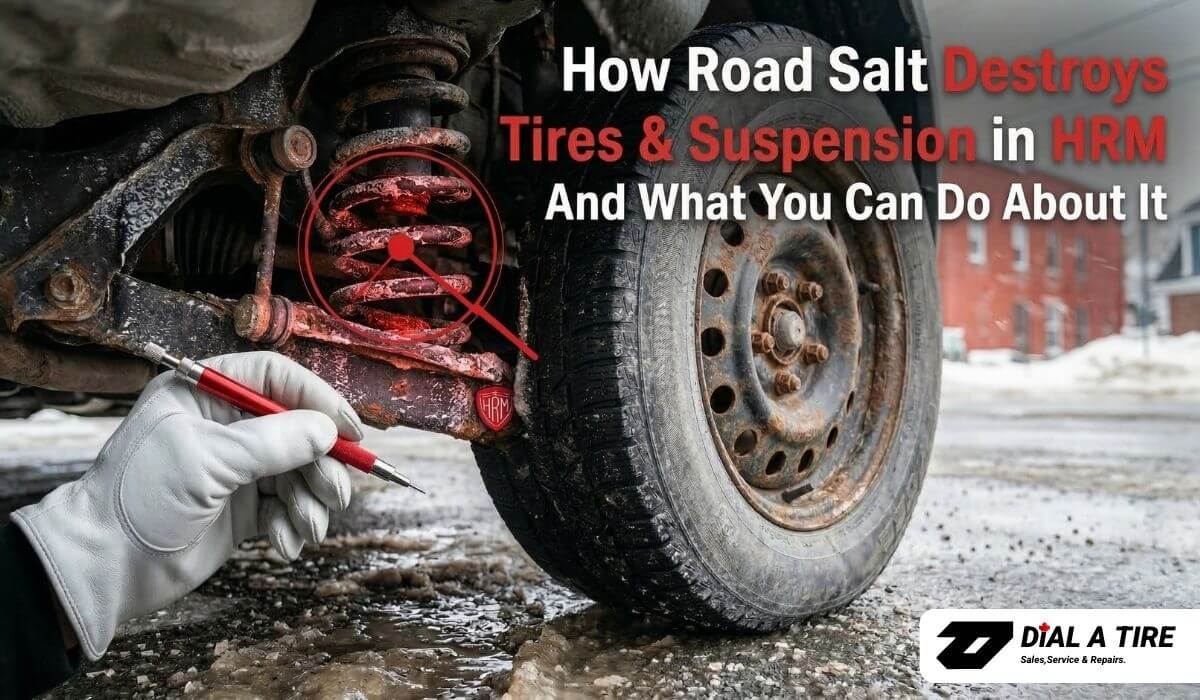
If you’ve ever crawled under a 10-year-old Halifax vehicle that hasn’t been protected yearly, you know the scene: rust-coloured everything. Brake lines that look like they’ve been underwater. Subframe bolts that might as well be welded in place. Suspension components that crumble if you look at them wrong.
That’s road salt.
Halifax goes through a staggering amount of the stuff every winter. Between the city, the province, and the various municipalities across HRM, the roads are salted before storms, during storms, and after storms. And for good reason it works. Salt keeps roads drivable when ice would otherwise shut the city down.
But what keeps you safe on the road in January is quietly eating your car from the bottom up. And because the damage happens slowly, underneath where you never look, most people don’t realize how much it’s costing them until something fails a brake line, a ball joint, a rim that won’t seal, a suspension arm that snaps at a rust-weakened point.
Here’s what road salt actually does to your tires, wheels, brakes, and suspension and the practical things you can do to slow it down.
What Salt Does To Your Tires?
Salt itself doesn’t dissolve rubber the way it dissolves metal. But it does damage tires in indirect ways that most people never connect back to salt.
Bead Corrosion And Slow Leaks
The bead area where the tire seals against the rim is supposed to be a smooth, airtight mating surface. Road salt attacks the rim surface at this seal point, especially on steel rims. Over a few winters, corrosion builds up along the bead seat. The tire still looks fine from the outside, but the seal isn’t airtight anymore.
The result: slow leaks. The tire loses a few PSI a week. You top it up, it drops again. You think the tire has a puncture, but there’s no nail just a rough, corroded rim surface that the bead can’t seal against.
We fix these regularly at the shop. The process is: dismount the tire, wire-brush or sand the corroded bead area on the rim, apply bead sealer, and remount. It’s not expensive, but it’s annoying and entirely preventable with proper cleaning between seasons.
Valve Stem Corrosion
The valve stem is the small rubber or metal fitting you use to inflate the tire. Salt and moisture attack the base where the stem meets the rim, especially on rubber snap-in stems. Over a few winters, the rubber deteriorates, the base cracks, and you get a slow or sudden air leak.
Metal valve stems (common on TPMS-equipped vehicles) are more durable but not immune. The sealing grommet and the core inside can corrode.
Simple fix: Have your valve stems inspected and replaced as needed during seasonal changeovers. They cost almost nothing compared to the hassle of a flat tire from a failed stem.
Accelerated Rubber Aging
Salt brine (the liquid form of road salt) is mildly caustic. It won’t melt a tire, but prolonged contact especially when tires are stored all summer without cleaning accelerates the surface-level degradation of rubber. That fine cracking you see on tire sidewalls after a few years? Salt exposure and UV together speed that process along.
What Salt Does To Your Rims And Wheels?
Steel Rims: The Obvious Victim
Steel winter rims take a beating. Salt accelerates the oxidation process (rust) dramatically. After 3-4 Halifax winters, a steel rim can be significantly corroded rough surface texture, flaking paint, pitting at the bead seat and lug nut holes.
The consequences:
- Bead-seal failures (slow leaks)
- Difficult tire mounting (corroded bead seats don’t release smoothly)
- Lug nut seating issues (corroded holes don’t torque evenly)
- Cosmetic deterioration (less of a performance issue, more of an eyesore)
Alloy Rims: Not Immune
People assume alloy wheels don’t corrode. They corrode differently. The clear coat or paint on alloy wheels protects the aluminum underneath, but salt and road debris chip away at that protective layer. Once the bare aluminum is exposed, it oxidizes not rust like steel, but a white powdery corrosion that’s equally problematic at the bead seal.
High-end alloy wheels with damaged clear coat and salt exposure can develop enough bead-area corrosion to cause slow leaks, just like steel rims.
What Salt Does To Your Brakes?
Rotor Surface Rust
This one’s mostly cosmetic. After a day or two of sitting, brake rotors in Halifax develop a thin layer of orange surface rust this is normal and wears off with the first few brake applications. It’s not damage.
The Real Brake Damage: Lines And Hardware
Brake lines the steel tubes that carry fluid from the master cylinder to the wheels are salt’s favourite target. Halifax brake lines corrode from the outside in. The damage is invisible until the line is thin enough to bulge, leak, or rupture under pedal pressure.
A brake line failure is as serious as it sounds. When it goes, you lose braking on that circuit which might mean half your brakes suddenly aren’t working. We see corroded brake lines on vehicles as young as 8-10 years old in Halifax. In drier provinces, those same lines last 15-20 years.
Brake hardware caliper slides, anchor bolts, pad retaining clips also corrodes. Seized caliper slides are one of the most common brake problems we see post-winter. The slide pins are supposed to let the caliper float freely; when they seize from corrosion, the brake pads wear unevenly and you get pulling, noise, and premature pad/rotor wear.
What Salt Does To Your Suspension?
This is where the real money hides.
Subframe And Cradle Corrosion
The subframe (or engine cradle) is the structural component that everything bolts to engine, transmission, steering rack, control arms. On many unibody vehicles, it’s steel, and it sits in the salt spray zone directly behind the front wheels.
We’ve seen subframes on 12-15-year-old Halifax vehicles corroded to the point of being structurally questionable. That’s a major safety concern and an expensive repair or replacement.
Control Arms, Ball Joints, And Tie Rod Ends
These suspension and steering components have rubber boots that protect the grease-filled joints inside. Salt and road debris tear at those boots. Once a boot is compromised, moisture and contaminants get in, the grease washes out, and the joint wears rapidly.
A worn ball joint or tie rod end affects alignment, handling, and steering response. In severe cases, a failed ball joint allows the wheel to separate from the suspension you don’t want to be on the Bedford Highway when that happens.
Spring Breakage
Coil springs carry the weight of the vehicle and absorb road impacts. Salt eats the protective coating, then works on the steel underneath. Halifax mechanics see broken springs regularly the spring snaps at a rust-weakened point, often over a pothole or bump. You’ll hear a loud bang and the car will sit lower on one corner.
What You Can Actually Do About It?
You can’t avoid salt on Halifax roads (and you shouldn’t it keeps the roads safe). But you can minimize its long-term damage with practical steps that don’t require obsessive behaviour.
1. Wash Underneath Regularly During Winter
This is the single most effective thing you can do. A periodic undercarriage wash even once a month during the salt season rinses accumulated salt off the most vulnerable components.
Many local car washes have an undercarriage option. Use it. It doesn’t need to be a detailed cleaning just get the heavy salt deposits off the brake lines, subframe, and suspension arms.
2. Undercoating And Rust Protection
Several shops in Halifax offer petroleum or oil-based or rubberized undercoating treatments. These create a barrier between salt and metal. Petroleum-based treatments like KROWN, which is what we use and recommend, are applied annually and penetrate into all seams and crevices. Then there are rubberized coatings also that provide a thicker physical barrier.
Neither is a magic shield, but both significantly slow the corrosion process especially when applied to a newer vehicle before significant rust has started.
3. Clean Your Tires And Rims Between Seasons
We covered this in our storage article, but it bears repeating: wash the salt off your tires and rims before putting them into storage. Six months of salt sitting on a bead surface is six months of corrosion you could have prevented with a hose and 20 minutes.
4. Inspect Brake Lines Annually
Ask your shop to look at the brake lines during any service where the vehicle is on a lift. A visual check takes seconds and can catch a compromised line before it fails on the road.
5. Don’t Ignore Small Suspension Noises
A clunk over bumps, a rattle at low speed, a new vibration these are often the first sign of a corroded or failing suspension component. Catching it early usually means a cheaper repair and no safety risk.
6. Consider Your Winter Rim Strategy
If you’re buying a separate set of winter rims (which we recommend it makes seasonal swaps faster and cheaper), steel rims are the affordable and practical choice. Yes, they’ll corrode, but they’re inexpensive to replace when they do. Think of them as a sacrificial layer that protects your nicer alloy wheels from salt exposure.
The Halifax Reality
Road salt is a fact of life here, and the corrosion it causes is arguably the single biggest hidden cost of vehicle ownership in Nova Scotia. You can’t eliminate it, but you can manage it.
The drivers who stay ahead of salt damage aren’t doing anything extreme they’re washing the undercarriage a few times a winter, getting an annual undercoat treatment, cleaning tires before storage, and paying attention when something starts clunking or leaking.
The drivers who ignore it? They’re the ones looking at a $1,500 brake line and subframe repair on a $6,000 car and wondering whether it’s still worth fixing.
If you want to know where your vehicle stands, bring it by for a look. We’ll tell you what’s healthy, what’s starting to corrode, and what needs attention no charge for the conversation.
Call us or book online we’ll keep Halifax road salt from winning.
FAQs
Q.1 Does Road Salt Damage Tires?
Ans: Salt doesn’t dissolve rubber directly, but it corrodes the rim bead seat (causing slow leaks), attacks valve stems, and accelerates rubber aging when left on tires during storage. Washing salt off before seasonal storage prevents most of this damage.
Q.2 How Often Should I Wash My Car Underneath In Winter?
Ans: Once a month during salt season is a good practical target. Many local car washes have an undercarriage option that rinses accumulated salt off brake lines, suspension components, and the subframe.
Q.3 Is Undercoating Worth It In Halifax?
Ans: Yes especially on newer vehicles before significant rust has started. Petroleum based annual treatments (like KROWN) penetrate seams and slow corrosion significantly. It’s one of the most cost-effective preventive measures for Maritime vehicles.
Q.4 How Long Do Brake Lines Last In Halifax?
Ans: Due to road salt, brake lines on Halifax vehicles can show significant corrosion in as few as 8-10 years. In drier provinces, the same lines often last 15-20+ years. Annual visual inspection during any shop visit is a smart precaution.
Q.5 Why Does My Tire Keep Losing Air In Winter?
Ans: If there’s no puncture, the most common cause is rim corrosion at the bead seat salt builds up where the tire seals to the rim, breaking the airtight seal. The fix involves removing the tire, cleaning the corroded rim surface, and remounting with bead sealer.
Also Read:
How Often Should You Really Change Your Oil in Halifax?
Spring Tire Swap Checklist – What to Inspect After a Harsh Halifax Winter?
When to Switch to Winter Tires in Halifax (2026/2027) – The 7°C Rule + Local Booking Window