Every October, both of our locations field the same cluster of questions: when should I call, what actually happens during the swap, and should I just wait until it snows? Here’s the short version: book now, and here’s why that’s the right call.
Book your changeover online now, or read on for what to expect.
When to Book
Book before the first hard frost. In Halifax that typically means targeting early to mid-October. The rule of thumb we give every customer is the 7°C rule: once daytime highs are consistently below 7°C, all-season rubber has already begun to stiffen and lose grip, even on cold dry pavement with no snow in sight. You don’t need to wait for the forecast to show snow. Cold pavement alone is reason enough.
A warm September tends to lull people into thinking there’s time, then a stretch of cold in mid-October fills the appointment calendar fast. The customers who call in late September or the first week of October get their pick of times: first thing on a weekday morning, or a convenient Saturday slot. The week after the first real cold snap or first snow is consistently our busiest of the year, and booking ahead beats calling day-of every time.
This isn’t about scaring anyone into an appointment. It’s just the honest pattern we see every season: people who book early get more choice in timing, and people who wait get whatever slot is left once everyone else has had the same idea.
What a Changeover Visit Involves
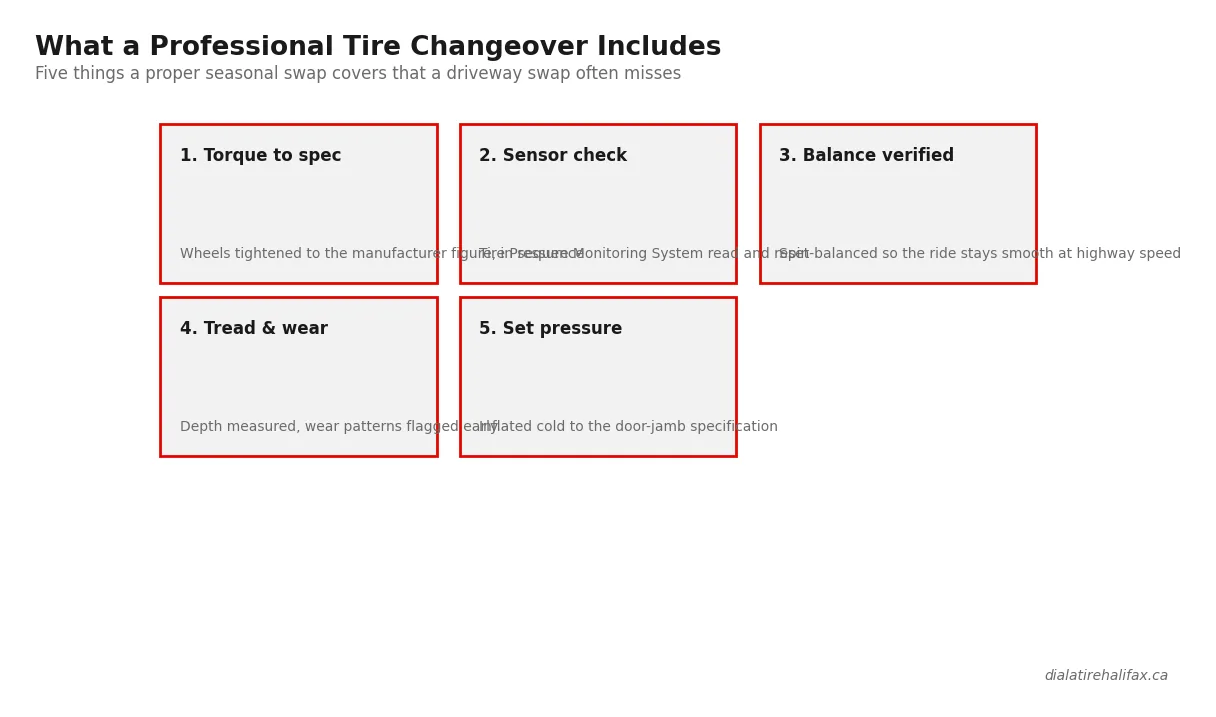
A changeover isn’t just a wheel swap. We run a set of standard checks every time, because the change of seasons is a natural point to catch things before they become problems.
Tread depth on both sets. We check the tires coming off and the tires going on. For winter tires, the useful working depth is typically 4 to 5 millimetres of tread; the legal minimum of 1.6mm isn’t enough for real snow and ice traction. If your winters are getting close to that number, we’ll flag it so you can plan ahead.
Wear patterns. Uneven wear often points to an alignment or suspension issue. We’re not doing a full four-wheel alignment at a changeover, but if a tire shows obvious irregular wear coming off, we’ll note it and recommend follow-up.
Tire pressure on the set going on. Cold temperatures drop pressure, roughly 1 pound per square inch (psi) for every 5 to 6°C, so we set pressures to your vehicle manufacturer’s specification before the car leaves. Don’t rely on the number from last spring.
Tire Pressure Monitoring System (TPMS) sensors. If your vehicle has direct-type sensors built into the valve stem, we check they’re reading and communicating properly. Swapping wheel sets sometimes needs a relearn procedure, and we handle that as part of the visit.
Torque to specification. Every wheel nut is torqued to the manufacturer’s spec with a calibrated tool, not just run down with an impact wrench and left there.
How Balancing Works
If you have a dedicated set of wheels already mounted with winter tires, that’s an on-rim swap: the wheel-and-tire assembly bolts straight on, and balancing is done on request rather than automatically. If you’re bringing in loose winter tires that need to come off storage and go onto your existing rims, that’s an off-rim mount, and balancing is included as part of that job. Either way, a properly balanced tire rides smoother and wears more evenly through the season, so it’s worth asking for if you’re not sure which applies to your setup.
Waiting In, or Dropping Off?
Either works. If you’re waiting, bring something to read, changeovers take real time and during peak season there may be cars ahead of yours. If you’d rather drop off and come back, that’s often the easier option once October and November scheduling gets tight: leave it in the morning, pick it up in the afternoon. Just make sure we have a good number to reach you, and have your winter tires accessible before you arrive; tires buried under garage clutter add time to the visit.
At pickup, we’ll flag anything worth knowing from the inspection. Most visits turn up nothing alarming, but if something needs follow-up, we’d rather tell you now than have you find out on the road in January. It’s also worth checking your tire pressure again within a week or two, especially if temperatures drop sharply after your visit; two minutes with a gauge at any gas station is a good winter habit.
What About Storing Your Off-Season Tires?
We offer tire storage at both our Halifax and Bedford locations, one less thing to find space for in the garage, and one less set of tires to load in and out of the trunk twice a year. Ask about it when you call to book, we can walk you through how it works at each location. If you’d rather store at home, our Nova Scotia tire storage guide covers the conditions, bagging, and common mistakes that age tires faster than they should. The short version: out of direct sunlight, away from ozone sources like electric motors, in a cool and consistently dry space, bagged in black plastic if possible.
Ready to Book?
The best time to book is before you think you need to. Our Halifax and Bedford shops are open daily, including weekends, which not every shop in the area is. If you want to talk through whether a dedicated winter wheel set makes sense for your vehicle, or you’re not sure which size you need, call and we’ll walk you through it. For details on the visit itself, see our seasonal tire changeover service page.
Book an appointment online or give either location a call.
Frequently Asked Questions
When should I book my seasonal tire changeover in Halifax?
Once daytime highs are consistently sitting below 7°C, that’s your cue, typically early-to-mid October around here. Book in late September or the first week of October and you’ll get your pick of appointment times before the calendar fills up.
What do technicians check during a seasonal tire changeover?
We check tread depth on both sets, look for uneven wear that might point to an alignment issue, set pressures to the manufacturer’s spec, and check your TPMS sensors if your vehicle has them. Every wheel nut gets torqued to spec before the car leaves the bay.
Is balancing included with a tire changeover?
It depends on the job. If your winters are already mounted on their own wheels, that’s a straight bolt-on swap and balancing is available if you ask for it. If we’re mounting loose tires onto your existing rims, balancing is already part of the job.
Should I wait at the shop during my changeover or drop the car off?
Either is fine. Dropping off tends to work better once October and November get busy, leave it in the morning and pick it up later, just make sure we have a good number to reach you.
Does Dial A Tire store off-season tires?
Yes, at both our Halifax and Bedford locations. If you’d rather store at home, keep them bagged in black plastic, out of the sun, away from anything like an electric motor that gives off ozone, and somewhere cool and dry.
HALIFAX — Dial A Tire
308 Herring Cove Rd, Halifax, NS
902-475-3358
BEDFORD — Dial A Tire
70 Rosno Lane, Bedford, NS
902-444-3425
Open daily 8 AM–5 PM. Please call before coming.
Locally owned since 1994 · Red Seal technicians · Professional installation & precision balancing