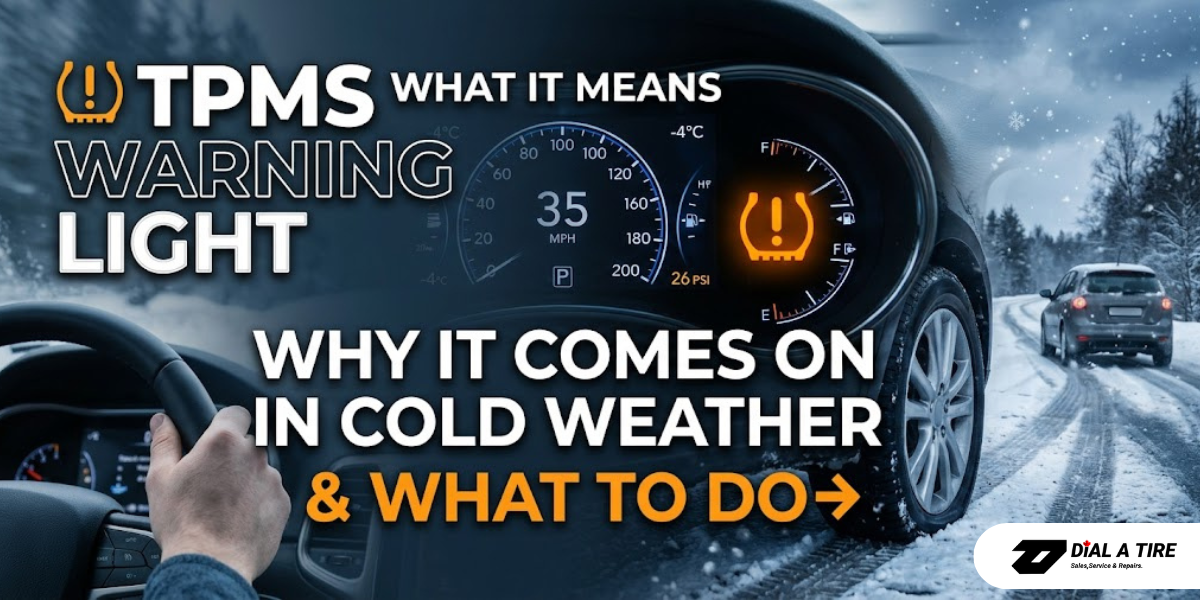
It’s 6:45 AM, it’s -8°C outside, and you’ve just started your car. There it is on the dash that little amber horseshoe-shaped light with an exclamation mark in the middle.
The tire pressure warning light. Again.
If you’ve been driving in Halifax for any length of time, you’ve seen this light. For some people, it’s a regular winter companion that shows up every cold snap and disappears by afternoon. For others, it triggers genuine anxiety:
“Is my tire flat?”
“Is it safe to drive?”
“Do I need to stop immediately?”
The answer, like most things in the car world, is: it depends.
But the good news is that TPMS (Tire Pressure Monitoring System) is actually a fairly straightforward system. Once you understand what triggers it, the light stops being scary and starts being useful.
What TPMS Actually Is (The 30-second version)
TPMS is a safety system designed to alert drivers when one or more tires drops significantly below the recommended pressure.
Most modern vehicles sold in Canada since the late 2000s are equipped with some form of TPMS.
The system’s job is simple:
- monitor tire pressure,
- warn you when pressure becomes dangerously low,
- and help prevent unsafe driving conditions caused by underinflated tires.
“Dangerously low” usually means roughly 25% below the recommended pressure.
So if your driver’s door sticker recommends 33 PSI, the warning light may trigger around 24–25 PSI.
That’s important because the light doesn’t come on for tiny fluctuations. It usually activates when pressure drops into a range that genuinely affects:
- handling,
- braking,
- tire wear,
- and fuel economy.
Also important: the TPMS light is different from your ABS or traction-control warning lights. TPMS specifically monitors tire pressure.
The Two Types Of TPMS Systems
Direct TPMS
This system uses physical pressure sensors mounted inside each wheel.
The sensors measure actual tire pressure in real time and send that information to the vehicle’s computer. Many newer vehicles can even display individual tire pressures on the dashboard.
Most Halifax vehicles on the road today use direct TPMS.
Indirect TPMS
Indirect systems don’t use pressure sensors inside the tire.
Instead, they monitor wheel rotation speeds through the ABS system. A low tire has a slightly smaller rolling diameter and spins faster than the others. The vehicle detects that difference and triggers the warning light.
Indirect systems are less precise and usually can’t identify which tire is low.
Why The TPMS Light Loves Cold Weather?
This is easily the most common TPMS question we get during Halifax winters.
And thankfully, the explanation is simple: physics.
Cold air takes up less space inside the tire, which lowers pressure.
The general rule:
For every 5–6°C drop in temperature, tire pressure drops approximately 1 PSI.
So if your tires were set to 33 PSI during a mild 15°C October afternoon, and Halifax drops to -5°C overnight, that’s roughly a 20°C temperature swing.
Result?
Your tires may now be sitting around 29–30 PSI.
A deeper cold snap common in January or February can easily push one tire below the TPMS warning threshold.
Then:
- the light comes on in the morning,
- the tires warm up while driving,
- pressure rises slightly,
- and the light disappears later in the day.
This is completely normal winter TPMS behaviour.
It does not automatically mean you have a flat tire.
Usually, it simply means the tires need topping up for colder temperatures.
What To Do When The TPMS Light Comes On?
Step 1: Don’t Panic But Don’t Ignore It Either
The warning light means at least one tire is significantly underinflated.
Even if cold weather is the cause, underinflation still affects:
- braking,
- handling,
- tire wear,
- and fuel economy.
Step 2: Walk Around The Vehicle
Look at all four tires before driving.
Does one look noticeably lower than the others?
If yes:
- you may have a puncture,
- slow leak,
- bead leak,
- or sidewall issue.
If they all appear similar, cold-weather pressure drop is more likely.
Important:
Modern tires can look “normal” even when dangerously low. Visual inspection alone is not enough.
Step 3: Check Pressures With a Gauge
Use a proper tire pressure gauge and compare the readings against the pressure listed on the driver’s door sticker.
If all four tires are slightly low:
This is typical Halifax winter behaviour. Inflate them back to specification.
If one tire is much lower:
You likely have a slow leak caused by:
- a nail or screw,
- rim corrosion,
- a leaking valve stem,
- or bead sealing issues.
If all four tires are severely low:
Don’t drive until they’re properly inflated.
Halifax-Specific TPMS Issue: Rim Corrosion
This is one of the biggest causes of recurring TPMS warnings in Nova Scotia.
Road salt corrodes aluminum rims over time, especially around the bead area where the tire seals against the wheel.
Once corrosion builds up:
- air slowly escapes around the rim,
- pressure drops repeatedly,
- and the TPMS light keeps returning.
We see this constantly on older Halifax vehicles.
Drivers often think they have a puncture because they keep adding air every week, but the actual issue is corrosion where the tire seals to the wheel.
In many cases, the fix involves:
- removing the tire,
- cleaning the rim surface,
- resealing the bead,
- and reinstalling/balancing the tire.
Step 4: Inflate To The Correct Pressure
Inflate the tires to the number listed on the driver’s door jamb sticker not the maximum pressure shown on the tire sidewall.
For most passenger vehicles, this is typically:
- 30–35 PSI,
- but always follow your specific vehicle recommendation.
Cold-weather tip:
If you’re inflating tires on a freezing morning, set them to the recommended pressure and leave them there. Pressure naturally rises slightly as the tires warm during driving.
Step 5: Drive and Let The System Reset
Most TPMS systems automatically reset after a few minutes of driving once pressure is restored.
Some vehicles may require:
- a manual reset procedure,
- or a TPMS relearn process.
If the light stays on after inflation and driving, there may be:
- a continuing leak,
- a damaged sensor,
- or a TPMS system fault.
When The TPMS Light Is NOT “just cold weather”?
Take the warning more seriously if:
One tire repeatedly loses pressure
That usually means a real leak.
The light comes on while driving
This may indicate rapid air loss.
The TPMS light flashes first, then stays solid
This often indicates:
- dead sensor batteries,
- communication problems,
- or a faulty sensor.
The light stays on during warm weather
If it’s 20°C outside, temperature isn’t the issue.
The vehicle feels unstable
If you notice:
- heavy pulling,
- flapping noises,
- strong vibration,
- or a tire visibly deflating,
pull over safely and inspect immediately.
TPMS and Winter Tire Changeovers
This is where things get slightly more complicated for Halifax drivers running separate winter wheels.
If Your Winter Rims HAVE TPMS Sensors
Great the system will function normally year-round.
Some vehicles automatically recognize the sensors after driving a short distance. Others require a relearn procedure using a TPMS programming tool.
Your tire shop should handle this during installation.
If Your Winter Rims DO NOT Have TPMS Sensors
The TPMS light will stay on all winter.
That’s normal.
The vehicle simply can’t detect tire pressures because there are no sensors installed in those wheels.
In that case, you’ll need to manually check tire pressures throughout the season.
Can TPMS Sensors Be Added To Winter Rims?
Yes.
Aftermarket TPMS sensors can be installed on most winter wheel packages, allowing the system to work properly year-round.
TPMS Sensor Batteries
Direct TPMS sensors contain sealed internal batteries.
Typical lifespan:
approximately 5–10 years.
Once the battery dies, the entire sensor is replaced.
If your vehicle is 7+ years old and the TPMS light behaves erratically, aging sensor batteries are a common cause.
Some vehicles may also require TPMS relearn procedures after:
- tire rotations,
- wheel swaps,
- or sensor replacement.
The “I’ll Just Ignore It” Problem
Here’s the honest concern:
Once drivers realize the TPMS light often comes on during cold weather, some begin ignoring it permanently.
The light becomes background noise.
That’s risky.
Because:
- a cold-weather pressure drop,
- a nail in the tire,
- a leaking valve stem,
- and a dangerous slow leak…
…can all trigger the exact same warning light.
The smarter approach is simple:
Take five minutes to check the pressures whenever the light appears.
If the light keeps returning after topping up air, something else is going on.
That small habit can prevent:
- premature tire wear,
- poor winter traction,
- or driving unknowingly on a dangerously underinflated tire.
Quick TPMS Troubleshooting uGide
| TPMS Behaviour | Most Likely Cause |
| Light appears only during cold mornings | Normal seasonal pressure drop |
| One tire repeatedly loses air | Slow leak or puncture |
| Flashing light then solid light | TPMS sensor/system fault |
| Light stays on after inflation | Ongoing leak or bad sensor |
| TPMS light after winter tire swap | Winter wheels may not have sensors |
| Tire feels unstable or noisy | Possible rapid pressure loss |
Bottom Line
The TPMS light is a tool not a threat.
In Halifax winters, it’s often triggered by completely normal cold-weather pressure drops. But it can also warn you about:
- punctures,
- rim corrosion,
- leaking valve stems,
- or failing TPMS sensors.
Check your tire pressures, top them up properly, and pay attention if the pattern changes.
That’s usually all it takes.
At Dial-A-Tire Halifax, we diagnose TPMS lights, tire pressure leaks, wheel corrosion, and sensor problems quickly and honestly.
Most TPMS inspections only take a few minutes.
Book online or call 902-475-3358 and we’ll help get that warning light sorted properly.
FAQs
Q1. Why Does My Tire Pressure Light Come On In Cold Weather?
Answer: Tire pressure drops as temperatures fall roughly 1 PSI for every 5–6°C decrease. Halifax winter temperatures commonly trigger TPMS warnings even when tires were properly inflated in fall.
Q2. Is It Safe To Drive With The TPMS Light On?
Answer: You can usually drive a short distance to safely check or inflate the tires, but the warning should never be ignored. Underinflated tires affect handling, braking, and tire wear.
Q3. Will The TPMS Light Go Off By Itself?
Answer: Sometimes. If pressure rises as the tires warm during driving, the light may turn off temporarily. But if the cause is a leak, the warning will return.
Q4. What Does A Flashing TPMS Light Mean?
Answer: A flashing TPMS light usually indicates a system malfunction such as a failed sensor battery, damaged sensor, or communication issue rather than a pressure problem.
Q5. Will My TPMS Work With Winter Rims?
Answer: Only if the winter rims contain TPMS sensors. Without sensors, the warning light typically stays on all winter and tire pressures must be checked manually.
Q6. How Long Do TPMS Sensors Last?
Answer: Most TPMS sensors last approximately 5–10 years before the internal battery fails. Once the battery dies, the entire sensor must be replaced.
Also Read:
Buying Used Tires in Halifax Smart Move or Risky? Red Flags to Watch
How Road Salt Destroys Tires & Suspension in HRM And What You Can Do About It
Signs Your Winter Tires Are Worn Out – Check Before Next Season
The Tire Pressure Monitoring System (TPMS) is a federally mandated safety feature on all new vehicles sold in Canada since 2008. Transport Canada’s tire safety resource explains the legal requirements and what drivers should know about low-pressure warnings. For a technical breakdown of how temperature affects inflation pressure, Tire Rack’s TPMS cold-weather guide is a reliable reference. Halifax drivers see the TPMS light most often in October and November — which is also when it’s time to think about your winter tire switch. Our post on TPMS in cold weather — what to do covers the full diagnostic, and our tire change service includes a pressure check at every visit. Need help now? Book an appointment and we’ll sort it out.
Frequently Asked Questions
Why does my TPMS light come on every fall in Halifax but not in summer?
Tire pressure drops roughly 1 PSI for every 6°C drop in air temperature. When Halifax temperatures fall from summer highs into single digits, a tire that was fine at 35 PSI in August can easily read 30 PSI or less by October — below the threshold that triggers the TPMS warning. Top up your tires to the manufacturer’s recommended pressure (found on the door jamb sticker) and the light should clear within a few km of driving.
Does the TPMS light mean I have a flat tire?
Not necessarily. A solid TPMS light usually means one or more tires are 25% or more below the recommended pressure — which can happen from cold temperatures alone, not just a puncture. Check all four tires with a gauge. If one is significantly lower than the others, you may have a slow leak that needs attention.
Can switching to winter tires reset or affect the TPMS?
Yes — if your winter tires are mounted on separate steel rims without TPMS sensors (which is common), the system will display a warning light all season. This is normal and not a malfunction. If your winter wheels do have sensors, they need to be programmed to your vehicle. Ask your technician at your seasonal tire swap.
How cold does it have to get before I should worry about tire pressure in Halifax?
Any sustained drop below 7°C — the same threshold used for the winter tire changeover rule — is enough to affect inflation pressure noticeably. Check your tire pressure with a gauge in the morning before driving when temperatures have been consistently cold, rather than after the car has been running (heat from driving temporarily raises pressure readings).
Updated June 2026.