We get asked this constantly: “Do I really need winter tires, or are my all-seasons good enough for Halifax?”
It’s a fair question. Winter tires mean an extra purchase, seasonal changeovers, storage logistics it’s a whole thing. And if your all-seasons “seem fine,” it’s natural to wonder whether the hassle is really worth it.
After 30 years of working on Halifax vehicles, here’s our honest take: the answer isn’t the same for every driver. But most people who tell us their all-seasons are “fine” haven’t actually tested them in a situation where it mattered because when all-seasons finally fail you on a cold road, the test happens all at once, and it’s not the kind you want to take.
What Makes Halifax Winters Different From The Rest Of Canada?
Let’s be clear about what we’re dealing with here. Halifax winter is not Calgary winter. It’s not Montreal winter. It’s its own breed:
- Cold and wet is the default mode. Not -30°C and dry, but hovering around -2°C to +4°C with moisture on every surface.
- Freeze-thaw cycles are constant. It rains, then freezes overnight, then warms up to 5°C, then freezes again. This creates ice in spots that “shouldn’t” be icy.
- Black ice loves our bridges, overpasses, and shaded stretches. The Macdonald Bridge at 7 AM in January is a different road than the Macdonald Bridge at noon.
- Slush builds up at intersections where traffic compresses snow into ruts. This is where braking and turning actually get tested.
- Hills. Halifax is not flat. Driving up Bayview Road or down Sackville Street in slush requires grip that compounds the challenge.
- Road salt is everywhere, which helps with ice but does a number on everything under your car.
So when we compare tire types, the real question isn’t “can I drive through a blizzard?” It’s: “On a typical cold, damp Halifax morning the kind where roads look fine but aren’t which tire gives me shorter stopping distance and more predictable control?”
And on that question, the data is pretty clear.
The Actual Difference Between All-Season And Winter Tires
All-Season Tires: The Jack-Of-All-Trades Compromise
All-seasons are designed to be acceptable across a wide range of conditions. That’s their selling point and their limitation. In warm weather, they’re fine. In light rain, they’re fine. In the first cool days of fall? Fine.
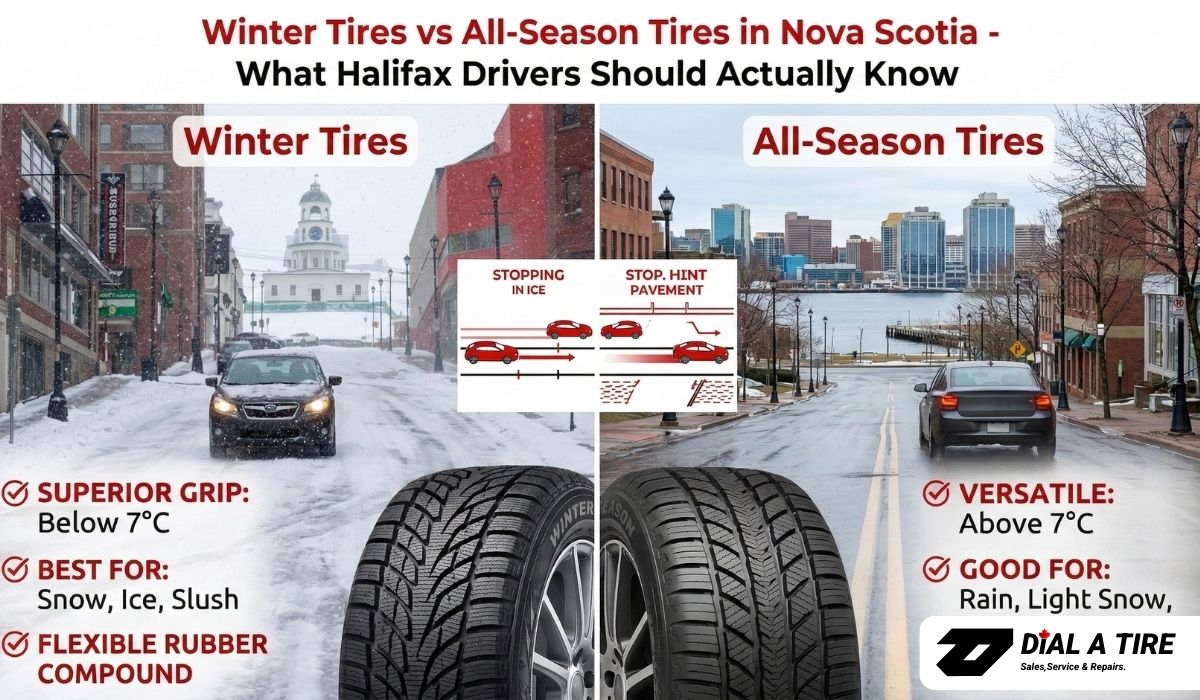
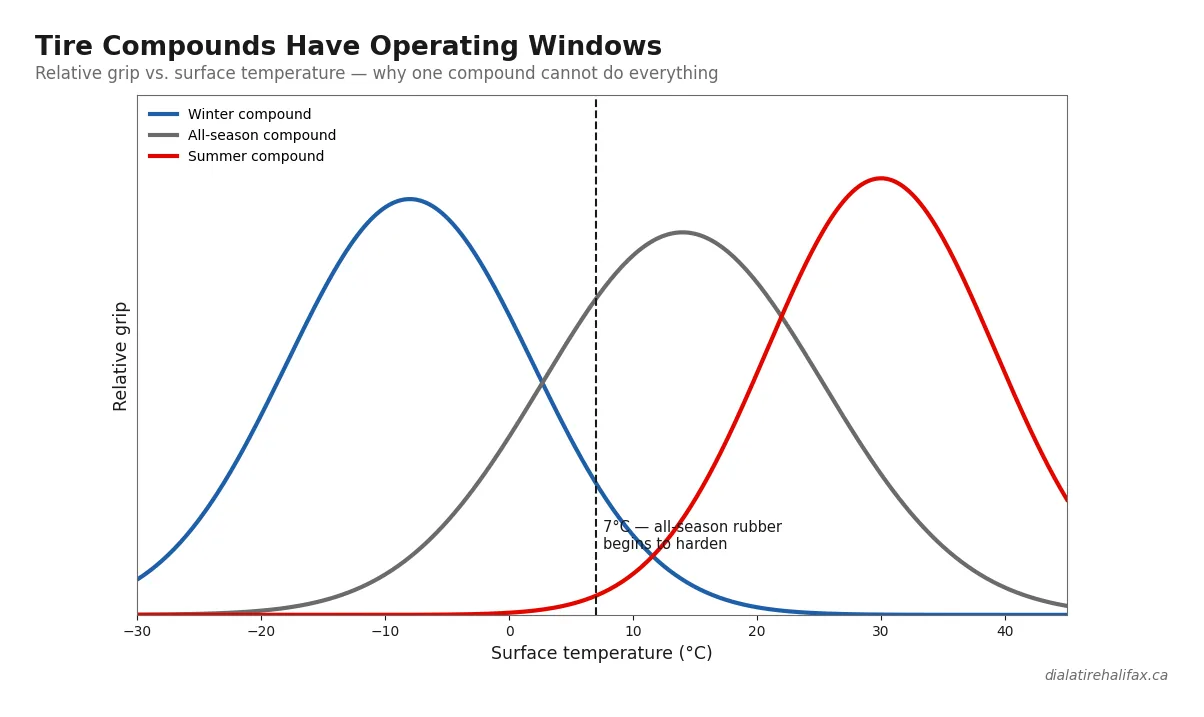
But the rubber compound in all-season tires starts stiffening as temperatures drop below ~7°C. This isn’t dramatic you won’t feel the rubber getting harder. But the physics are real: stiffer rubber has less microscopic contact with the road surface, which means less friction, which means less grip.
The tread design is also a compromise. All-season treads prioritize longevity and quiet highway performance. They don’t have the aggressive siping (thousands of tiny slits in each tread block) that winter tires use to create extra biting edges on snow and ice.
Winter Tires: Purpose-Built For Cold
Winter tires attack the cold-weather grip problem from two angles:
- The compound. Winter tire rubber uses a different formulation (higher silica content, different polymers) that stays pliable when it’s cold. Pliable rubber conforms better to road surface imperfections, creating more friction. This works on cold dry pavement, cold wet pavement, frost, ice, and snow.
- The tread. Aggressive siping, deeper grooves, and tread patterns specifically shaped to channel slush, water, and packed snow away from the contact patch. The sipes flex under pressure to create tiny “gripping” edges that all-season tires simply don’t have.
The biggest real-world difference shows up in braking and cornering not acceleration. Your car will still move on all-seasons in winter. The problem is stopping it and steering it when the surface is cold and compromised. Transport Canada testing has shown that winter tires can reduce braking distance on ice and snow by significant margins compared to all-seasons. We see evidence of this every year in the shop when customers come in after a close call.
A Practical Comparison (No Hype, No Scare Tactics)
Winter Tires Have A Clear Edge In:
- Braking distance on cold, wet pavement (the most common Halifax winter surface)
- Grip at icy intersections the moment between “starting to brake” and “actually stopped”
- Stability in slush and rutted snow
- Predictable turning and cornering below ~7°C
- Confidence on hills both going up and coming down
All-Seasons Have An Edge In:
- Convenience one set, no swaps, no storage headaches
- Longevity in warm months (winter compound wears faster in heat)
- Lower upfront cost (no second set to buy)
- Quieter highway ride in summer months
Here’s What’s Important To Understand:
The number one reason people think all-seasons are “good enough” for Halifax winters is that their car still moves. And it does. All-season tires will get you rolling from a stop sign, they’ll take you up most hills, they’ll get you to work on most days.
The problem is the 2% of moments where stopping and turning actually matter and those are the moments where the gap between the two tire types becomes very real, very fast. An intersection where traffic suddenly stops. A lane change on the MacKay bridge with a patch of black ice. A left turn through a slushy rut on Robie Street… You get the picture!
“But I Have AWD / 4×4…”
This is hands-down the most common misconception we hear, so let’s put it to rest.
AWD helps you accelerate. That’s it. It distributes engine power to all four wheels, which makes it easier to get moving from a stop and maintain traction while driving forward.
AWD does not help you STOP! AWD does not help you TURN!
Stopping and steering are tire-traction problems. Your brakes work on friction between pad and rotor. Your tires work on friction between rubber and road. No drivetrain configuration in the world creates grip that isn’t there. If the rubber is stiff and the road is cold, your AWD SUV needs just as much stopping distance as a front-wheel-drive sedan on the same tires.
We’ve had many conversations with customers who were genuinely surprised that their AWD vehicle slid through an intersection. The AWD gave them false confidence it felt great pulling away from lights, so they assumed the grip was there for everything else too.
An AWD vehicle on proper winter tires? That’s a genuinely capable winter setup. AWD on all-seasons? You’ve got half the equation.
What Does The “Two-Set Strategy” Actually Cost Over Time?
A lot of Halifax drivers avoid winter tires because they mentally file it under “double the expense.” But the math is more nuanced than that.
Here’s the reality:
- If you run one set of all-season tires year-round, that set absorbs 12 months of wear every year.
- If you run two sets (all-seasons for spring/summer/fall, winters for the cold months), each set is only working about 6 months per year. Both sets last longer individually.
You’re not buying tires twice as often you’re splitting the wear across two sets. Over 5-6 years, many drivers end up spending roughly the same total on rubber, but they get vastly better winter performance for half the year.
The added cost is really the seasonal changeover labour (which at our shop takes about 20 minutes) and potentially a second set of rims if you want to make the swap faster and cheaper each time.
Is it free? No. Is it “double the cost”? Not even close.
When All-Season Tires Might Be Good Enough In Halifax?
We’re not going to tell you everyone needs winter tires. That wouldn’t be honest. All-seasons can be workable if:
- You drive very low mileage a few short trips per week, not a daily commute
- You mostly drive midday when temperatures are highest and roads are best treated
- You stick to well-plowed, well-salted city routes not the 103, not rural roads, not steep hills
- You can genuinely stay home on bad weather days (not “I probably could” but actually can and will)
- You’re comfortable driving significantly slower in winter and adjusting your route to avoid problem areas
If that honestly describes you, a high-quality all-season tire plus cautious, defensive driving can get you through a Halifax winter. We won’t pretend otherwise.
But understand the trade-off: you have less margin for error. That one morning where it’s icier than expected, or the day you can’t avoid the highway, or the intersection where someone stops short in front of you those moments become higher-stakes on all-seasons.
When Winter Tires Are The Obvious Call?
Winter tires are the clear choice if:
- You commute daily, especially early mornings or late evenings
- You cross the harbour bridges often
- You carry passengers kids, family, coworkers
- You drive a rear-wheel-drive vehicle (RWD + cold all-seasons is a genuinely dicey combination)
- You drive highways outside HRM where roads are less treated and conditions change quickly
- You run a work vehicle that can’t afford to be off the road
- You just don’t want to worry about it you want to know that your car will stop when you ask it to
Studded vs Studless The Halifax Edition
Since we’re doing a full comparison, let’s cover this too.
We install studded winter tires when they make sense. Studs small metal pins embedded in the tread bite into glare ice in a way that rubber alone can’t. They’re excellent for pure ice grip.
Studded makes sense if:
- You regularly drive rural or untreated routes
- Your commute has steep hills
- You’re on the road before clearing crews most mornings
- Ice is a regular feature of your drive, not a rare event
Studless is usually the better urban choice if:
- Most of your winter driving is in and around HRM
- You do highway driving (studs add road noise at speed)
- You prefer a quieter, smoother ride
- You park in an apartment building or indoor parkade most buildings prohibit studded tires because they chew up concrete floors
If you’re not sure which makes sense for your situation, tell us your route and your typical schedule. We’ll give you a recommendation based on your actual driving, not a generic answer.
A Pro Tip From 30 Years In The Shop
If you choose to run all-seasons through a Halifax winter, get them inspected every fall. Not just a glance an actual tread depth measurement and condition check. We regularly see all-season tires that “look fine” to the owner but have lost meaningful cold-weather grip due to age, a hardening compound, or a wear pattern that’s reduced the tread in the areas that matter most.
A tire that’s “legal” and a tire that’s “safe for a Halifax winter morning” are not always the same tire.
Bottom line
There’s no single right answer for every Halifax driver but there is a right answer for your situation.
If you want maximum safety and confidence in our cold, wet, slushy, icy, hilly, bridge-heavy, pothole-filled winter? Dedicated winter tires win. Especially below 7°C, they’re not just “a bit better” they feel like a different car.
If you want one set for convenience and you fit the low-risk profile above, a high-quality all-season can work just understand the trade-offs and drive accordingly.
Either way, we’re happy to walk through your options honestly. No pressure, no “you have to buy this.” Just straight talk about what makes sense for how you drive.
Most tire consultations and changeovers at Dial-A-Tire are done in about 20 minutes fast, but never rushed. Call us or book online for the quickest answers.
FAQs
Q.1 Are All-Season Tires Safe For Halifax Winters?
Ans: They can be workable for very low-mileage, midday-only, city-route drivers who can stay home in bad weather. But for daily commuters, bridge drivers, and anyone who can’t avoid winter conditions, dedicated winter tires provide meaningfully better grip, shorter stopping distance, and more predictable handling below 7°C.
Q.2 Does AWD Replace The Need For Winter Tires?
Ans: No. AWD helps you accelerate, but it doesn’t reduce your stopping distance or improve cornering grip. Those are tire-traction problems. An AWD vehicle on winter tires is a capable winter setup. An AWD vehicle on all-seasons still has all-season stopping and turning performance.
Q.3 Are Winter Tires Worth The Cost?
Ans: When you factor in the two-set strategy where each set wears roughly half the year and both last longer the total tire cost over time is often similar. The changeover labour is the added expense, but it’s modest compared to the safety improvement.
Q.4 What About All-Weather Tires Are They A Good Compromise?
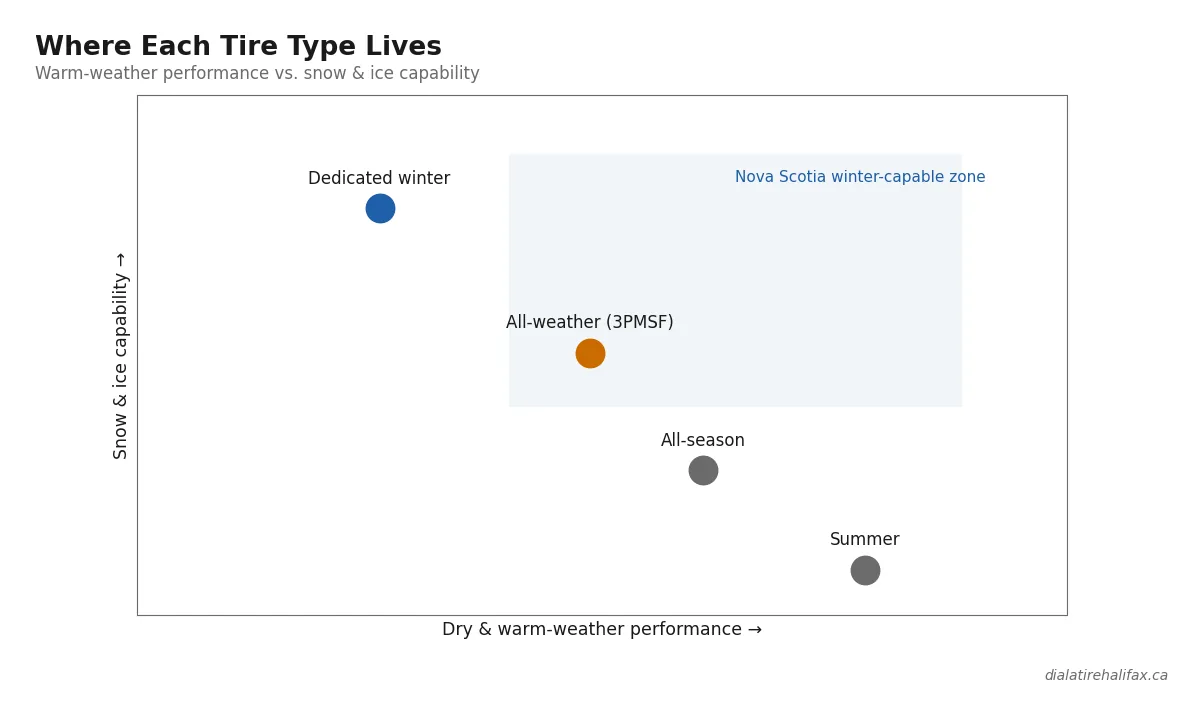
Ans: All-weather tires (not the same as all-season look for the three-peak mountain snowflake symbol) are a legitimate middle ground. They’re designed to handle moderate winter conditions without seasonal swaps. They won’t match a dedicated winter tire in severe cold or ice, but they outperform standard all-seasons below 7°C. They’re worth considering if you want a single-set solution with real winter capability.
Q.5 Should I Put Winter Tires On Just The Front Wheels To Save Money?
Ans: Never. Running winter tires on only two wheels creates unpredictable handling the end without winter tires has less grip, which can cause the rear to swing out (on a front-drive car) or the front to plow (on a rear-drive car). Always install four matching winter tires.
Q.6 How Do I Know If My Tires Are “Winter Rated”?
Ans: Look for the three-peak mountain snowflake symbol on the sidewall. Tires with this symbol have passed snow traction testing. An M+S (mud and snow) marking alone does not mean the tire is rated for winter performance.
Also Read:
When to Switch to Winter Tires in Halifax (2026/2027) – The 7°C Rule + Local Booking Window
How To Store Winter Tires In Nova Scotia? Halifax Tire Storage Guide
When to Take Off Winter Tires in Halifax? – The Spring Timing Guide
Frequently Asked Questions: Winter Tires vs All-Season Tires in Nova Scotia
Do I really need winter tires in Halifax, or are all-seasons good enough?
For most Halifax drivers, winter tires provide a meaningful safety advantage. Halifax winters sit in a narrow, wet temperature band — hovering around −2°C to +4°C with constant freeze-thaw cycles and black ice on bridges and overpasses. All-season rubber stiffens below about 7°C, increasing braking distance on exactly the cold, damp surfaces Halifax roads produce most often. Roughly 85% of Nova Scotia drivers use winter tires, and after 30 years in the shop, we understand why. The drivers who rely on all-seasons and get through winter safely typically drive low mileage in the city at midday and can stay home on bad days — a luxury most commuters don’t have.
What is the actual difference between all-season and winter tire rubber?
The key difference is the rubber compound. All-season compounds are formulated to perform across a broad temperature range, but they stiffen as the mercury drops below roughly 7°C. Winter tire compounds use higher silica content and different polymer blends that remain pliable in the cold. Pliable rubber conforms better to road surface texture, creating more friction and grip. The difference is not dramatic on a single braking event — it shows up over dozens of cold, wet commutes in reduced stopping distances and more predictable cornering.
Does all-wheel drive (AWD) mean I don’t need winter tires?
No, and this is one of the most common misconceptions we hear. All-wheel drive (AWD) helps your vehicle accelerate from a stop on slippery surfaces — it distributes torque to the wheels with the most grip. But AWD does nothing for braking or cornering, which are tire-limited regardless of how the power is delivered. A front-wheel-drive car on proper winter tires will stop and turn on ice significantly better than an AWD vehicle on all-seasons. AWD gives you confidence getting moving; winter tires give you the ability to stop and steer.
Are all-weather tires the same as winter tires?
No. All-weather tires carry the 3-Peak Mountain Snowflake (3PMSF) symbol, meaning they have passed a standardized snow-traction test. All-season tires do not carry that symbol — they are rated for mud and snow (M+S) as a tread-pattern designation, not a performance certification. All-weather tires are a genuine compromise: better than all-seasons in cold weather, but not as capable as a dedicated winter tire in deep cold or heavy snow. They suit drivers who want one set year-round and drive modest city mileage. For highway commuters, rural drivers, or anyone on Halifax’s hilly terrain, dedicated winters remain the stronger choice.
When should I switch to winter tires in Nova Scotia?
Switch when daily temperatures are consistently sitting around 7°C or below — the 7°C rule. In Halifax, that typically means late October into early November. Don’t wait for snow; the grip advantage of winter tires begins on cold, wet pavement well before the first flake. Book your changeover appointment in early-to-mid October to avoid the rush that follows every first cold snap.